How to Reduce Food Waste in Your Food Business
Food waste is one of the biggest hidden expenses in any food business. It quietly drains profit through over-ordering, spoilage, trim loss, inaccurate forecasting, and customer leftovers. It also creates operational stress: last-minute prep changes, messy storage areas, inconsistent menus, and staff frustration.
If you’re serious about protecting margins, strengthening your brand, and running a cleaner operation, your fastest win is to reduce food waste with a system—rather than a one-time “be more careful” campaign.
The challenge is that food waste isn’t one problem. It’s dozens of small breakdowns across purchasing, receiving, storage, prep, production, service, and disposal. The good news is that you can reduce food waste without sacrificing food safety, quality, or speed.
In fact, the best waste-reduction programs improve consistency and guest satisfaction because they force clarity: clearer parts, clearer recipes, clearer labeling, and clearer accountability.
Food waste also matters beyond your four walls. Food that ends up in landfills generates methane, a powerful greenhouse gas, and resource waste stacks up across water, energy, labor, packaging, and transport.
The Environmental Protection Agency has repeatedly highlighted that a large share of food produced is never eaten and that landfilled food waste is a major environmental problem.
This guide is built for owners, operators, and managers who want a practical, modern, “do-this-next” approach. You’ll learn how to measure waste, redesign workflows, train staff, use newer tech, and build partnerships for donation, reuse, and recycling—all while staying aligned with current food safety guidance like the FDA’s Food Code updates.
Build a Waste Baseline That Actually Changes Behavior
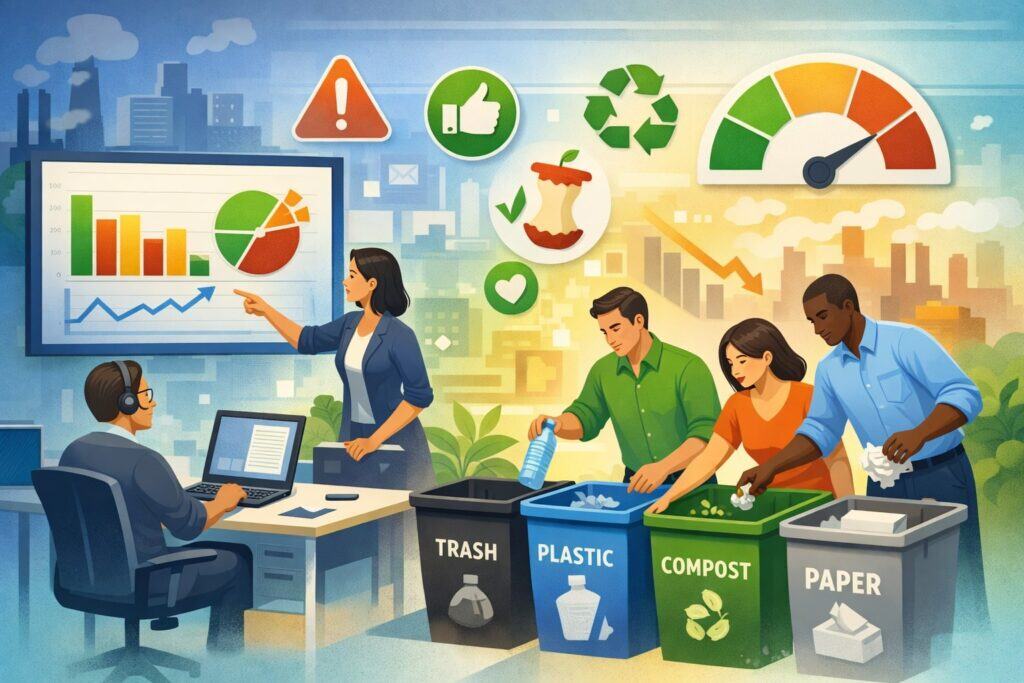
If you can’t see waste clearly, you can’t reduce food waste reliably. Many teams track “food cost” and assume that’s enough. It isn’t. Food cost tells you what you spent, not what you threw away, over-portioned, mis-prepped, or let spoil. To reduce food waste, you need a baseline that separates waste into categories your team can control.
Start with a two-week baseline using simple bins and labels. Create three waste categories: spoilage (expired or rotten), prep waste (trim, overproduction, mistakes), and plate waste (customer leftovers).
If you run retail or a deli, add damaged (torn packaging, dropped items) and date-code pulls (product removed from sale due to date standards). Assign one person per shift to record what goes into the bin and why. Keep it quick: item, amount, reason, station.
The real trick is turning data into action. Each week, pick the top five recurring waste items and write a one-sentence corrective step for each.
Example: “We waste cooked rice at close → reduce batch size after 7 pm and switch to par-cook + finish method.” Then review outcomes the following week. This feedback loop is where you reduce food waste permanently.
A reliable baseline also supports smarter purchasing and pricing. When you can prove you’re losing money on a specific ingredient due to spoilage, you can change pack sizes, delivery frequency, storage method, or menu design. Over time, your waste baseline becomes a profit dashboard—not a guilt report.
Upgrade Forecasting, Pars, and Ordering to Stop Overbuying
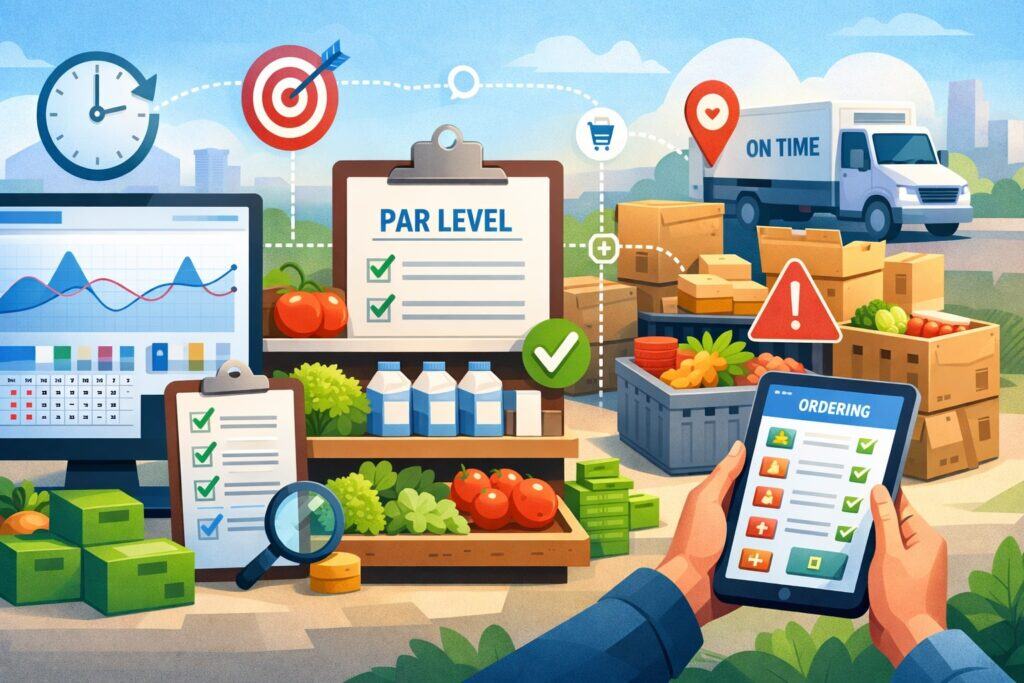
Overbuying is the most common reason businesses fail to reduce food waste. It feels safe to “have extra,” but extra inventory is usually wasted inventory. Even if it doesn’t spoil, it increases clutter, slows rotation, and makes it harder to see what you already have. To reduce food waste, you want lean inventory with tight reorder logic.
Start with pars that reflect reality, not habit. Build parts from actual sales patterns: day of week, seasonality, local events, weather swings, and promotions.
Don’t rely on averages alone—averages hide spikes that cause panic ordering. Use a “base + buffer” method: base par for normal demand, buffer for known variability. Then revise parts every month using your waste baseline and sales.
Next, fix ordering behavior. Require every order to start with a physical count of key perishables and “high-waste” items. One rule helps you reduce food waste quickly: “No ordering without counting.” For multi-unit operators, compare store-to-store waste items and copy best practices.
Also, reduce pack-size mismatch. If you consistently waste fresh herbs, switch to smaller packs, split deliveries, or shift some herbs to frozen/purée formats where quality holds. For dairy and proteins, consider more frequent deliveries with smaller drops if your supplier network allows. You will reduce food waste when deliveries match your production rhythm.
Finally, coordinate purchasing with menu planning. If you plan a special, plan the procurement and the exit strategy. Every special should answer two questions: “What inventory does this burn down?” and “What’s the plan if it doesn’t sell?”
Receiving and Storage Systems That Prevent Spoilage Before It Starts
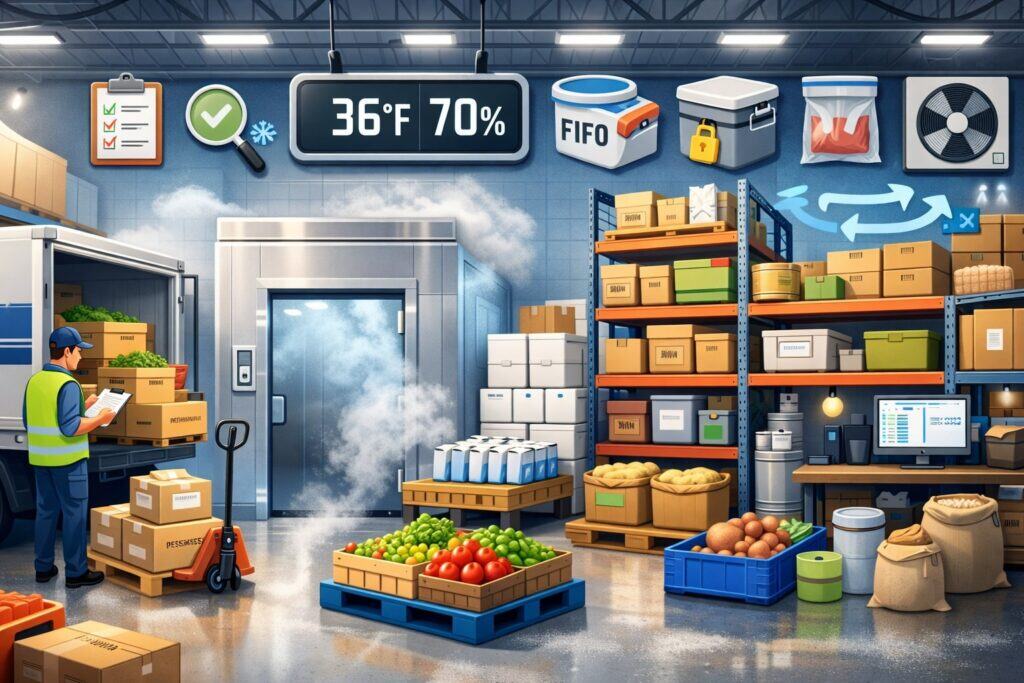
You can do everything right in purchasing and still fail to reduce food waste if receiving and storage are sloppy. Spoilage is often created in the first 30 minutes after delivery—warm product left on the dock, incorrect rotation, mislabeled containers, or uninspected cases. To reduce food waste, treat receiving like a quality-control checkpoint.
Build a receiving checklist with three non-negotiables: temperature, condition, and dates. Temperature checks should be documented for high-risk items. Condition checks catch crushed produce, broken seals, and leaks early, while you can still reject or credit. Date checks ensure you don’t accept short-dated products that can’t be used in time.
Storage is where small habits matter. Label everything with the same format: item name, prep date, discard date, and initials. If you want to reduce food waste, stop “mystery containers.” Mystery containers become trash. Use clear bins for visibility and store in a way that supports FIFO: front-load older inventory, back-load new. Make FIFO physically easy.
Control your “danger zones.” Temperature abuse increases spoilage risk and can create safety concerns. Align your practices with current Food Code guidance; the FDA published a supplement to the 2022 Food Code in late 2024, reinforcing the need to keep operational controls updated.
One underrated tactic to reduce food waste is storage zoning. Create zones for: ready-to-eat, raw proteins, produce, dairy, and “open packages.” Put open packages in a single, clearly labeled shelf so they get used first. When staff can find open products instantly, you reduce food waste and speed up prep.
Smarter Prep and Production: Batch, Hold, and Cross-Utilize
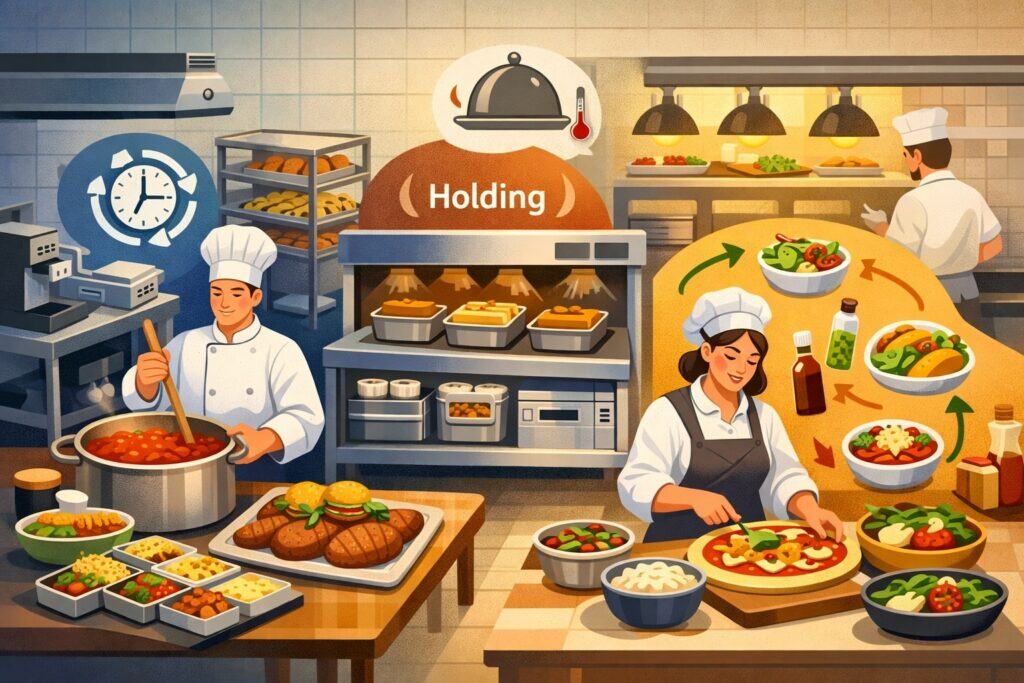
Prep and production waste usually comes from two things: overproduction and inconsistency. You can reduce food waste fast by redesigning how you batch, hold, and finish food. The goal is to produce closer to real demand without slowing service.
Move from “big batch” to “smart batch.” Identify items that hold well (soups, sauces, braises) and items that degrade quickly (fried foods, cooked starches, cut produce). Keep large batches only where quality remains high.
For fragile items, adopt par-cook and finish-to-order systems. This approach helps you reduce food waste because you stop cooking full volumes before demand is proven.
Standardized recipes are essential. Without them, you don’t have predictable yields. Yield loss is silent waste: too much trim, inconsistent portion sizes, and unpredictable prep quantities. Write prep recipes with yields and target weights.
If your team peels 50 pounds of onions but ends up with 38 pounds usable, that yield needs to be known. Then you can plan correctly and reduce food waste at the planning level.
Cross-utilization is your safety net. Design menus so ingredients can “escape” into other items if one dish underperforms.
Example: roasted vegetables can become a side, a grain bowl topping, an omelet filling, a soup base, or a pizza topping. When every ingredient has at least two backup uses, you reduce food waste without discounting everything.
Finally, manage holding times with intention. Use smaller pans, refresh more often, and prioritize “first in, first out” for hot and cold holding. “Just in case” food on the line is a major reason businesses fail to reduce food waste.
Portion Control and Menu Engineering That Protect Margin and Reduce Plate Waste
Plate waste is a customer-facing signal that portion sizes, sides, or menu descriptions don’t match what people actually want. If you want to reduce food waste, you must treat portioning as both a cost-control tool and a guest experience tool.
Start with portion standards that can be executed under pressure. Use scoops, ladles, spoodles, scales, and portion bags where appropriate. The best portion control is mechanical, not motivational. If you rely on “remembering,” you’ll drift.
Drift increases cost and creates leftovers customers don’t finish. When portions are consistent, you reduce food waste and improve repeatability.
Next, look at your menu through a waste lens. Identify items with high trim loss or short shelf life. Then either redesign the dish, change the cut/spec, or price it to reflect true yield. Menu engineering also includes language.
If a dish comes with large sides by default, many guests will leave food. Offer side choice and right-size options. Even a simple “half portion” option can reduce food waste while attracting customers who want lighter meals.
Use your POS data to adjust. If certain items are frequently modified (“no fries,” “sauce on side”), that’s feedback. Consider making those modifications the default. One of the simplest ways to reduce food waste is aligning defaults with real ordering behavior.
Finally, train servers to offer take-home packaging proactively for items with high leftover rates. Provide high-quality containers so food is actually taken and eaten. Plate waste reduction is not only a back-of-house problem; it’s a sales and hospitality opportunity that helps reduce food waste at the guest level.
Inventory Rotation, Date Labeling, and “Use-First” Culture
Culture is what happens when managers aren’t watching. If you want to reduce food waste consistently, you need habits that staff follow automatically: rotation, labeling, and “use-first” decision-making. This is where many programs collapse—because the system exists on paper but not in daily motion.
Standardize date labeling with one policy that everyone understands. Avoid multiple systems by station or person. Labels should be readable, consistent, and placed the same way on every container.
Pair labeling with a daily “use-first” review: designate one shelf or rack as Use First Today. Every shift begins with a quick scan and a plan to move those items into production. When staff know “use-first” is part of the opening rhythm, you reduce food waste continuously rather than occasionally.
Rotation also needs physical design. FIFO fails when shelves are packed and products are stacked randomly. Use bins, dividers, and clear signage. Put older products in the most accessible position. Make the right action the easiest action. This is a powerful way to reduce food waste without relying on perfect memory.
Another key is managing partials. Opened cases, half bags, and partial pans are prime waste sources because they get lost. Create one dedicated “partial zone” in each storage area. Everything open goes there. This alone can reduce food waste significantly because it prevents duplicate opening and forgotten leftovers.
Managers should reinforce the culture with micro-audits: two-minute checks during each shift change. Praise correct behavior publicly. Correct mistakes privately. Over time, staff learn that reducing food waste is part of professional pride, not just a cost initiative.
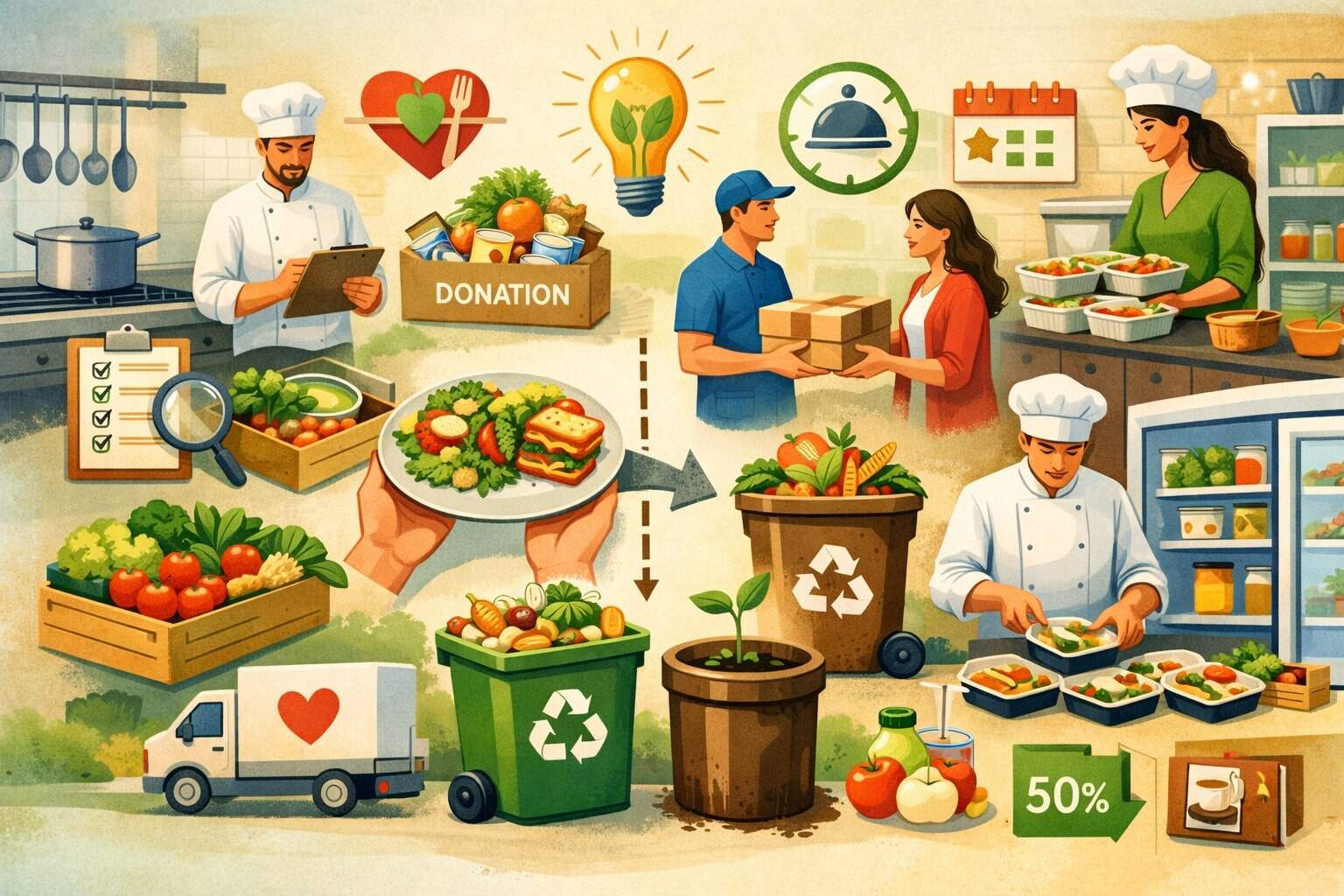
Donation, Rescue, and Safe Redistribution to Keep Food Out of the Trash
Once you’ve minimized waste at the source, the next step is preventing edible surplus from becoming garbage. Donation and rescue programs can reduce food waste while supporting community needs and strengthening your local reputation. Many operators hesitate because of liability concerns, logistics, or uncertainty about what can be donated.
Liability protection is stronger than many people realize. The Bill Emerson Good Samaritan Food Donation Act provides federal protections when food is donated in good faith and meets relevant criteria.
The USDA’s updated FAQs (reflecting amendments enacted in early 2023) explain how protections apply and what “apparently wholesome food” means in practice.
To reduce food waste through donation, design the workflow. Identify donation-safe foods in your operation—often packaged items, bakery, produce, and prepared foods that have been handled correctly.
Then define packaging standards, labeling requirements, and cold-chain rules. Partner with a local food rescue organization that can accept the types and volumes you generate.
Make donations predictable. Instead of scrambling after a big event, schedule consistent pickups or drop-offs. Consistency prevents surplus from sitting too long and becoming unsafe. It also helps your team treat donation as a normal output stream, not an exception.
If you operate retail, consider “rescue pricing” before donation—marking items down as they approach quality dates. This can reduce food waste while recovering revenue. Also watch for policy developments: food donation policy landscapes continue to evolve, with ongoing efforts to clarify donation pathways and protections.
Donation is not a substitute for prevention. But as a second line of defense, it’s one of the most meaningful ways to reduce food waste and demonstrate values in action.
Composting, Rendering, and Recycling: Choose the Right Diversion Path
Not all food waste is edible, and that’s okay. The goal is to keep unavoidable scraps out of landfill whenever possible. Diversion options like composting, rendering, and food waste recycling can reduce food waste impacts and sometimes lower hauling costs, depending on your area and contracts.
First, classify your waste streams: prep scraps (vegetable peels), inedible food (bones), spoiled food, and plate waste. Different streams have different best destinations. Rendering is often best for fats and certain animal byproducts.
Composting works for many organisms if contamination is controlled. Some regions offer anaerobic digestion programs, where food waste becomes energy and soil amendments.
Operationally, contamination is the big barrier. If compost bins contain plastic, gloves, or packaging, diversion programs can fail. To reduce food waste through diversion, place bins where waste is generated and train staff on what goes where. Use clear signage with pictures, not text-heavy rules.
Technology is pushing new options into the market. For example, recent reporting described grocery operations piloting AI-enabled recycling systems that dehydrate and process food scraps to dramatically reduce waste volume.
While that example focused on larger retailers, similar systems are expected to expand into broader commercial use over the next few years.
Be strategic: diversion is valuable, but prevention is still the highest ROI. Think of diversion as your “last mile” after you’ve done the hard work to reduce food waste upstream.
Train Your Team and Build Accountability Without Killing Morale
You can buy tools, write SOPs, and redesign storage—and still fail to reduce food waste if training is weak. Food waste is a people problem as much as a process problem. The key is teaching staff why it matters, exactly what to do, and how success will be measured.
Start with role-based training. Cooks need yield, portion, and batch logic. Prep staff need labeling, rotation, and salvage rules. Servers need take-home prompts and order accuracy habits.
Managers need audit routines and coaching language. When training is targeted, it sticks, and you reduce food waste through consistent execution.
Use “waste walks.” Once a week, leaders review waste bins with a calm, problem-solving tone. Ask: “What caused this?” and “What system change prevents it?” Avoid blaming individuals unless there’s repeated negligence. The goal is learning. This approach keeps morale intact while you reduce food waste using real evidence.
Add simple accountability metrics. Examples: “Top 3 wasted items,” “spoilage dollars,” “prep waste pounds,” or “plate waste percentage by menu category.” Share results with the team and celebrate improvements. Even small wins matter, because they prove the system works.
Also train on food safety alignment. Waste reduction must never encourage unsafe practices. Use current, science-based guidance (like the FDA’s Food Code updates) to reinforce that safe time/temperature control and proper handling are non-negotiable.
A strong team culture doesn’t just reduce food waste—it builds pride in craft and operations.
Use Technology and Data to Reduce Food Waste in 2025 and Beyond
Technology won’t fix broken habits, but it can accelerate improvement once you have basic discipline. In 2025, the most useful tech for operators trying to reduce food waste falls into three buckets: measurement, forecasting, and redistribution/diversion.
Measurement tools include waste tracking apps, smart scales, and camera-assisted logging. These reduce friction so staff actually record waste. When logging is easy, you get better data, which helps you reduce food waste with targeted interventions instead of guesswork.
Forecasting tools use POS trends, reservations, and sometimes local signals (events, weather) to suggest pars and production volumes. Even simple forecasting improvements can reduce food waste because they reduce panic cooking and excessive backups. The best systems don’t just predict—they create actionable prep lists and alerts.
Redistribution and diversion tech is evolving quickly. Some commercial systems dehydrate or process organic waste to shrink volume dramatically, which can change hauling frequency and cost structure.
Large retailers have begun testing newer approaches, and broader adoption in foodservice is a realistic near-term trend as equipment costs fall and sustainability expectations rise.
FAQs
Q.1: What’s the fastest way to reduce food waste without major investment?
Answer: The fastest way to reduce food waste is to tighten ordering and production using a short baseline measurement period. For two weeks, track the top five items you throw away and categorize why: spoilage, overproduction, mistakes, or plate waste.
Then apply one corrective action per item. This is effective because most businesses have a small set of “repeat offenders” driving a large share of loss.
Operationally, focus first on perishables and high-cost items: leafy greens, berries, herbs, dairy, seafood, and ready-to-eat prepared components. Reduce batch sizes late in the day. Require counts before ordering.
Create a “Use First Today” shelf for open items. These steps don’t require new equipment, but they reduce food waste quickly by preventing duplicate prep and forgotten products.
Also, implement portion tools. A few scoops, ladles, and a station scale can reduce food waste by preventing over-portioning and inconsistent yields. Make sure you train staff on how and why to use them. If you treat portion control as “hospitality consistency” rather than “cost cutting,” it lands better.
Finally, align front-of-house with the mission. Encourage servers to offer half portions where feasible and proactively offer take-home containers. The combined effect of these low-cost actions can reduce food waste meaningfully in the first month.
Q.2: How do I reduce food waste while maintaining strict food safety standards?
Answer: To reduce food waste safely, you need clear rules for time, temperature, labeling, and handling—plus a strong “no exceptions” culture. Waste reduction should never mean stretching food beyond safe limits. Instead, it should mean planning better so food stays within safe windows and still gets used.
Start by standardizing date labels: prep date, discard date, and initials. Then ensure storage temperatures are checked and logged for cold and hot holding where appropriate. Receiving checks also matter: rejecting warm or damaged products prevents downstream spoilage and safety risks.
Align your SOPs with current guidance used by regulators and operators, such as the FDA Food Code and its updates. The FDA published a supplement to the 2022 Food Code in November 2024, which signals the importance of keeping procedures current.
If you plan to donate food, make donation-safe categories and packaging rules. Donation is a great way to reduce food waste, but only if you maintain the cold chain and proper handling. Use reputable partners and document your process.
The practical mindset is: reduce food waste by removing causes, not by taking risks. Better forecasting, smaller batches, better rotation, and smarter cross-utilization keep you safe and profitable at the same time.
Q.3: Can food donation really reduce food waste, and what about liability?
Answer: Yes—donation can reduce food waste significantly when it is designed as an operational workflow, not an occasional event. Many businesses generate edible surplus due to forecasting variability, catering cancellations, or end-of-day unsold products. Donation creates a consistent pathway so edible food is not trashed.
Liability is a common fear, but federal protections exist. The Bill Emerson Good Samaritan Food Donation Act provides protection from certain civil and criminal liability when businesses donate food in good faith and meet key criteria.
The USDA’s FAQs—updated to incorporate amendments enacted in early 2023—explain how the law works and what conditions donors should follow.
To make donation effective, select donation-ready items, define packaging and labeling standards, and set pickup schedules. Consistent pickups help you reduce food waste because food doesn’t sit too long waiting for a one-off donation run. If you’re a retailer, pair donation with rescue markdowns to sell items close to quality dates, then donate what remains.
Donation should be your second line of defense after prevention. Prevent first, donate second, then divert scraps through composting or other options to reduce food waste across every stage.
Q.4: How do I reduce food waste in a restaurant where demand is unpredictable?
Answer: Unpredictable demand is exactly why restaurants need systems to reduce food waste. The answer is not “cook less” across the board—it’s “cook smarter,” using flexible production and menu design.
Use smart batching: large-batch items that hold quality (soups, sauces, braises) can be produced more confidently. Items that degrade quickly (fried foods, cooked starches, cut produce) should be finished closer to order time. Par-cooking and rapid finishing help you reduce food waste without slowing service.
Build “variable prep lists.” Instead of one prep target, create low/medium/high targets based on forecast confidence. Use reservations, historical day-of-week patterns, and nearby event calendars. Then train managers to choose the correct prep tier. This approach helps you reduce food waste while still protecting guest experience during rushes.
Menu cross-utilization is the other big lever. Ingredients should have at least two roles on the menu. That way, if one dish underperforms, the ingredient can be moved into another item without discounting or tossing. Cross-utilization is one of the most reliable ways to reduce food waste in real-world restaurant conditions.
Finally, measure and adjust weekly. The fastest restaurants at learning are the fastest at profitability—and the fastest to reduce food waste.
Q.5: What future trends will help food businesses reduce food waste over the next 3–5 years?
Answer: Several trends are shaping how operators will reduce food waste through 2028. First is better data and measurement. Waste tracking tools are becoming cheaper and more automated, making it easier to capture real waste patterns and fix root causes.
Second is the expansion of recycling and processing technology. Newer systems can reduce the volume of scraps and create usable outputs, and large retailers have started pilot programs that may spread more broadly into commercial foodservice over time.
As these systems scale, expect more service providers to offer bundled solutions: equipment, hauling, and reporting.
Third is policy and labeling evolution. Confusing date labels contribute to discards. State-level actions aimed at standardizing or changing certain label terms beginning in 2026 suggest a broader direction toward clarity to reduce food waste. While adoption varies by jurisdiction, it’s a signal of where consumer education and compliance may head.
Finally, expect more emphasis on landfill methane reduction and organics diversion as regulators and communities focus on climate impacts of landfilled food.
Agencies have repeatedly highlighted the methane and environmental impacts of food waste, which will continue to drive programs and incentives that indirectly help businesses reduce food waste.
Conclusion
To reduce food waste in your food business, you don’t need perfection—you need a repeatable system. Start by measuring waste in categories that lead to action. Tighten forecasting, pars, and ordering so you stop buying tomorrow’s trash.
Upgrade receiving and storage to prevent spoilage at the door. Redesign prep and production around smart batching and cross-utilization. Standardize portion control and adjust menus so guests finish what you serve.
Build a “use-first” culture through labeling, rotation, and quick audits. Then, for unavoidable surplus and scraps, use donation and diversion pathways that keep food out of landfill and improve community outcomes.
Food waste is also evolving as a business topic. Agencies and industry groups have strengthened data tools and guidance, and policy attention continues to grow due to methane and resource impacts.
The operators who win in the next few years will be the ones who treat waste reduction as a competitive advantage—cleaner operations, stronger margins, and a more trustworthy brand.