How to Open a Food Truck in Delaware (2026 Step-by-Step Guide)
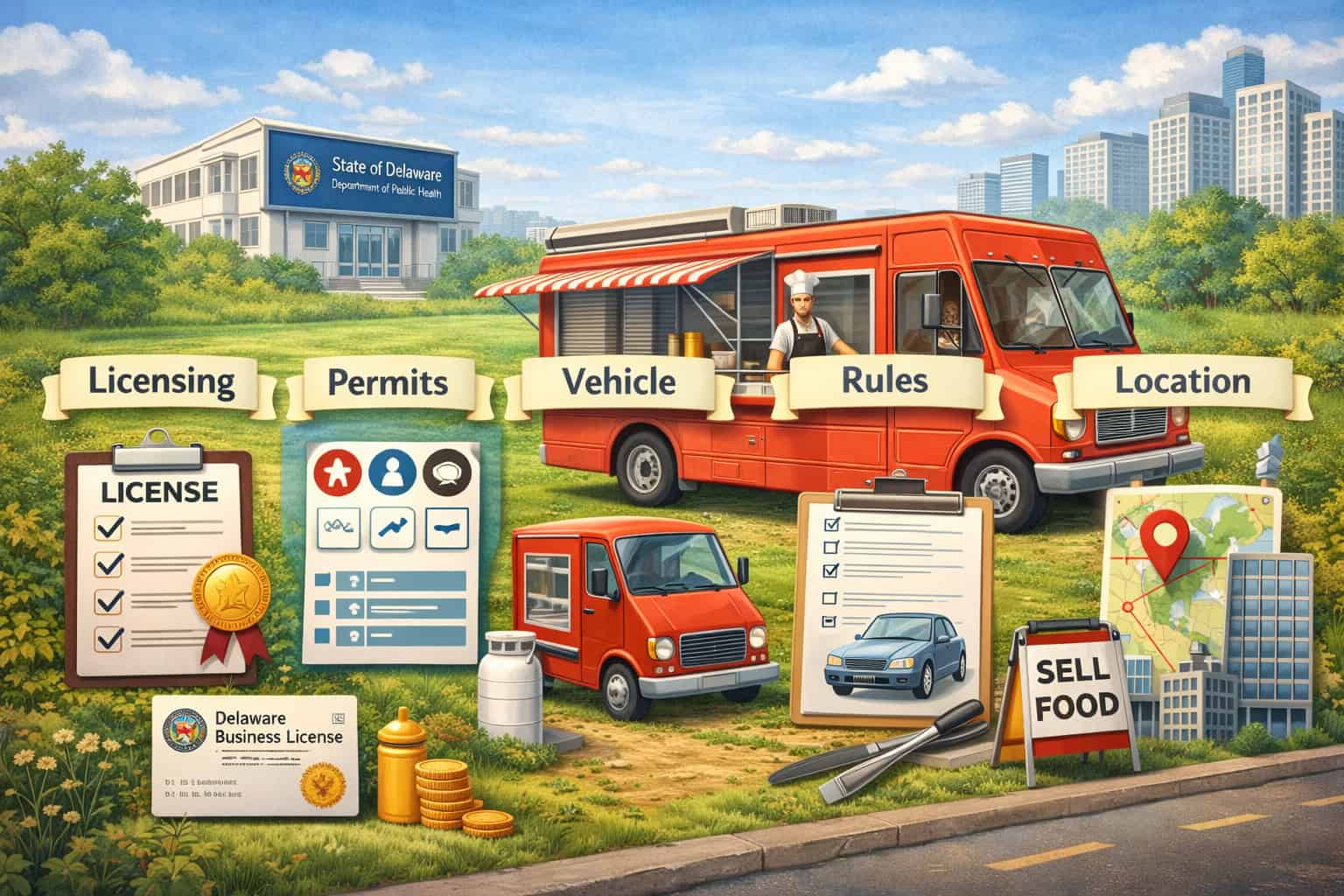
If you want to open a food truck in Delaware in 2026, the good news is Delaware is relatively small (so you can cover a lot of ground fast), and the state has clear food-safety expectations.
The “not-so-simple” part is that Starting a food truck business in Delaware is a two-layer process: you’ll meet state-level health and business requirements, and you’ll follow local (city/town/county/event) rules on where and how you can vend—especially in high-demand areas like Wilmington, Newark, Dover, and the beach towns.
That’s why people often get tripped up by Delaware food truck permit requirements: they’re not just one permit, and the “right” permits depend on your menu, equipment (propane/generator/hood), and where you plan to park.
This guide walks you through Food truck licenses and permits in Delaware in a practical, consultant-style way—with checklists, a realistic timeline, inspection prep, budgeting, and a 30/60/90-day launch plan. It’s general guidance (not legal advice).
Always confirm details with the Delaware Division of Public Health (Office of Food Protection) and the municipalities and event organizers where you’ll operate.
What’s Unique About Delaware Food Truck Licensing in 2026
Delaware’s mobile food scene is shaped by a simple reality: the state oversees food safety, while cities/towns and event organizers control vending locations.
So even if your food truck is fully permitted from a health perspective, you can still be “non-compliant” if you park somewhere that requires a city vendor license, a special event authorization, or property-owner permission.
Here’s what makes Delaware mobile food vendor requirements different from many other states:
- State food rules are centralized under Delaware’s Division of Public Health (DPH), which enforces the State of Delaware Food Code for food establishments (including mobile units).
- Local vending permission is highly location-specific: For example:
- Wilmington has a Mobile Food Truck Program and requires a city mobile food service license before reserving certain approved spots.
- Newark requires a Peddlers/Vendors license for vendors operating stands/vehicles in the city, issued daily/monthly/yearly.
- Dover’s guidance notes city business licensing plus state public health approval, and separate event licensing may apply for certain events.
- Business registration tools are evolving: Delaware One Stop notes that trade names (DBAs) are managed by the Division of Revenue effective February 2, 2026—a very practical “2026 detail” that affects how you file.
- Delaware has no state/local sales tax, but Delaware imposes gross receipts tax and a business license requirement—which matters for pricing, accounting, and POS reporting.
Pro Tip: Think of Delaware compliance as three folders you keep updated:
- Health folder (DPH + Food Code compliance), 2) Fire/safety folder (propane/electrical/hood suppression if applicable), 3) Where-you-sell folder (city permits + property permissions + event approvals). You’ll pull from these constantly.
Choose Your Concept and Validate Demand (Without Overbuilding)
Most first-time owners make the same expensive mistake: they build a truck around a “dream menu” before confirming where they’ll realistically sell.
In Delaware, your concept must fit (1) local demand and (2) the physical constraints of a mobile kitchen that can pass inspection under the Delaware Food Code expectations for safe cooking, holding, and sanitation.
Start with a concept that is:
- Fast to execute (3–6 core items + 2 rotating specials)
- Low waste (ingredients cross-used across the menu)
- Mobile-friendly (minimal “last-second assembly complexity”)
- Inspectable (your workflow supports handwashing, safe temps, and separation)
Quick Delaware-style demand validation steps (7–14 days)
- Pick 2–3 target zones per county (New Castle, Kent, Sussex): one weekday lunch zone, one evening zone (breweries/parks), one weekend zone (events/farmers markets/beach traffic).
- Do “parking reality checks.” Even if you love a spot, you may need local permission/licensing. Wilmington, Newark, and Dover each have their own processes, and beach towns often add seasonal rules and strict property permissions.
- Pre-sell before you build:
- Launch an Instagram + Facebook page
- Post 3 sample menu boards and ask followers to vote
- Collect emails via a simple form (“Founding Taster Club”)
- Talk to 10 venue managers: breweries, office parks, HOAs, and event organizers. Ask:
- “Do you require proof of health permit and insurance?”
- “Do you take a vendor fee or % of sales?”
- “Do you require a city vendor license?”
Business Setup in Delaware: LLC/DBA, Business License, Banking, Insurance
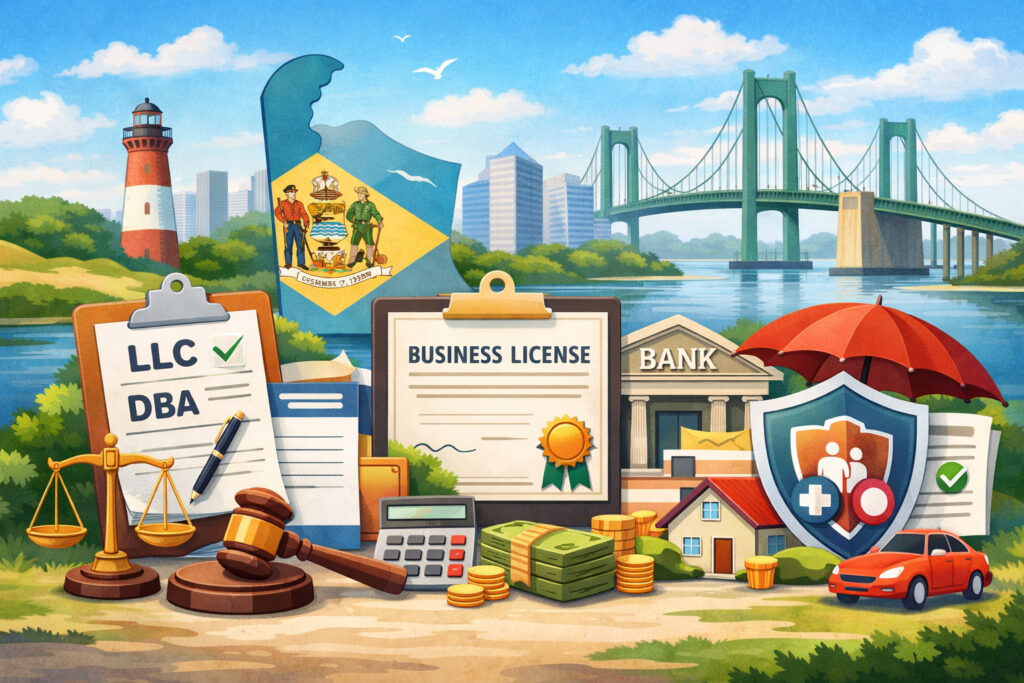
Before you chase permits, set up a clean legal and financial foundation. It makes approvals faster (because your business name and tax accounts match), and it protects you when you start booking events.
Delaware LLC/DBA basics (and what changed for 2026)
- If you’ll operate under a brand name that’s not your personal legal name (sole prop) or not exactly your LLC name, you’ll likely use a trade name/DBA. Delaware One Stop states that trade names are managed by the Division of Revenue effective February 2, 2026—so make sure you’re using the current workflow.
- For many food truck owners, an LLC is a practical choice for liability separation and professionalism when dealing with venues and lenders. (Talk to a qualified professional for legal/tax advice.)
Delaware business license (Division of Revenue)
Delaware generally requires an annual Delaware business license (Division of Revenue) for businesses operating in the state, and Delaware uses gross receipts tax (rather than a traditional sales tax).
Key tax reality that surprises newcomers:
- Delaware’s Division of Revenue explains there are no state or local sales taxes in Delaware, and sales tax exemption/reseller certificates are not applicable; instead, Delaware imposes license and gross receipt taxes on most sales of goods and services.
Banking, insurance, and accounting (high-level)
- Banking: Open a dedicated business checking account (don’t mix personal spending).
- Insurance: Expect to price out:
- commercial auto (truck)
- general liability
- product liability
- workers’ comp if you hire
- Accounting: Set up bookkeeping from day one (POS exports + bank feeds). Delaware’s gross receipts tax is based on total receipts, so clean revenue records matter.
Delaware Food Truck Licenses and Permits Checklist (Step-by-Step)
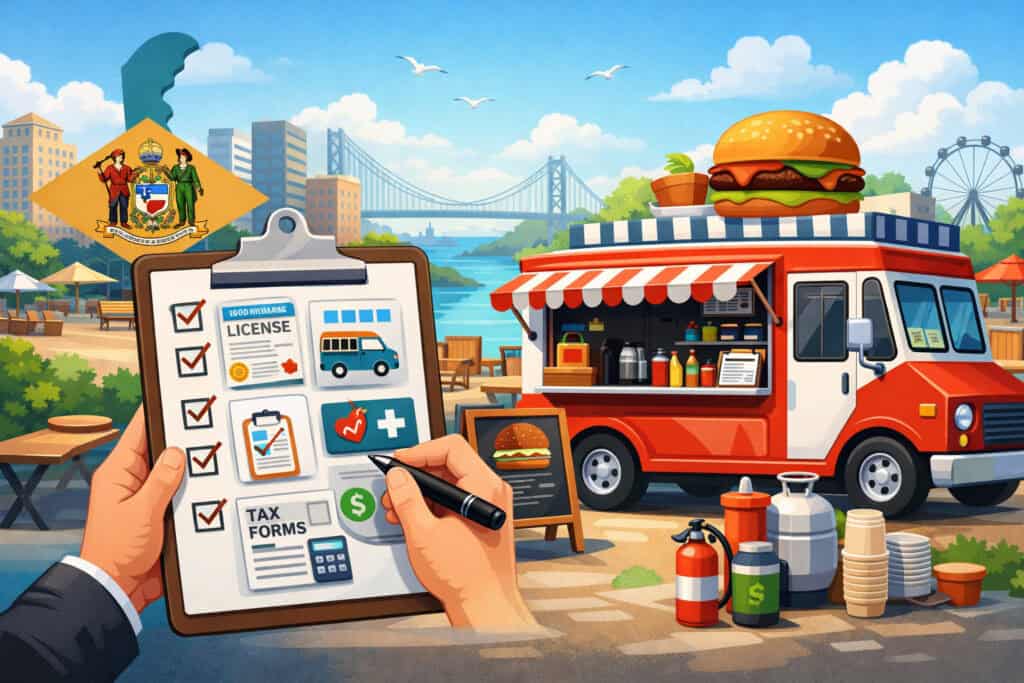
This is the heart of Delaware food truck permit requirements. Think of it as a sequence: business foundation → health approval → safety/fire → local vending permissions → event permissions.
Printable-style master checklist (Delaware)
Business + tax
- Choose entity (LLC/sole prop) and register as needed
- Register trade name/DBA if applicable (Division of Revenue workflow noted for 2026)
- Obtain/renew Delaware business license via Delaware One Stop
- Set up gross receipts tax compliance workflow (monthly or quarterly depends on activity/thresholds)
Health (DPH / Office of Food Protection)
- Contact the Office of Food Protection early (Delaware encourages calling early to understand the process)
- Determine whether you need a plan review (common for new builds/conversions)
- Prepare commissary/approved kitchen plan if applicable
- Schedule and pass the food truck inspection (mobile unit) under Delaware Food Code expectations
Fire/safety
- Fire safety inspection expectations (suppression/extinguishers if applicable)
- Propane safety setup (tank mounting, leak checks, shutoffs)
- Electrical/generator safety plan (safe wiring, ventilation, CO awareness)
- If you have a hood/suppression system, use properly licensed service providers and documentation
Local vending permissions (examples)
- Wilmington mobile food licensing/program steps if operating in city-controlled spots
- Newark Peddlers/Vendors license if vending in Newark
- Dover business licensing requirements and any itinerant/event license triggers
- Property owner permission (written) for private lots
Event/festival
- Confirm if event uses a temporary food establishment style permit process
- Submit applications early; Delaware’s temporary event application language (as published) indicates time limits and submission timing expectations (plan ahead)
Health Department Permits, Plan Review, and the Delaware Food Code (Mobile Units)
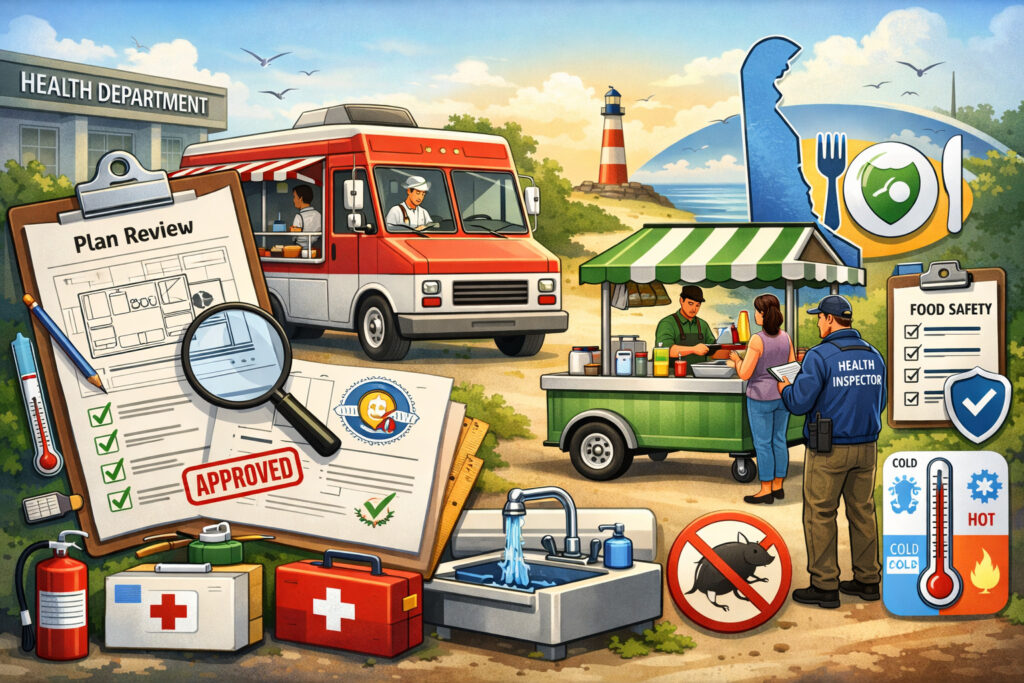
Most delays happen here, so treat this phase like a project. Delaware’s Business First Steps site strongly encourages operators to contact the Office of Food Protection early—before construction or major changes—so you avoid costly rework.
Delaware Division of Public Health food permits: what “mobile” typically means
Delaware considers a food establishment to include operations conducted in a mobile facility, and these operations are inspected to monitor compliance with the State of Delaware Food Code.
In practice, a mobile operation is expected to demonstrate:
- safe food sourcing and storage
- adequate handwashing
- warewashing/sanitizing
- temperature control for TCS foods
- cleanable surfaces and proper waste handling
Mobile food establishment permit Delaware: equipment expectations you should design around
A Delaware mobile requirements memo (widely circulated by Delaware health organizations) spells out core expectations many mobile units must meet, such as:
- Three-compartment sink (or approved commercial dishwasher) for wash/rinse/sanitize
- Dedicated hand sink with warm running water under pressure
- Sufficient hot water tank capacity for peak operations
- Commercial equipment for cooking/storage/holding of TCS foods
- Ventilation hood/filters for fry equipment (as applicable)
- Smooth, non-absorbent, easily cleanable floors/walls/ceilings
- Approved sanitizer available (chlorine/quats/iodine)
These are not “nice-to-haves.” They’re building decisions.
Health department plan review: when you should assume you need it
Even if plan review is not explicitly required in every scenario, you should act as if it is whenever you are:
- building a truck from scratch
- converting a vehicle
- changing equipment layout
- changing menu/process (e.g., adding frying, raw protein handling, vacuum packaging)
Pro Tip: Your fastest path is to design your menu around the simplest compliant workflow. Every “extra process” (cooling large batches, complex sauces, raw seafood) adds inspection scrutiny.
Commissary Kitchen Requirements in Delaware (And How to Set Yours Up)
“Do I need a commissary?” is one of the most common questions. The real answer is: it depends on your operation—your water capacity, storage, prep needs, and the expectations tied to how you’ll clean, dispose of waste, and safely prepare food.
Delaware defines food establishments broadly and recognizes that operations may include a central preparation facility that supplies a vending location.
What your commissary is typically used for
Even well-equipped trucks rely on a base kitchen for:
- bulk prep (washing produce, portioning proteins)
- safe cooling and storage (walk-in refrigeration)
- grease disposal arrangements
- potable water fill and wastewater dump
- dry storage
- staff restroom access (often required by venues/events)
What to put in a commissary agreement (simple but inspection-friendly)
Create a signed agreement (even a one-page template) that includes:
- commissary address and contact
- hours you’re allowed to access
- what you’re allowed to store (dry, cold, frozen)
- water fill location and method
- wastewater disposal method
- grease/oil disposal method
- cleaning responsibilities (your team vs facility)
“Approved kitchen” alternatives (when you don’t own a commissary)
If you’re using a shared kitchen or renting prep space:
- verify the kitchen is permitted/inspected
- keep copies of the kitchen’s permit/inspection summary if available
- document your usage schedule and storage arrangement
Pro Tip: If your concept is heavy prep (BBQ, birria, scratch sauces), plan for commissary costs from day one. It’s usually cheaper than overbuilding the truck—and it reduces service-day chaos.
Fire Safety, Propane, and Electrical: What to Plan For in 2026
Fire safety is where food trucks can get expensive fast—especially if your build includes frying, grills, or hood systems. Delaware’s Office of the State Fire Marshal publishes resources and licensing information for commercial cooking hood suppression systems, and notes 2026 updates (including fee increases and regulation updates effective January 1, 2026).
Delaware fire safety inspection: what you should expect
While the exact inspection pathway may vary by jurisdiction and your equipment, your practical goals are consistent:
- demonstrate safe installation and maintenance of cooking equipment
- show appropriate extinguishers (type and accessibility)
- keep suppression system documentation (if you have one)
- ensure propane tanks/lines are mounted, protected, and leak-checked
- confirm electrical is safe and not “DIY-dangerous”
If your truck uses a commercial hood suppression system, make sure it’s installed and serviced by qualified providers and that you can produce inspection/service documentation. Delaware’s Fire Marshal site specifically maintains licensing and quality assurance resources for these systems.
Propane safety requirements (practical, not theoretical)
- Use properly rated cylinders/tanks and secure mounting
- Keep shutoff valves accessible
- Protect lines from abrasion/heat
- Train staff on leak smell and emergency shutoff
- Store spare cylinders safely (never inside near ignition sources)
Generator safety and electrical requirements (real-world checklist)
- Size generator for peak load (fridge + hot holding + POS + lights)
- Use proper gauge cords rated for outdoor/commercial use
- Keep generator exhaust away from service windows and customers
- Carry a CO detector if you have any enclosed workspace exposure risks
- Document your electrical layout so troubleshooting is fast
Pro Tip: If you’re unsure whether your build triggers hood/suppression expectations, decide early—changing later is one of the most expensive “oops” moments.
8) How Delaware Food Truck Inspections Work (And How to Pass the First Time)
Inspections feel intimidating until you realize inspectors are looking for a repeatable theme: can you consistently produce safe food in a tight space?
Delaware’s food establishment oversight is tied to compliance with the State of Delaware Food Code, and Delaware encourages operators to coordinate early with the Office of Food Protection to understand processes and avoid delays.
What inspectors typically check (mobile unit)
Food safety controls
- cold holding at safe temperatures
- hot holding at safe temperatures
- cooking and reheating controls
- cooling methods (if you cool food)
- separation of raw and ready-to-eat
Facilities and hygiene
- hand sink accessible, stocked, working
- warewashing capability (3-comp sink or approved method)
- sanitizer present and used correctly (and test strips, if applicable)
- cleanable surfaces in good repair
- pest prevention (tight doors, no gaps)
Water and waste
- potable water supply adequate
- hot water supply adequate for peak operations
- wastewater tank properly sized and managed
- waste disposal plan (trash, grease)
A Delaware mobile requirements memo lists key built-in requirements like a three-compartment sink, dedicated hand sink, adequate hot water, and approved sanitizer availability—use it as a build-and-prep guide.
Common failures (and how to prevent them)
- Hand sink blocked or used for storage → designate a “no storage zone” around it
- No sanitizer/test strips → keep a labeled sanitizer kit in a fixed spot
- Hot water runs out → confirm tank capacity and recovery time
- Cross-contamination risk → color-coded bins, clear raw/ready workflow
- Missing thermometers → keep calibrated probe thermometers + logs
Local Rules: Parking and Vending in Wilmington, Newark, Dover (And Why It Matters)
Your health approval gets you “legal to serve food.” Local rules determine whether you’re legal at a specific spot on a specific day. This is why people think they’ve met all Food truck licenses and permits in Delaware, then get shut down for vending without the right city authorization.
Wilmington food truck parking rules (program-based approach)
Wilmington’s official Mobile Food Truck Program explains that before reserving a spot, a truck must receive a Mobile Food Service Establishment License from the city, and the application expects documentation like business licenses, health inspections, and fire marshal inspection. The city also references a daily use fee for reserved spots through its scheduling partner.
Newark food truck vending rules (vendor license model)
Newark’s official guidance states that persons who operate a vendor stand or vehicle in the city must obtain a peddlers/vendors license, issued daily, monthly, or yearly (with listed fees).
Dover food vendors (city license + state approval + event nuances)
Dover’s “Basic Rules for Food Vendors” document states that all food vendors require public health approval from the State of Delaware prior to issuance of a city business license, and it distinguishes mobile vendors, stationary vendors, and special events—where certain events may require a separate itinerant business license.
Where to Sell in Delaware: The Most Realistic Channels (By County)
A strong Delaware food truck strategy is usually a mix of recurring weekly stops + high-revenue events. Your goal is predictable cash flow (weekly) with occasional spikes (events). The best locations also reduce operational stress (parking, power access, and bathrooms).
New Castle County ideas (Wilmington/Newark corridor)
- Wilmington program spots (if you qualify and schedule through the city’s process)
- office parks near major commuter routes
- brewery nights and trivia nights
- university-adjacent areas (but watch local vendor rules)
Kent County ideas (Dover and surrounding)
- state-worker lunch zones
- community events and parades (watch Dover’s event license notes)
- partnerships with local businesses for “customer appreciation nights”
Sussex County ideas (beach economy)
- breweries and taprooms near beach traffic
- private events (weddings, rentals, HOA pools)
- seasonal festivals (start outreach early—vendor lists fill fast)
Truck Build and Equipment Requirements (Designed for Delaware Inspections)
Your truck build should be designed around compliance and speed. Every inch matters, and inspectors want a setup that supports safe behavior naturally.
Water system, sinks, refrigeration, and hot holding
At a minimum, plan for:
- a dedicated hand sink that’s always accessible
- warewashing capacity (often a three-compartment sink for many operations)
- hot water supply that can keep up during peak hours
- adequate refrigeration for your busiest day
- hot holding equipment if you hold cooked food before service
Delaware’s mobile requirements memo calls out these core elements explicitly, including the hand sink, three-compartment sink (or approved dishwasher), and sufficient hot water.
Sanitation, waste disposal, and pest control
- Smooth, cleanable interior surfaces
- Covered trash containers
- Grease management plan (don’t “improvise” disposal)
- Tight seals and door management to reduce pests
- Daily wipe-down and weekly deep-clean schedule
Propane and electrical/generator safety (build choices)
- Keep propane components protected and documented
- Ensure ventilation and safe clearances near heat sources
- Use professional-grade electrical work—food trucks vibrate and move; weak wiring fails fast
Costs and Budget: What It Takes to Start a Food Truck in Delaware
You asked for realistic costs without fake stats—so here’s a practical range approach. Your actual number depends heavily on whether you buy used vs new, and whether your menu requires heavy equipment (hood, suppression, fryer banks, etc.).
Startup cost ranges (typical buckets)
Truck + build
- Used truck + light retrofit: lower five figures to low six figures
- New(er) truck + custom build: mid five figures to well into six figures
Permits + licensing + professional services
- Business formation/registration and license costs (Delaware One Stop + Division of Revenue workflows)
- Health permit/inspection pathway (DPH; varies by operation)
- Fire/safety compliance costs (especially if hood/suppression)
Commissary + storage
- Shared kitchen memberships or rental + storage racks
- Water fill/waste dump arrangements if not included
Insurance
- Commercial auto + general liability + product liability (and workers’ comp if hiring)
Ongoing monthly expenses (plan for these from day one)
- commissary / kitchen access
- propane and generator fuel
- maintenance (tires, brakes, generator service)
- POS fees and connectivity
- staff wages and payroll costs
- event fees (some weekends can be expensive but profitable)
Delaware tax note for pricing
Delaware’s Division of Revenue states there are no state or local sales taxes and instead Delaware uses license and gross receipts taxes that generally may not be passed on to the consumer as a “sales tax line item.” This affects how you design pricing and receipts.
Operations Playbook: Daily Checklists, Food Safety SOPs, Staffing, Inventory
A food truck is a restaurant with fewer square feet and more moving parts—so systems matter. Your ops playbook should make it easy to follow safe practices consistently under the Delaware Food Code framework.
Printable daily opening checklist (food truck)
- Hand sink stocked (soap, paper towels)
- Sanitizer mixed and labeled; tools ready
- Thermometers on-hand (and calibrated if needed)
- Refrigeration at safe temp before loading TCS foods
- Hot holding preheated
- Fresh water filled; wastewater capacity confirmed
- POS charged + backup battery ready
- Fire extinguisher accessible; propane shutoff known
- Menu board + pricing visible
- Trash plan ready (bins + liners)
Printable closing checklist
- Cool/handle leftovers safely (don’t guess—document your SOP)
- Dump wastewater at approved location
- Clean and sanitize food-contact surfaces
- Clean fryers/grill area (reduce grease buildup)
- Restock paper goods and sanitizer supplies
- Cash reconciliation + POS batch close
- Next-day prep list created
Staffing and scheduling (simple rules that work)
- Start lean: 2-person crew for many concepts (1 cook, 1 assembly/cash)
- Cross-train everyone on:
- handwashing timing
- allergen awareness
- temp checks
- emergency shutoffs (propane/generator)
Inventory and prep planning
- Use par levels (minimum stock) for core items
- Prep in “service units” (portioned proteins, labeled sauces)
- Track waste daily and adjust menu weekly
Marketing for Delaware Food Trucks: Simple, Local, and Repeatable
Marketing is easier when your operations are consistent. In Delaware, you can win by being predictable (weekly stops) and easy to find (Google + social).
Social media basics that actually drive sales
- Post your schedule at the same time weekly
- Use location tags: “Wilmington,” “Newark,” “Dover,” “Rehoboth,” etc.
- Share short videos of the top seller being made
- Run polls for weekly specials (builds engagement + forecast demand)
Google Business Profile (GBP) for a mobile business
Even if you don’t have a storefront, you can often set up a profile as a service-area business. Use:
- consistent business name (matching your licensing/branding)
- updated hours/schedule posts
- photos that show the truck, menu, and best items
- a clear link to ordering (if applicable)
Local partnerships (your fastest growth lever)
- breweries (recurring nights)
- apartment complexes (resident events)
- office parks (lunch rotations)
- gyms and studios (post-class rush)
- wedding venues (preferred vendor list)
Payments and POS: What Food Trucks Need (and How to Avoid Processing Headaches)
Food trucks live and die by line speed. Your POS setup should be fast, reliable, and able to handle spotty connectivity—especially in parks, festivals, and beach zones.
Choosing a mobile POS for a Delaware food truck
Look for:
- offline mode (so you can keep selling if signal drops)
- quick menu buttons and modifiers (no endless screens)
- tap-to-pay + chip
- text/email receipts
- inventory or item-level reporting (helps pricing decisions)
Tips for reducing processing issues (real-world)
- Use a dedicated hotspot (don’t rely only on a personal phone)
- Keep devices fully charged + backup battery packs
- Train staff on:
- how to switch to offline mode
- how to capture signatures when required
- how to handle tips quickly
Delaware tax/recordkeeping note
Because Delaware relies on gross receipts tax and business licensing rather than sales tax, you still need accurate revenue records and good categorization. Delaware’s Division of Revenue explains gross receipts tax is imposed on total receipts with no deductions, and Delaware does not impose state/local sales tax.
Common Mistakes to Avoid (Delaware Edition) + Troubleshooting
Most problems aren’t “bad luck”—they’re predictable.
Mistake #1: Building the truck before confirming your health pathway
Delaware encourages contacting the Office of Food Protection early, before construction or major changes, to avoid delays and costs. Do that.
Fix: Treat the build like a regulated project: layout, sinks, water heating, surfaces, ventilation, and workflow.
Mistake #2: Assuming one permit lets you vend everywhere
Wilmington, Newark, and Dover each show different local licensing approaches (program license, vendor license, city business license + event nuances).
Fix: Keep a “where-you-sell” tracker by municipality/event with required approvals and renewal dates.
Mistake #3: Underestimating fire/suppression costs
If you need hood suppression, plan early and keep documentation. Delaware’s Fire Marshal site highlights licensing and 2026 updates.
Fix: Decide your cooking method early (griddle vs fryer vs open flame) to control build complexity.
Mistake #4: No commissary plan (when your concept needs one)
Even if your truck is capable, you still need a reliable base for prep, storage, and waste handling.
Fix: Budget commissary from day one and formalize access in writing.
Troubleshooting quick hits
- Inspection failed for sanitizer: Keep labeled sanitizer bottles + test method ready (and staff trained).
- Hot water runs out: Increase tank capacity or reduce peak draw (pre-wash strategy, fewer utensils).
- POS outages: Offline mode + paper backup + clear end-of-day reconciliation process.
30/60/90-Day Delaware Food Truck Launch Plan (Week-by-Week)
This is a realistic plan if you’re starting from scratch. If you already own a truck, compress the timeline.
Days 1–30: Foundation + compliance roadmap
Week 1
- Define concept (core menu + price targets)
- Choose target selling zones per county
- Start brand basics (name, logo, social handles)
Week 2
- Register business pathway (LLC/DBA as needed)
- Start Delaware One Stop workflow for licensing; note 2026 trade name handling
- Open bank account and bookkeeping
Week 3
- Contact Office of Food Protection early for your health permit pathway
- Draft truck layout/workflow
- Source commissary options and get pricing
Week 4
- Finalize equipment list based on mobile requirements (sinks, hot water, surfaces, sanitizer, etc.)
- Build your permit packet folder structure
Days 31–60: Build, prep, and approvals
Week 5
- Secure truck (purchase/lease) or finalize retrofit plan
- Begin build with compliance-first layout
Week 6
- Write SOPs (temps, cleaning, allergen, waste)
- Create menu board and test recipes for speed
Week 7
- Start local permission outreach:
- Wilmington program requirements if applicable
- Newark vendor license pathway if applicable
- Dover vendor rules if applicable
Week 8
- Fire/safety readiness (suppression documentation if applicable)
- POS selection + test offline mode
Days 61–90: Soft launch → schedule → scale
Week 9
- Schedule health inspection(s) and do a mock inspection day
- Staff training (line speed + safety + customer flow)
Week 10
- Soft launch: 2–3 controlled services (private lot or partner venue)
- Track ticket times, top sellers, and waste
Week 11
- Lock recurring weekly stops (2–4 anchors)
- Confirm local permits/licenses active for each city you’ll operate in
Week 12
- Public grand opening weekend
- Begin consistent weekly schedule posts + email list growth
- Review finances weekly (gross receipts tracking, profitability by item)
FAQs
Q1) What permits do I need to open a food truck in Delaware?
Answer: Most operators need: a Delaware business license, a DPH food establishment/mobile approval pathway tied to the Delaware Food Code, and local vending permissions where you park (city vendor licenses or program participation). Delaware encourages contacting the Office of Food Protection early to understand the process.
Q2) Do Delaware food trucks need a commissary kitchen?
Answer: Sometimes. It depends on your menu, storage, water/waste setup, and how you’ll handle prep, cleaning, and disposal. Delaware recognizes that food operations can include a central preparation facility supporting vending locations. Confirm your specific requirements with the Office of Food Protection.
Q3) How much does it cost to start a food truck in Delaware?
Answer: Costs vary widely based on truck condition, build complexity (hood/suppression), commissary needs, and insurance. Plan for truck/build, licensing/permits, commissary, insurance, and operating cash reserves. Fire/suppression complexity can increase costs significantly.
Q4) How long does it take to get approved?
Answer: Timelines depend on build readiness, plan review needs, and local licensing. To avoid delays, Delaware recommends contacting the Office of Food Protection early—before construction or major changes.
Q5) Can I operate in multiple counties/cities in Delaware?
Answer: Yes, but you must comply with each local jurisdiction’s rules (and event organizer rules). Wilmington, Newark, and Dover illustrate different local requirements.
Q6) What inspections are required for Delaware mobile food vendors?
Answer: Expect a health inspection/approval pathway tied to Delaware Food Code compliance, plus fire/safety checks depending on your equipment and where you operate. Some cities and programs may request proof of inspections.
Q7) Do I need a fire suppression system on my food truck?
Answer: It depends on your cooking equipment and whether you have a hood/duct setup. If you have commercial hood suppression, keep proper documentation and use qualified service pathways; Delaware’s Fire Marshal provides licensing resources and notes 2026 updates.
Q8) Can I sell at festivals and beaches in Delaware?
Answer: Often yes, but festivals and beaches are usually controlled by organizers/municipalities and may require special vendor approvals. Delaware’s temporary event language indicates time limits and application timing—apply early and follow event rules.
Q9) Do I need food handler training (ServSafe, etc.)?
Answer: Training expectations can vary by operation and risk level. Even when not explicitly mandated for every worker, food safety knowledge and documented SOPs make inspections smoother and reduce risk. Confirm expectations with the Office of Food Protection and your local inspector.
Q10) What’s the best POS system for a food truck?
Answer: The best POS is the one that is fast, supports offline mode, and gives clean reporting for revenue tracking (important for Delaware’s gross receipts tax compliance workflow).
Q11) Does Delaware have sales tax on food truck sales?
Answer: Delaware’s Division of Revenue states there are no state or local sales taxes; instead, Delaware imposes license and gross receipts taxes, and those generally may not be passed to consumers as a sales tax line item.
Q12) Do I need a city permit to park my food truck in Wilmington?
Answer: If you want to use Wilmington’s program-controlled spots, the city indicates you must obtain a Mobile Food Service Establishment License and provide documentation like business license, health inspections, and fire marshal inspection.
Q13) Do I need a vendor license to sell in Newark, Delaware?
Answer: Newark states that vendors operating a stand or vehicle in the city must obtain a peddlers/vendors license, issued daily/monthly/yearly.
Q14) What does Dover require for mobile food vendors?
Answer: Dover’s guidance emphasizes city business licensing and requires state public health approval before city business license issuance; it also notes certain events may trigger separate itinerant licensing.
Q15) What’s the easiest way to avoid permit delays?
Answer: Contact the Office of Food Protection early (before you build), design your truck around the core mobile requirements (sinks, hot water, cleanable surfaces), and keep a complete permit packet ready for cities and events.
Conclusion
To open a food truck in Delaware in 2026 without painful delays, follow this order:
- Set up the business correctly (LLC/DBA + Delaware business license via One Stop, and plan for gross receipts tax).
- Treat health compliance like a design project—call the Office of Food Protection early, build around mobile requirements (sinks, hot water, sanitizer, cleanable surfaces), and align with the Delaware Food Code.
- Plan for fire/safety realities (especially hood/suppression and 2026 updates).
- Get local permission everywhere you vend—Wilmington program steps, Newark vendor licensing, Dover licensing nuances, and event organizer rules.