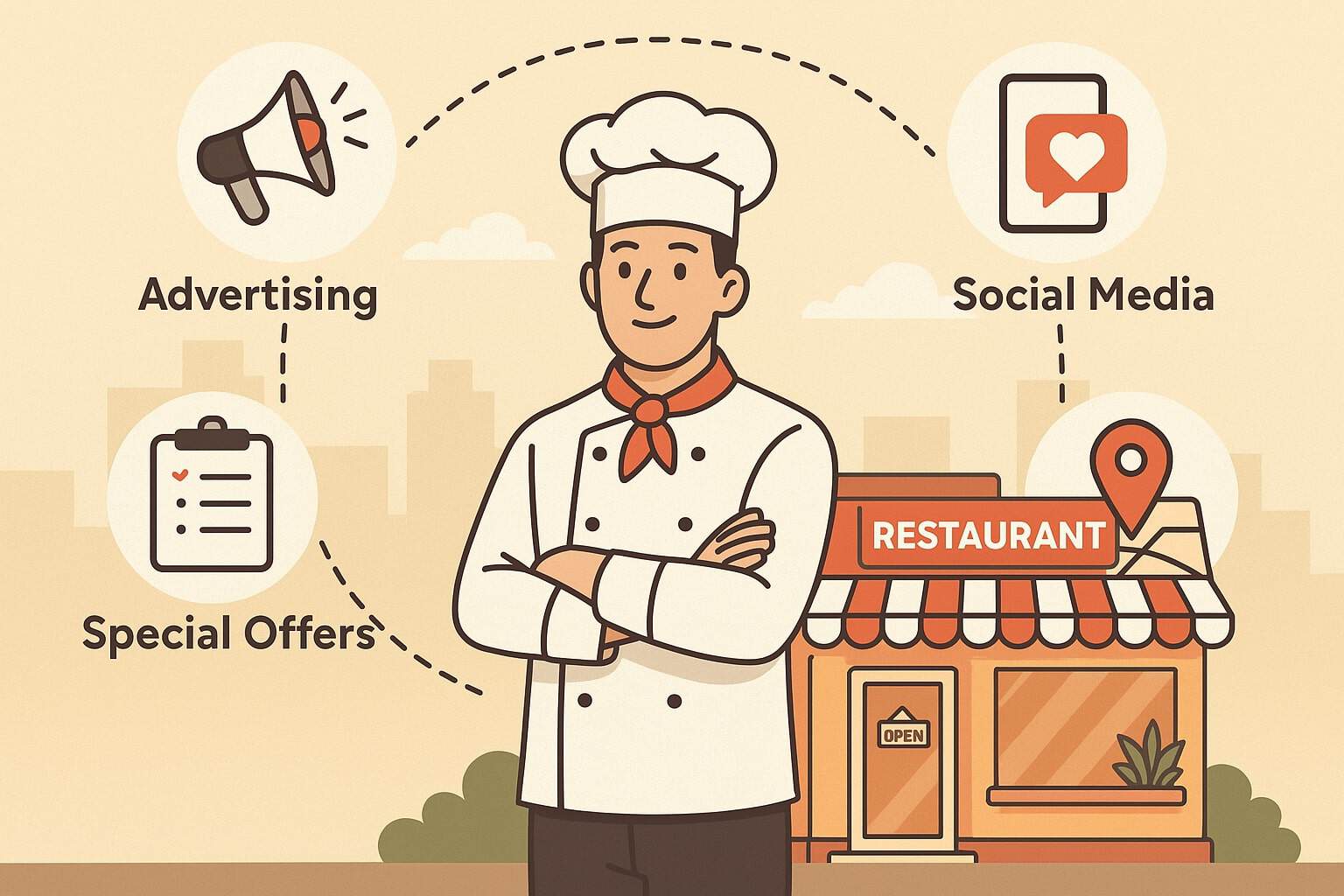
How to Market a Small Restaurant in a Competitive Area
Running a small restaurant in a competitive area can feel like an uphill battle, but learning how to market a small restaurant in a competitive area effectively can turn that challenge into an advantage.
When you combine smart branding, local SEO, social media, community connections, and data-driven strategies, you can stand out even when it feels like there’s a restaurant on every corner.
This guide is written for small restaurant owners in the United States who want practical, up-to-date tactics that work in real neighborhoods, not just in theory. We’ll walk through how to position your concept, attract more walk-ins, boost online orders, and build a loyal base that keeps coming back and brings friends.
The focus is always on real-world marketing moves you can execute with limited time and budget, but with maximum impact in a crowded market.
Understanding Your Market and Positioning Your Restaurant

Before you dive into ads or social media, you need a clear understanding of how to market a small restaurant in a competitive area by studying your market. Many owners skip this step and jump straight into promotions, but that often leads to generic marketing that blends into the noise.
Start by creating a simple local market analysis. Look at the types of restaurants within a one to three-mile radius. Note their price range, cuisine, atmosphere, hours, and what they appear to emphasize: speed, health, comfort, nightlife, or family-friendly dining.
This helps you understand where there are gaps and where your restaurant already fits into the local ecosystem.
Next, define your unique value proposition (UVP). Your UVP is the sentence that explains why someone should choose your restaurant instead of the one down the street.
It might be “fast, fresh bowls for busy downtown workers” or “scratch-made comfort food for families on a budget.” When you think about how to market a small restaurant in a competitive area, your UVP becomes the anchor for your messaging, your visuals, and your promotions.
It should be visible on your website, your Google Business Profile description, your menus, and your social profiles. Over time, this consistent positioning will shape how local diners talk about you and recommend you.
In the U.S. market, diners increasingly care about story, transparency, and values. That means your positioning can go beyond food type into your sourcing, culture, or mission. If you support local farms, employ neighborhood youth, or reduce waste, these can be powerful differentiators in a crowded field.
Looking ahead, restaurants that clearly communicate their values and community impact are likely to win more loyalty as consumers prioritize ethical and local spending. So when you ask how to market a small restaurant in a competitive area, start with who you are, who you serve, and why it matters, then build every tactic around that core.
Building a Strong Brand Identity for a Small Restaurant

Once your positioning is clear, the next step in how to market a small restaurant in a competitive area is building a strong, recognizable brand identity. Brand identity is more than just a logo; it’s the complete experience someone has with your restaurant—from your signage and menu design to your tone of voice online.
In a competitive neighborhood, a memorable brand makes your restaurant easier to recognize, easier to remember, and easier to recommend. It gives people language and imagery they can use when they talk about you to friends, post photos, or leave reviews.
Start with visual elements: your logo, color palette, typography, and imagery style. These should align with the feeling you want guests to have. A cozy, family-style restaurant might lean on warm colors and friendly fonts, while a modern fast-casual concept might use clean lines and bold accent colors.
Consistency is crucial. The same logo and colors should appear on your storefront, menus, website, social media, and takeout packaging. This visual consistency signals professionalism and makes your marketing more efficient.
When people see your content in a feed or an ad, they instantly recognize it as yours, which is a huge advantage when you are figuring out how to market a small restaurant in a competitive area.
Your brand identity also includes your voice and story. Decide how you want to “sound” when you write captions, replies, emails, and website content. Are you playful, sophisticated, family-oriented, or health-focused?
Use that voice consistently and weave in pieces of your story: how you started, the inspiration behind your dishes, your chef’s background, and your connection to the neighborhood.
In the future, as digital channels continue to expand and AI-generated content becomes more common, restaurants with genuine, human, story-driven branding will stand out more.
So investing time now in brand identity is one of the smartest ways to improve how you market a small restaurant in a competitive area for long-term growth.
Local SEO and Google Business Profile Optimization

For most U.S. restaurants, one of the most powerful answers to how to market a small restaurant in a competitive area is local SEO. Local SEO (search engine optimization) focuses on helping your restaurant appear when people near you search for phrases like “best tacos near me” or “family restaurant in [your city].”
The centerpiece of local SEO is your Google Business Profile (GBP). This listing powers your appearance on Google Maps and the local “map pack” results. If your GBP is incomplete or outdated, you are leaving a lot of revenue on the table, especially in a competitive cluster of restaurants.
First, claim and fully verify your Google Business Profile. Fill out every field you can: categories, attributes (like “takes reservations” or “outdoor seating”), hours, phone number, website, menu links, and a detailed description.
Use your main keyword—how to market a small restaurant in a competitive area—naturally in your description by explaining how you serve local diners and what makes you unique.
Add high-quality photos of your dishes, interior, exterior, and staff to give potential guests a sense of what to expect. Update these photos regularly so your profile stays fresh and engaging.
Next, focus on local keywords and on-page SEO for your website. Include location-based phrases such as your city, neighborhood, and nearby landmarks on your homepage, contact page, and menu page.
Make sure your name, address, and phone number (NAP) are consistent across your website, Google Business Profile, and other citation sites like Yelp and TripAdvisor. Encourage customers to leave Google reviews and respond to each one with gratitude and your brand voice.
Over time, this builds credibility and signals activity to search engines, improving your rankings. Looking ahead, local search will continue to evolve with more AI-powered recommendations and voice search through devices and cars.
Optimizing for conversational phrases and maintaining an accurate GBP will be essential for anyone exploring how to market a small restaurant in a competitive area over the next five to ten years.
Social Media Strategies for Small Restaurants in Competitive Areas
Social media is another crucial pillar when you’re learning how to market a small restaurant in a competitive area. Platforms like Instagram, Facebook, TikTok, and even YouTube offer visual, location-aware channels to reach local diners where they spend a lot of time.
For small restaurants, the goal is not to become a global influencer but to become locally famous within a few miles of your door. That means focusing on content that highlights your dishes, staff, guests (with permission), and neighborhood, rather than generic stock photos or overly corporate messaging.
Instagram and TikTok are especially powerful for restaurants because food is so visual and “shareable.” Post short videos of dishes being prepared, plated, or served, and show behind-the-scenes moments in the kitchen.
Share daily specials, limited-time items, and events through Stories and Reels. Use local hashtags that match how people search and talk about your area, such as #NYCeats, #AustinFood, or #ChicagoBrunch.
When planning how to market a small restaurant in a competitive area, aim for consistent posting—ideally several times per week—rather than one big burst and then silence. Consistency builds familiarity and keeps you in front of potential diners when they’re deciding where to eat this weekend.
Engagement is just as important as posting. Reply to comments, thank people for tagging you, and share user-generated content (UGC) with credit. Consider collaborating with local micro-influencers who genuinely like your food and have a focused following in your neighborhood.
Offer them a free meal in exchange for honest coverage rather than paying for fake enthusiasm. In the future, social platforms will likely integrate more direct ordering, reservations, and loyalty features.
Being active now sets you up to leverage these tools quickly when they arrive, giving you an edge as you continue to think about how to market a small restaurant in a competitive area in a digital-first world.
Crafting Irresistible Offers, Promotions, and Loyalty Programs
In a crowded neighborhood, smart offers and loyalty programs can make a huge difference in how to market a small restaurant in a competitive area. The key is to design promotions that attract new guests without training people to only visit when there’s a discount.
Start by defining your goals: Are you trying to increase weekday lunch traffic, boost slow evenings, or grow online orders? Once your goals are clear, you can create targeted offers like “Happy Hour Appetizer Specials,” “Neighborhood Night,” or “Lunch Combo for Office Workers.”
Instead of random discounts, tie your promotions to occasions and behaviors that matter to your audience. For example, if your restaurant is near offices, create a punch card or digital loyalty program that rewards frequent lunch visits.
If you are more family-oriented, offer a “Kids Eat Free on Tuesdays” promotion to fill a traditionally slow night. These tactics align directly with how to market a small restaurant in a competitive area because they give people a specific, compelling reason to choose you over other options at a particular time.
Promote your offers through in-store signage, social media, email, and your Google Business Profile posts so they reach both existing and potential guests.
Loyalty programs are especially important for long-term success. You can use simple punch cards, but digital loyalty platforms that integrate with your POS or online ordering system give you much more data and flexibility.
They allow you to track visit frequency, average spend, and favorite items, then send targeted rewards or birthday offers. Looking ahead, expect loyalty programs to become even more personalized, using AI and data to tailor offers to individual preferences.
Restaurants that start building their loyalty base now will have a huge advantage in the future, making loyalty strategy a core part of how to market a small restaurant in a competitive area and build sustainable revenue instead of relying on one-time deals.
Leveraging Delivery Apps, Online Ordering, and First-Party Channels
In the U.S., many diners discover where to eat or order by browsing delivery apps like DoorDash, Uber Eats, and Grubhub. That’s why these platforms play a major role in how to market a small restaurant in a competitive area.
They can dramatically expand your visibility, but they also charge high commissions and control the customer relationship. The smartest approach is to treat delivery apps as top-of-funnel marketing tools while also building your own first-party ordering and contact list.
The goal is to reach new guests on third-party apps and then encourage them to order directly from your website or app over time.
First, make sure your listings on delivery platforms are complete, accurate, and visually appealing. Use high-quality photos, clear item descriptions, and categories that make it easy to browse. Highlight your signature dishes and best sellers.
Consider offering a few exclusive bundles or family meals, which can stand out in crowded search results and increase average order value. This is a practical way to apply how to market a small restaurant in a competitive area because it uses the apps’ built-in audience while showcasing what makes you special.
At the same time, set up first-party online ordering through your own website, ideally integrated with your POS to reduce errors. Promote direct ordering everywhere: on your menus, social media, email, and even inside delivery bags with printed inserts.
Offer small incentives like a free dessert after a certain number of direct orders or slightly better prices than third-party apps. Looking ahead, as fees and regulations around delivery apps continue to evolve in the U.S., restaurants with strong first-party channels will have more control over margins and customer data.
So when you consider how to market a small restaurant in a competitive area for the long term, investing in your own ordering and customer database is just as important as optimizing third-party listings.
Community Engagement and Local Partnerships
One of the most underrated strategies in how to market a small restaurant in a competitive area is deep community engagement. While digital marketing is crucial, your physical presence and relationships in the neighborhood can create a strong moat against larger competitors and chains.
People love supporting places that feel like part of the community. When your small restaurant shows up consistently at local events, supports local causes, and collaborates with nearby businesses, you build emotional loyalty that can’t be replicated by discounts alone.
Start by mapping out community touchpoints: schools, churches, gyms, co-working spaces, local nonprofits, and neighborhood associations. Reach out and explore win-win partnerships.
You might provide catering for school events at a discount, host fundraising nights where a portion of sales goes to a local cause, or offer special deals for members of a nearby gym.
These initiatives illustrate how to market a small restaurant in a competitive area by turning community members into advocates who talk about you in their circles and bring groups to dine with you.
Local business partnerships can be especially powerful. Collaborate with nearby coffee shops, breweries, or dessert spots for cross-promotions or joint events.
For example, you could host a “Taste of the Block” night with a fixed-price menu that includes items or beverages from several neighboring businesses. Looking into the future, communities are likely to value hyper-local connections even more as big brands automate and scale.
Small restaurants that weave themselves into the fabric of the neighborhood through partnerships and events will have a strong competitive edge. So when you plan how to market a small restaurant in a competitive area, make sure community engagement is a core, ongoing strategy, not a one-time marketing stunt.
Email Marketing, SMS, and Building a Customer Database
While social media gets a lot of attention, email and SMS remain some of the most effective tools for how to market a small restaurant in a competitive area. They give you direct access to customers without relying on algorithms or paid ads.
The first step is to start building a customer database with email addresses and, where appropriate, mobile numbers. You can do this through your website, online ordering system, Wi-Fi sign-ups, and in-store QR codes that encourage people to join your list in exchange for a small reward like a free appetizer on their next visit.
Once you have a list, use email to send regular but not overwhelming updates—often one to four times per month. Share new menu items, upcoming events, seasonal specials, and exclusive offers for subscribers.
Make sure your branding and voice are consistent with your other marketing channels. Segment your list where possible, so frequent lunch customers receive messages tailored to weekday deals, while evening diners see more about date nights or family dinners.
This targeted communication is a sophisticated way to approach how to market a small restaurant in a competitive area because it ensures your messages are relevant, improving open rates and conversions.
SMS can be powerful for time-sensitive promotions, such as last-minute specials, event reminders, or weather-related offers like “Rainy day? Come in today and get a free coffee with your entrée.”
Because text messages are so direct, use them sparingly and always with explicit permission, following U.S. compliance guidelines. In the future, expect email and SMS tools to offer even more automation and personalization, allowing you to send messages based on visit frequency, favorite dishes, and loyalty status.
Restaurants that start building and nurturing their customer database now will have a major advantage as technology evolves, making email and SMS a critical part of how to market a small restaurant in a competitive area with a long-term view.
Data, Reviews, and Reputation Management
In a competitive area, your online reputation can either fuel growth or quietly hold you back. That’s why reviews and data play a central role in how to market a small restaurant in a competitive area.
Many diners check Google, Yelp, or TripAdvisor reviews before choosing where to eat, especially if they are new to the neighborhood. A strong rating with recent, detailed reviews can tip the scales in your favor, while unanswered complaints or old, sparse reviews can push people toward another option that feels “safer.”
Make it a habit to actively encourage happy customers to leave reviews. Train staff to ask at the end of a positive interaction, and include gentle reminders on receipts, table tents, and follow-up emails.
Don’t offer incentives that violate platform policies, but you can frame it as “Your review helps other locals discover us.” When you receive reviews—positive or negative—respond promptly and professionally.
Thank guests for kind words and address complaints with empathy and solutions, not defensiveness. This approach is crucial in how to market a small restaurant in a competitive area because it shows that you listen, care, and are committed to improvement.
Beyond reviews, use the data from your POS, online orders, and loyalty program to make smarter marketing decisions. Look at which dishes sell best, which days and times are busiest, and which promotions drive repeat visits.
Test different offers or messages and track results. Over time, you can refine your strategies based on real behavior rather than guesswork. Looking ahead, data analytics tools will become increasingly accessible to small restaurants, making it easier to understand customer patterns and forecast demand.
Embracing data and reputation management now will keep you competitive and efficient as you continue to refine how to market a small restaurant in a competitive area in an increasingly data-driven marketplace.
Future Trends in Restaurant Marketing for Competitive Urban and Suburban Areas
As you think about how to market a small restaurant in a competitive area over the next five to ten years, it’s important to pay attention to emerging trends that are already reshaping the U.S. restaurant industry.
One major shift is the rise of short-form video and personalized recommendations powered by AI. Platforms like TikTok, Instagram Reels, and YouTube Shorts are influencing where people eat, especially younger diners.
A single viral video of one signature dish or unique experience can drive huge spikes in traffic. Small restaurants that learn basic video storytelling and post consistently will be better positioned to catch these waves than those that ignore video altogether.
Another trend is the expansion of omnichannel experiences, where guests expect seamless interactions across dine-in, takeout, delivery, and digital channels. This affects how to market a small restaurant in a competitive area because your marketing can no longer focus on just one channel.
Instead, your website, online ordering, social media, email, and in-store experience must tell the same story and reinforce your brand.
As large chains deploy more technology, small restaurants can differentiate by combining simple tech with high-touch, personal service, such as remembering regulars’ orders and names while offering convenient online ordering and contactless payment.
Sustainability and values-based dining will also continue to grow in importance. Diners increasingly look for restaurants that care about local sourcing, waste reduction, and fair treatment of staff.
Communicating your efforts in these areas—honestly and without exaggeration—will become a key part of how to market a small restaurant in a competitive area. Future marketing may involve more transparency, such as showing where ingredients come from or highlighting community initiatives.
Small restaurants that align their operations and marketing with these values will attract loyal guests who want their spending to reflect their beliefs, giving them a durable advantage in competitive markets.
FAQs
Q1. How much should I budget for marketing a small restaurant in a competitive area?
Answer: When deciding how to budget for how to market a small restaurant in a competitive area, a common guideline is to allocate roughly 3–8% of your gross revenue to marketing, depending on your growth goals and margins.
New restaurants in highly competitive U.S. neighborhoods may lean toward the higher end for the first year to build awareness. This budget should cover website maintenance, local SEO, social media content, basic advertising, in-store signage, loyalty program tools, and maybe small influencer or event collaborations.
Start small, track results, and shift more budget toward tactics that clearly drive visits or orders. Over time, your data will show where your marketing dollars have the most impact.
Q2. What is the most effective single strategy to market a small restaurant in a competitive area?
Answer: There is no universal “one best” tactic, but if you have to choose one core pillar for how to market a small restaurant in a competitive area, local SEO and Google Business Profile optimization are often the most consistently impactful.
Being easily discoverable when people search “restaurants near me” or “best [cuisine] in [city]” can drive daily traffic with relatively low ongoing cost.
Combining a strong Google presence with good reviews, high-quality photos, and a clear brand message puts you in front of people who are already hungry and ready to choose. From there, you can layer social media, community events, and loyalty programs for even better results.
Q3. How often should I post on social media to market my restaurant?
Answer: When figuring out how to market a small restaurant in a competitive area through social media, consistency matters more than perfection. For most small restaurants, posting three to five times per week on a primary platform like Instagram or TikTok is a realistic and effective frequency.
You can supplement with Stories or shorter updates on busier days. The content should focus on your food, people, and daily life at the restaurant, not just promotions.
Monitor which posts drive the most engagement and traffic, then adjust your strategy accordingly. Over time, your social presence becomes a living portfolio that convinces new guests to try you and reminds regulars to return.
Q4. How can I attract local customers instead of just tourists or one-time visitors?
Answer: Attracting locals is central to how to market a small restaurant in a competitive area because local regulars provide stable, repeat business. To do this, lean into neighborhood-focused marketing: sponsor local events, partner with nearby businesses, and acknowledge local schools or organizations.
Offer loyalty programs that reward frequent visits and create specials or nights designed around local schedules, such as “Neighborhood Night,” early happy hours, or family-friendly evenings. Use geo-targeted ads or local hashtags to reach people who live or work nearby.
Make sure your branding and story highlight your commitment to the community, so locals feel proud to support you rather than seeing you as a tourist-only spot.
Q5. How long does it take to see results from restaurant marketing efforts?
Answer: When you start implementing how to market a small restaurant in a competitive area, you may see quick wins from promotions, social media posts, or events within days or weeks.
However, the deeper impact from local SEO, branding, and reputation building typically takes several months. It can take three to six months to see significant movement in search rankings and review volume, and even longer to fully establish your restaurant as a neighborhood favorite.
The key is to stay consistent, keep measuring what works, and refine your approach. Over time, these compounding effects—more reviews, better search visibility, stronger social presence, and loyal regulars—create a powerful, sustainable marketing engine.
Conclusion
Successfully learning how to market a small restaurant in a competitive area is not about one magic trick. It’s about layering strategies that reinforce each other and reflect who you are as a business. You start by understanding your market and defining a clear position and brand identity.
Then you make sure your restaurant is easy to find through local SEO and an optimized Google Business Profile. You show up consistently on social media with real, relatable content and use targeted offers, loyalty programs, and events to drive specific behaviors.
Along the way, you build a customer database through email and SMS, manage your reviews and reputation, and use data to make smarter decisions.
In the U.S. restaurant landscape, competition is intense, but so is the opportunity for small, authentic concepts that connect deeply with their communities. By combining digital tools with local relationships and a strong story, you can stand out even on a crowded block.
As technology, consumer behavior, and local search evolve, the restaurants that adapt, listen to their guests, and stay consistent with their marketing will thrive.
If you commit to applying these principles of how to market a small restaurant in a competitive area, step by step, you can transform your restaurant from just another option into a beloved local favorite that people go out of their way to visit and recommend.