How to Manage Inventory in a Restaurant Kitchen
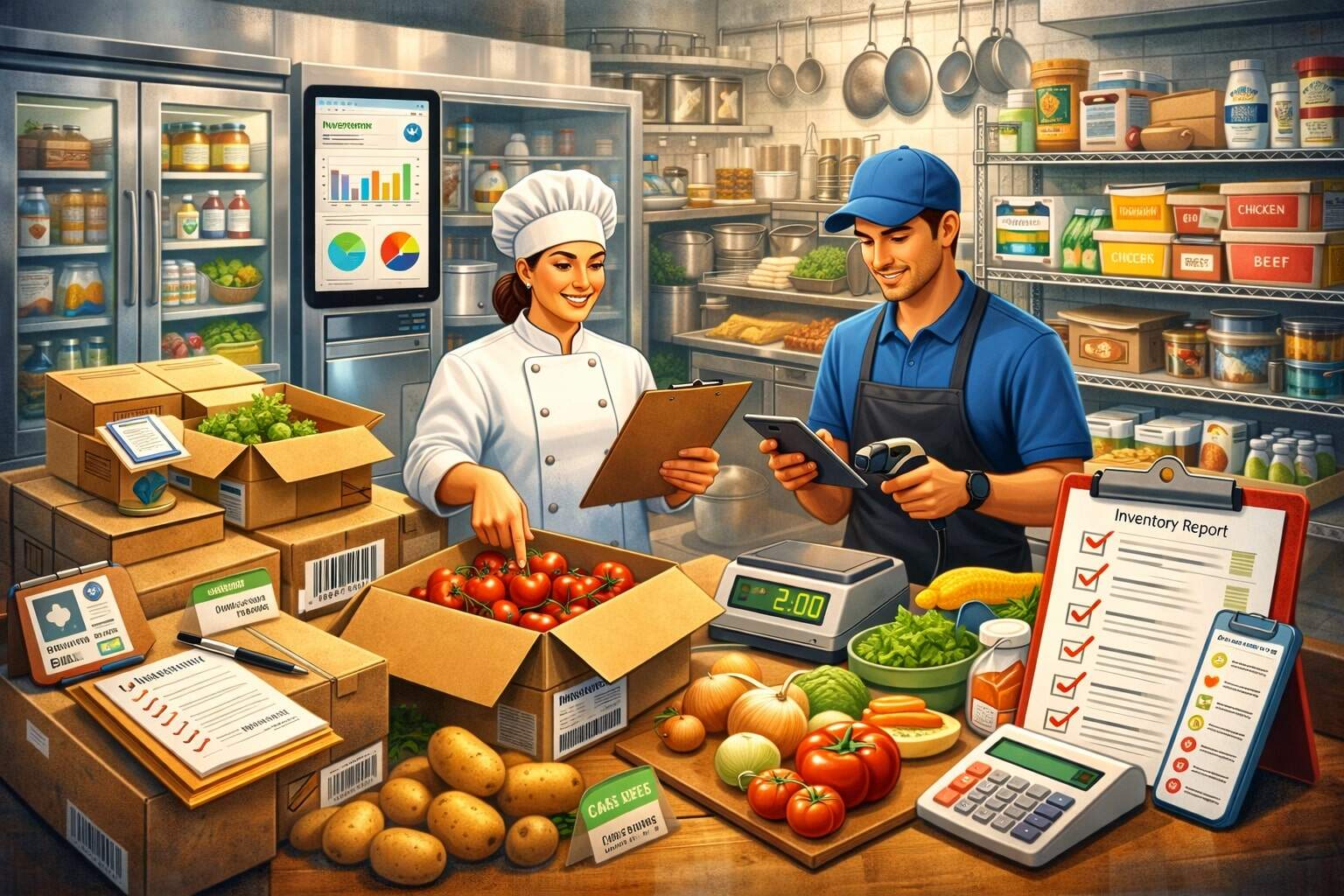
Managing inventory in a restaurant kitchen isn’t just counting cases of tomatoes and hoping nothing runs out. Restaurant kitchen inventory management is a daily system that protects food quality, controls costs, reduces waste, prevents theft, and keeps service smooth.
When inventory is handled well, your team spends less time “searching and substituting” and more time cooking consistently.
A strong approach to manage inventory in a restaurant kitchen ties together five things: accurate receiving, smart storage, consistent counting, disciplined purchasing, and real-time usage tracking. When these parts work together, you stop guessing. You know what you have, what you need, and what you’re losing.
This guide is designed for working kitchens—from a single-location bistro to a multi-unit operation. You’ll learn practical methods to set up par levels, run counts, forecast demand, manage perishable items, and standardize ordering.
You’ll also see how to build a system that’s easy for your staff to follow, even during busy shifts. Throughout this article, you’ll notice the repeated focus on restaurant kitchen inventory management because it’s the foundation for profitability and consistency.
Why Restaurant Kitchen Inventory Management Matters More Than You Think

If your food cost is higher than expected, inventory is usually part of the story. The gap between “what you should have spent” and “what you actually spent” often comes from weak processes—over-ordering, portion creep, spoilage, and rushed substitutions. Restaurant kitchen inventory management is how you close that gap.
Inventory impacts guest experience directly. When you run out of core items, you 86 menu dishes, disappoint guests, and overload the kitchen with improvisation. On the other hand, when you overstock, you risk spoilage and freezer burn, and you tie up cash that could be used for labor, marketing, or equipment.
It also affects food safety. Poor rotation, mislabeled containers, and inconsistent storage temperatures raise the risk of contamination. A kitchen that can manage inventory in a restaurant kitchen effectively is usually the same kitchen that labels properly, rotates stock, and maintains organized storage.
Finally, inventory is a leadership tool. When counts are consistent, you can coach your team with facts—not feelings. You can spot patterns like “we always over-prep this item on Fridays” or “we’re losing high-cost proteins at the portioning station.” Strong restaurant kitchen inventory management turns chaos into clarity.
Build the Foundation: Define Your Inventory Categories and Locations

Before you can manage inventory in a restaurant kitchen, you need a structure that matches how your kitchen actually works. Many restaurants fail here by building inventory lists that look nice in a spreadsheet but don’t match storage reality. The goal is simple: anyone should be able to walk into your kitchen and count items in the same order every time.
Start by dividing inventory into major categories like proteins, produce, dairy, dry goods, beverages, disposables, and chemicals (kept separate from food). Then break each category into subcategories that reflect your menu.
For example, proteins might split into beef, poultry, seafood, and deli items. This step improves accuracy because counters don’t bounce around the kitchen.
Next, map your storage locations: walk-in cooler, walk-in freezer, lowboy station coolers, dry storage shelves, bar cooler, and prep line backups. Your inventory sheet should follow a physical path. If the walk-in is counted top-left shelf to bottom-right shelf, your sheet must mirror that route. This reduces missed items and double counts.
A practical tip for restaurant kitchen inventory management is to standardize naming. If one person writes “Mozz,” another writes “Mozzarella,” and the invoice says “Cheese, Mozz,” your data becomes messy fast. Use one name, one unit, and one SKU-style code if possible. This is the difference between “counting food” and truly managing inventory.
Create Standard Units, Yields, and Pars So You Stop Guessing
One of the fastest ways to improve restaurant kitchen inventory management is to standardize units. Inventory becomes unreliable when some items are counted by case, others by pounds, and others by “about half a bag.” Your system needs clear units, clear conversions, and predictable yields.
Set a primary unit for each item: pounds, gallons, each, #10 can, case, or pack. Then define how that item is purchased and how it is used. For example, you might purchase chicken breasts by the case but use them by the pound or by portion. You must record a conversion so your counts and recipes align.
Yields matter because raw product doesn’t always equal usable product. Trim loss, cooking loss, and spoilage affect true cost. If your kitchen trims 20% off whole tenderloins, your “usable cost per portion” is higher than the invoice suggests. A smart restaurant kitchen inventory management setup includes yield estimates so menu costing is accurate.
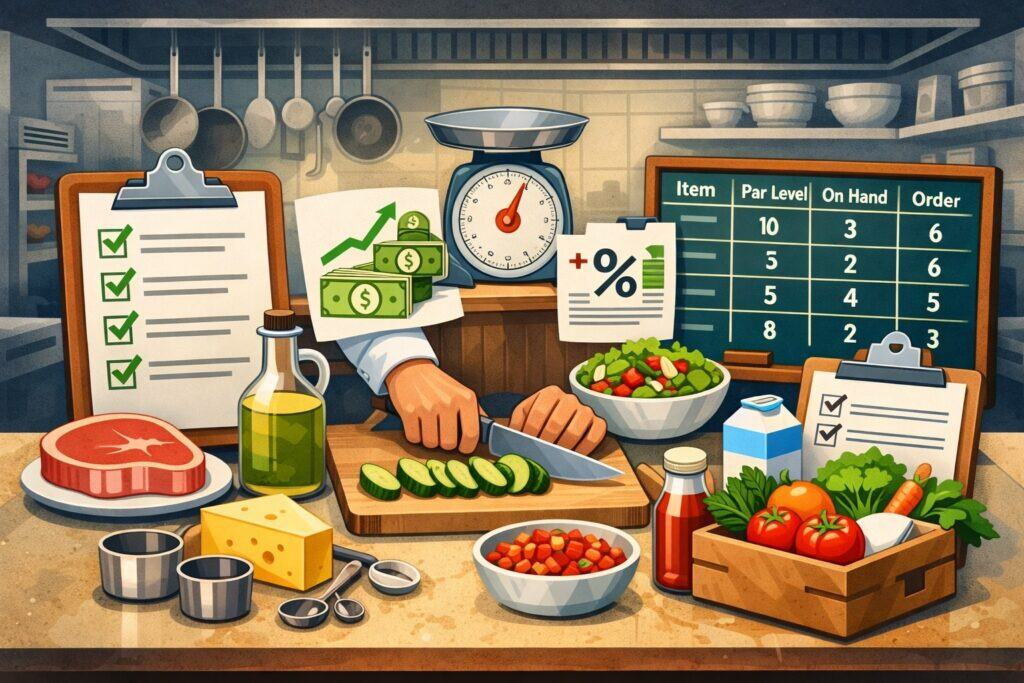
Then set pars. A par is the target amount you want on hand to meet demand without overstocking. Pars should be set by item, by day, and sometimes by season. Start with a simple weekly baseline: par = average weekly usage + safety stock.
Safety stock should reflect vendor lead times and your volume variability. If a vendor delivers twice a week, your safety stock can be lower than a vendor that delivers once weekly.
When you standardize units, yields, and parts, your ordering becomes calmer and more accurate. That’s a core skill to manage inventory in a restaurant kitchen consistently.
Master Receiving: The Most Overlooked Step in Restaurant Inventory
Receiving is where money becomes a product. If receiving is sloppy, your counts, costs, and ordering will be wrong no matter how well you count later. Strong restaurant kitchen inventory management starts at the back door.
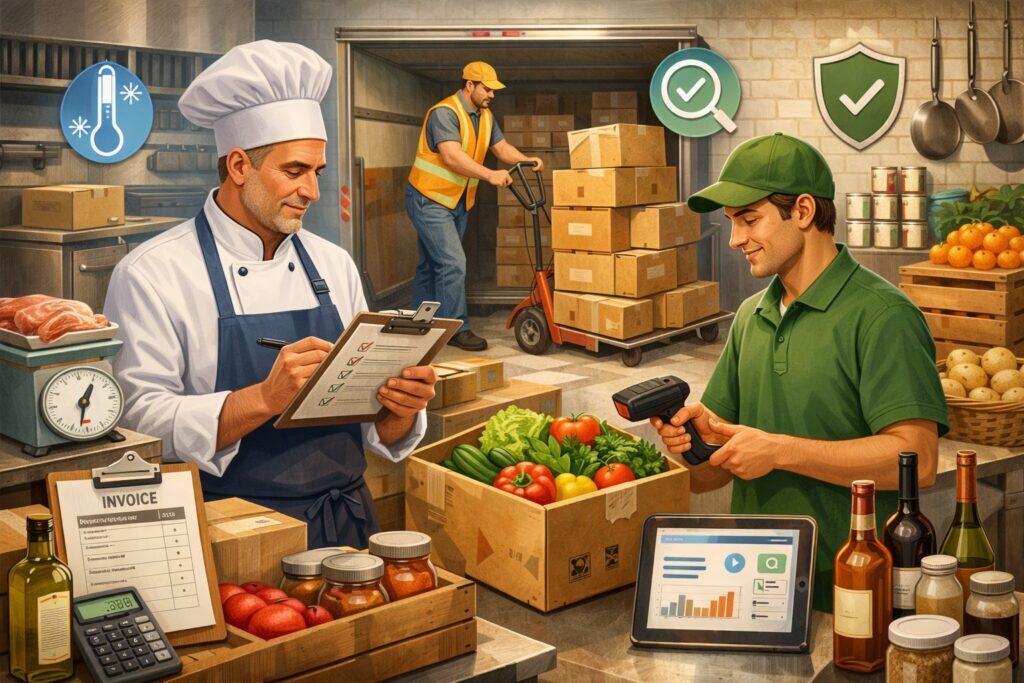
Create a receiving checklist. Verify invoice items match what arrived. Count cases, check weights, confirm pack sizes, and look for substitutions. If you ordered a 12-count pack and got a 10-count, the invoice might not show the difference clearly. Catch it immediately.
Inspect quality and temperature. Perishable items should arrive within safe temperature ranges and show no signs of damage or thawing. If boxes are soaked, cans are dented on seams, or produce is bruised, document and reject as needed.
Your team should know that rejecting poor-quality products isn’t “being difficult”—it protects your guests and your margins.
Label items at receiving with date, initials, and location. This builds accountability and makes rotation easier. A major reason kitchens struggle to manage inventory in a restaurant kitchen is “mystery product” that sits unlabeled until it spoils.
Also track credits. If you reject items or receive short deliveries, log it immediately and follow up with the vendor. Many restaurants lose significant money in unclaimed credits. Receiving is not just counting boxes—it’s confirming value.
When receiving is standardized, your inventory data becomes trustworthy. Trustworthy data is the engine of great restaurant kitchen inventory management.
Storage and Organization: Set Up the Kitchen So Counting Is Easy
A disorganized storage area creates waste and makes counting painful. To manage inventory in a restaurant kitchen efficiently, design storage with two goals: food safety and inventory visibility.
Use clear zones: raw proteins below ready-to-eat items, chemicals stored separately, and high-turn items placed for easy access. Keep items together. If flour is stored in three places, you will over-order flour—almost guaranteed.
Invest in consistent containers and labels. Transparent bins with tight lids prevent contamination and help staff see inventory levels quickly. Labels should include item name, prep date, and discard date where applicable. Rotation becomes automatic when labels are visible and consistent.
Apply FIFO—first in, first out—everywhere. This means the new product goes behind the older product, and staff use the older product first. FIFO sounds simple, but it requires shelf discipline. Make it easier by leaving space behind items and training staff to rotate during restocking.
Set a “count shelf” for high-cost items like proteins, specialty cheeses, and premium oils. If these items are always in the same place, inventory counts are faster and variances become more obvious. A key trick in restaurant kitchen inventory management is to reduce “hiding places” where expensive items disappear into random corners.
When storage is clean, labeled, and consistent, you reduce waste, speed up service, and make inventory less stressful. Organization is a profit strategy.
Inventory Counting Systems That Actually Work in Busy Kitchens
Counting inventory doesn’t have to be a nightmare. The best counting system is the one your team will actually follow. To manage inventory in a restaurant kitchen, you need a cadence and a method.
Most kitchens benefit from two types of counts:
- Full inventory counts weekly or biweekly for financial accuracy.
- Cycle counts daily or a few times per week for high-cost, high-risk items.
Cycle counts are powerful. Instead of counting everything at once, you count a small group of items on a schedule: proteins on Monday, dairy on Wednesday, dry goods on Friday. This keeps data fresh and catches problems early. It also reduces the pressure of one massive weekly count.
Use “count-to-sheet,” not “sheet-to-count.” Walk the kitchen in the same order every time and record what you see. If you jump around, you miss items. Always count the same way: cases first, then partials, then loose units.
Standardize partial counts. Teach staff how to estimate partials consistently: half a case, quarter pan, or “X pounds remaining” for bulk bins. For key items, use scales for accuracy. Consistency matters more than perfection, because consistent counts reveal trends.
Finally, lock in a rule: no receiving or transfers during counts unless documented. Otherwise, you’ll chase phantom variances forever. A dependable counting routine is one of the strongest tools to manage inventory in a restaurant kitchen long-term.
Purchasing and Ordering: Turn Your Counts Into Smart Buying Decisions
Ordering is where inventory becomes a strategy. Even if your counts are perfect, poor purchasing habits can destroy margins. Restaurant kitchen inventory management improves dramatically when ordering is based on pars and usage—not anxiety.
Start with a simple ordering formula:
Order Quantity = Par Level – (On-Hand + On-Order)
This prevents double-ordering and reduces overstocking. “On-order” includes what you have already placed but haven’t received. Many kitchens forget this step and overbuy.
Use a consistent ordering calendar. Assign delivery days for different categories: produce deliveries more frequently, dry goods less frequently, and proteins based on your volume and storage capacity. A structured schedule reduces last-minute “panic orders” that cost more and cause waste.
Negotiate pack sizes that match your usage. If you only use 6 gallons of a sauce ingredient weekly, ordering a case of 12 gallons invites spoilage. Vendors can often adjust pack sizes or suggest alternatives. This is a practical way to manage inventory in a restaurant kitchen without changing your menu.
Also build an “approved substitution list.” When vendors run out, they substitute. If your kitchen doesn’t control substitutions, quality and costs drift. Decide in advance what substitutions are acceptable and what requires manager approval.
Purchasing is not just about getting a low price. It’s about buying the right amount, in the right format, at the right time, to match your menu demand.
Recipe Costing, Portion Control, and The Link to Inventory Accuracy
If portions are inconsistent, inventory will never line up. The kitchen might feel busy and productive, but food cost creeps up quietly. To manage inventory in a restaurant kitchen well, connect recipes to real usage.
Start with recipe cards that include exact ingredient weights, yields, and portion sizes. “One ladle” is not a measurement unless every ladle is identical and always filled the same way. Use scoops, scales, and portion tools. These small standards can save thousands over a year.
Next, train to plate. If one cook adds extra protein “to be nice,” you might lose margin on every plate. Portion control isn’t stingy—it’s consistency. Guests come back because the dish tastes the same each time.
Track prep batches. When you make a sauce, log the batch size and the date. If a batch yield is lower than expected, something is wrong—either measurement drift, waste, or spillage. Batch tracking makes restaurant kitchen inventory management more precise because it connects prep to depletion.
Menu engineering matters too. High-variance items like premium steaks or seafood should have tight controls: standardized cuts, controlled thawing, and documented waste. When recipe costing and portions align, your inventory counts become meaningful instead of confusing.
Waste Tracking and Spoilage Control: Reduce the Silent Profit Leak
Waste is not just a trash can problem. It’s a system problem. To manage inventory in a restaurant kitchen, you must track waste in a way that leads to action.
Use a waste log with simple categories: overproduction, spoilage, returned plates, prep mistakes, and expired items. Keep it easy. If the log is too complex, nobody uses it. The goal is to record what happened, how much, and why.
Then review waste weekly. Look for patterns. If you throw away the same garnish every week, reduce prep quantities or redesign the garnish. If a specific station has repeated errors, retrain that station with clearer specs.
Spoilage control starts with proper storage temperatures and rotation, but it also depends on ordering accuracy. If you repeatedly over-order herbs, they will spoil. Waste data should feed back into pars and order quantities. That feedback loop is the heart of strong restaurant kitchen inventory management.
Also consider repurposing policies that maintain quality and safety: turning trim into staff meal, using overripe produce in sauces, or converting excess bread into croutons. These strategies must be carefully controlled, labeled, and time-bound.
When you treat waste as measurable and fixable, you protect margins without cutting quality.
Inventory Variance: How to Find Problems Before They Get Expensive
Variance is the difference between what you should have and what you actually have. Variance is not always theft—often it’s process breakdown. Still, if you want to manage inventory in a restaurant kitchen, you must learn to diagnose variance calmly.
Common causes include:
- Inaccurate receiving (short shipments, wrong pack sizes)
- Miscounts (partial cases, items stored in multiple areas)
- Portion creep (inconsistent plating)
- Unrecorded comps or staff meals
- Waste not logged
- Transfers between locations not documented
Start by focusing on top-dollar items. If chicken, steak, shrimp, and cooking oil are your biggest costs, track their variance first. Small errors on high-cost items create big losses.
Use a variance report approach: compare usage from POS sales (theoretical usage) to actual depletion from counts. If the theoretical says you used 50 pounds of chicken but actually says 70 pounds, that’s a red flag. The fix might be portioning, yield, prep loss, or mis-ringing in the POS.
A practical habit in restaurant kitchen inventory management is “variance walks.” When variance spikes, physically inspect storage: check for unlabeled product, duplicate open cases, improper rotation, or hidden backstock. Often the answer is visible.
Variance is feedback. It tells you where your system is leaking, so you can tighten it.
Managing Perishables: Produce, Proteins, Dairy, and Ready-to-Eat Items
Perishables are the hardest part of restaurant kitchen inventory management because they change quickly. The key is to control time and temperature while keeping purchasing aligned with demand.
For produce, focus on inspection and rotation. Produce quality varies daily. Train your receiver to check firmness, bruising, mold, and moisture. Stores produce by needs: some items prefer airflow, others prefer humidity. Keep items off the floor and away from raw proteins.
For proteins, control thawing and trimming. Use controlled thawing in refrigeration, never at room temperature. Label thaw dates and use-by windows. Track yield loss during trimming to keep costs accurate. High-cost proteins should have tighter access controls and standardized portioning.
For dairy, maintain consistent cold storage and prevent “open container drift.” Many kitchens lose dairy to forgotten open containers. Use smaller containers, label opened dates, and store dairy in a consistent zone.
Ready-to-eat items need strict labeling and discard discipline. Use date marking policies consistent with local health regulations and food code guidance. When you manage inventory in a restaurant kitchen with perishables in mind, you reduce risk, increase freshness, and keep your menu consistent.
Technology and Tools: When to Use Spreadsheets vs Inventory Software
You can run restaurant kitchen inventory management on a clipboard, but technology can make it faster and more accurate—if used correctly. The right tool depends on your volume, menu complexity, and staffing.
Spreadsheets work for smaller operations when:
- You have stable vendors and limited SKUs
- Counts are consistent and performed by trained managers
- Recipes and costing are simple
- You don’t need real-time depletion
To make spreadsheets work, standardize units, protect formulas, and use consistent item naming. Spreadsheets fail when too many people edit without rules.
Inventory software helps when:
- You have many SKUs or multiple locations
- You want POS-linked theoretical usage
- You need vendor price tracking and invoice importing
- You want automated order suggestions based on par and history
Even with software, the system still depends on accurate receiving, consistent storage, and disciplined counting. Software won’t fix chaos. But it can highlight variance, reduce manual entry, and provide cleaner reporting for decisions.
A balanced approach to manage inventory in a restaurant kitchen is to start with a strong process, then add technology to remove friction. The “best” tool is the one your team will use daily without shortcuts.
Staffing and Accountability: Make Inventory a Team Habit, Not a Manager Burden
Inventory collapses when only one person “owns it” and everyone else ignores it. To manage inventory in a restaurant kitchen long-term, build shared accountability without creating fear.
Assign clear roles:
- Receiver checks quantities, quality, and invoices
- Prep lead labels and rotates all prepped product
- Line leads monitor portion tools and station pars
- Manager reviews counts, variance, and ordering
Train inventory behaviors into daily routines. For example, every restock includes rotation. Every prep includes labels. Every waste event gets logged. These small actions prevent large losses.
Create checklists that take under five minutes. People follow short checklists. They ignore long documents. Post them where the work happens: receiving area, walk-in door, prep station.
Also make inventory performance visible. Track a few simple metrics weekly: food cost percent, top variance items, and waste totals. Celebrate improvements and coach problems privately. The goal is stable habits, not blame.
Strong restaurant kitchen inventory management is a culture. When the team believes inventory matters, results follow.
Forecasting Demand: Plan Inventory Around Real Sales Patterns
Forecasting reduces both stockouts and waste. It’s a key step to manage inventory in a restaurant kitchen proactively instead of reactively.
Use sales history by daypart and day of week. Most restaurants have predictable spikes: weekend dinner rush, holiday events, local sports schedules, or seasonal tourism. Look at your POS reports and identify patterns in covers and top-selling items.
Then translate sales into ingredient demand. If you typically sell 40 burgers on Friday, convert that into buns, patties, cheese slices, and produce. This is where recipe mapping helps. Forecasting becomes faster when each menu item is linked to ingredient usage.
Consider external factors too: weather shifts, local events, school schedules, and promotions. If you plan a promotion, adjust parts in advance and confirm vendor availability. Many kitchens run out during promotions because they didn’t increase safety stock.
Forecasting also helps labor planning. If demand is higher, prep increases. If demand is lower, scale down prep to prevent waste. This is how restaurant kitchen inventory management supports the entire operation.
Quality Control and Food Safety: Inventory Policies That Protect Guests
Inventory and food safety are inseparable. When you manage inventory in a restaurant kitchen, you are also managing risk. Safe storage, labeling, temperature control, and rotation are not optional.
Use temperature logs for coolers and freezers. If equipment fails, inventory is immediately impacted. A small temperature issue can lead to major product loss and safety risk. Train staff to report issues fast and document corrective actions.
Follow clear labeling and date marking rules for all prepped and opened foods. Use “prep date” and “discard date” labels. Make labels large and readable. The best label system is the one that can’t be ignored.
Control cross-contamination with storage rules: raw proteins below ready-to-eat items, dedicated containers for allergens, and separate utensils for allergen-heavy ingredients where appropriate. Inventory organization makes these rules easier to follow.
If your team follows recognized food safety standards and the applicable food code guidance for holding and storage, your restaurant kitchen inventory management becomes safer and more reliable. Safety and profitability move together.
Multi-Unit and High-Volume Kitchens: Control Transfers and Standardize Everything
As volume increases, inventory complexity grows. Multi-unit operations face extra challenges: transfers, inconsistent vendor pricing, and different manager habits. To manage inventory in a restaurant kitchen across locations, you must standardize core processes.
First, standardize item lists and units across units. If one location counts fish by “each” and another counts by “pounds,” corporate reporting becomes messy and comparisons become useless. Use one standard.
Second, create transfer procedures. Transfers must be documented immediately with item, quantity, date, and reason. Unrecorded transfers are a top driver of variance in multi-unit systems.
Third, centralize key reporting. Track food cost, variance, and waste by location and compare trends. If one store shows higher variance on the same items, that’s a training or process issue—not bad luck.
Finally, train managers the same way. Inventory should not depend on a manager’s personality. It should depend on the system. A consistent system is the only way to manage inventory in a restaurant kitchen at scale.
Future Predictions: Where Restaurant Kitchen Inventory Management Is Headed
The future of restaurant kitchen inventory management is moving toward real-time visibility and automation, but human discipline will still matter. More kitchens are adopting tools that import invoices, connect to POS sales, and estimate theoretical usage automatically. This reduces manual work and highlights variance faster.
Expect stronger forecasting driven by machine learning. Systems are getting better at predicting demand based on historical patterns, events, and even weather. For restaurants, that means more accurate parts and fewer stockouts. However, forecasting is only as good as data quality. If recipes, portions, and counts are inconsistent, even advanced tools will struggle.
Waste tracking will likely become more automated too. Some operations already use connected scales, prep logs, or camera-based tracking to record waste without relying on staff memory. As labor gets tighter, automation that reduces paperwork will become more attractive.
Supplier transparency and price volatility will keep pushing restaurants to monitor costs closely. Inventory systems that track price changes by vendor and suggest alternative purchasing strategies will become more common.
Even with all these changes, the fundamentals won’t disappear. To manage inventory in a restaurant kitchen, you’ll still need consistent receiving, organized storage, disciplined rotation, and clean counting habits.
FAQs
Q.1: What is the best inventory method for a restaurant kitchen?
Answer: The best method is a combination of weekly full counts and frequent cycle counts for high-cost items. This approach keeps your data accurate without overwhelming the team. A strong restaurant kitchen inventory management method also includes standardized units, pars, and consistent storage locations so counts are repeatable.
Q.2: How often should a restaurant kitchen do inventory?
Answer: Most kitchens should do a full inventory weekly (or every two weeks for very small operations) and cycle counts multiple times per week. Proteins and high-cost items often deserve daily or every-other-day checks. The right frequency depends on volume, spoilage risk, and vendor delivery schedules.
Q.3: How do I set par levels for kitchen inventory?
Answer: Start with average usage and add safety stock. A simple baseline is: Par = Average Usage for the Period + Safety Stock. Safety stock should reflect lead time and demand variability. As you improve restaurant kitchen inventory management, refine pars seasonally and adjust for promos or events.
Q.4: What causes food inventory variance in restaurants?
Answer: Variance usually comes from inaccurate receiving, inconsistent portioning, waste not recorded, miscounts, or undocumented comps and transfers. Theft can happen, but most variance is process-based. The fix is tighter routines and better visibility through cycle counts and waste logs.
Q.5: Should I use inventory software or a spreadsheet?
Answer: If you have a smaller menu and stable purchasing, spreadsheets can work. If you need POS-linked usage, invoice importing, multi-location controls, or deeper reporting, inventory software often pays off. Either way, software can’t replace disciplined restaurant kitchen inventory management practices.
Q.6: How can I reduce spoilage in a restaurant kitchen?
Answer: Improve labeling and rotation, tighten ordering to match demand, store items properly, and track waste by category. Use FIFO everywhere and train staff to rotate during every restock. Spoilage drops fast when inventory routines become daily habits.
Conclusion
To manage inventory in a restaurant kitchen effectively, you don’t need complicated theory—you need a reliable system your team follows every day.
Start with the basics: clean receiving, organized storage, standardized units, and consistent counts. Then build parts, ordering routines, and waste tracking that feed back into smarter decisions.
When restaurant kitchen inventory management is done well, food cost becomes predictable, service becomes smoother, and the kitchen feels more controlled. You reduce spoilage, minimize emergency orders, and protect your best-selling dishes from stockouts. Over time, inventory turns into one of your strongest operational advantages.