How to Improve Table Turnover Without Rushing Guests
Improving table turnover without making guests feel rushed is one of the biggest challenges for restaurant owners and managers. You want to serve more people, increase revenue, and keep labor costs under control, but you also need glowing reviews, repeat business, and a relaxed, welcoming atmosphere.
Learning how to improve table turnover without rushing guests is about designing your entire operation—from floor plan to menu to technology—to work faster in the background so the guest experience still feels calm, warm, and unhurried.
In Delaware, where many restaurants depend on seasonal crowds, local regulars, and a mix of business and leisure diners, every seat counts. Beach towns like Rehoboth, Lewes, and Bethany can be slammed on summer weekends, while Wilmington and Newark might peak on business lunches, events, and university calendars.
Instead of telling guests to “speed it up,” the best operators build systems that reduce idle time, streamline service, and gently guide the guest journey. This article will walk you step-by-step through practical, modern, and future-focused ways to improve table turnover while still earning five-star hospitality.
Why Table Turnover Matters for Delaware Restaurants
Before you can master how to improve table turnover without rushing guests, you need to understand why table turnover really matters. Table turnover is simply how many times you can seat, serve, and reset a table during your shift.
A table that turns over two or three times in a busy evening can generate double or triple the revenue of a table that only sees one party. For restaurants in Delaware’s competitive dining markets, that difference can be the line between a strong season and a stressful one.
Many local restaurants face a blend of challenges: seasonal tourism, rising food costs, wage expectations, and sometimes unpredictable foot traffic. You might have a packed dining room one weekend and a quieter room the next.
When your operation is optimized for efficient table turnover, you’re better prepared to capture peak demand without sacrificing service. You can serve more guests during summer beach rushes, graduation weekends, or busy holiday seasons, while still keeping your staff sane and your reviews positive.
There’s also a profitability angle that often gets overlooked. Every minute that a table sits idle—waiting for menus, waiting to order, waiting for the check—is money your restaurant is not earning. Yet if you try to solve this by rushing guests, you risk bad word-of-mouth, negative online reviews, and fewer repeat visits.
The key is to design your systems so that guests feel like everything happens right on time, even when you are intentionally working to improve table turnover. When you focus on smooth flow instead of speed for speed’s sake, you discover that you can increase revenue, cut waste, and maintain a genuine sense of hospitality.
Understanding Table Turnover vs. Guest Experience
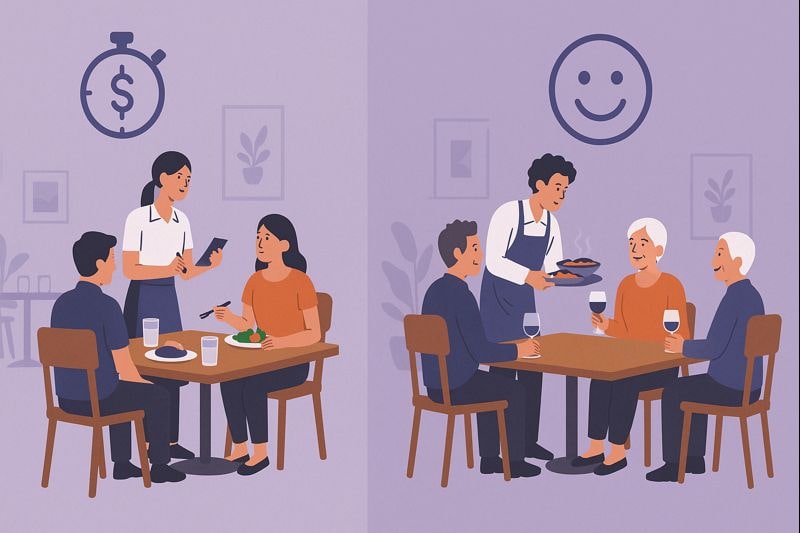
A lot of operators start with the wrong mental model. They think improving table turnover is about making guests eat faster. In reality, how to improve table turnover without rushing guests is about eliminating friction, not eliminating enjoyment.
You want to remove dead time, not happy time. The periods that usually cause problems are before the first order is taken, between courses, and at the end when guests are ready to pay but can’t find their server or the check.
To get this balance right, break the dining experience into stages: greeting and seating, ordering, food and drink delivery, check-backs and add-ons, dessert and coffee decisions, and finally payment and departure.
Guests don’t mind a busy restaurant if they feel taken care of at each stage. What they hate is waiting around with empty glasses, no information, or uncertainty about what happens next. When you map out each stage and identify your average time per stage, you’ll see where your bottlenecks really are.
From the guest’s point of view, the experience is emotional, not operational. They remember whether staff seemed friendly, whether they felt rushed, and whether the pace of the meal matched the occasion.
A family grabbing dinner before a Blue Rocks game might appreciate a quick, efficient experience, while a couple celebrating an anniversary in Wilmington’s riverfront district might want a slower, more indulgent pace.
The art of mastering table turnover is learning to flex your service according to guest cues, while your systems still support a consistently efficient flow.
Analyzing Your Current Table Turnover Data

Before changing anything, you should measure how things actually work today. To master how to improve table turnover without rushing guests, start by tracking accurate data from your POS system, reservation platform, or even a simple spreadsheet.
Record the time a table is seated, the time the first order is placed, when entrées arrive, when dessert is offered, and when payment is completed. Do this for different days of the week and different dayparts (lunch, early dinner, late dinner).
Once you have data, calculate average table duration per party size and per shift. A two-top at lunch might average 45–60 minutes, while a four-top at Saturday dinner might average 90–120 minutes.
Look for patterns: maybe your lunch shift is slow to take orders, or your kitchen slows down at 7 p.m., or closing checks drag on for 20 minutes because guests are waiting on a server to bring a physical check and then return with a payment terminal. Each of these patterns reveals a leverage point to improve table turnover without sacrificing guest comfort.
You can also segment the data further by type of guest: walk-ins vs. reservations, locals vs. tourists, bar seating vs. dining room. In Delaware’s beach towns, for example, you may find that tourists stay longer on vacation weekends and order more rounds, while weekday locals prefer faster, more predictable timing.
When you understand these differences, you can adjust staffing, pre-prep, and even seating patterns according to expected table durations. This data-driven approach allows you to improve table turnover in a targeted way instead of making broad changes that might accidentally create a rushed feeling.
Front-of-House Layout and Seating Strategies
Optimize Floor Plan for Natural Flow
Your floor plan has a huge effect on how to improve table turnover without rushing guests. If servers constantly go the long way around the bar, squeeze through tight spaces, or zig-zag between sections, they waste minutes that add up over the course of a shift.
A smart layout creates clear paths from kitchen to dining room, from bar to tables, and from host stand to every section. You want a design that minimizes backtracking and allows staff to see as many of their tables as possible from key vantage points.
Take a walk through your dining room during a busy service and observe where traffic jams happen. Are guests lining up near the door, blocking servers trying to deliver food? Are buses stuck behind a bottleneck by the expo line or dish area?
Even small changes—shifting a two-top by a few feet, relocating a service station, or repositioning your waitlist kiosk—can have a big impact on flow. When staff can move freely, food arrives faster, plates get cleared smoothly, and guests experience a naturally more efficient meal.
Lighting and visibility also matter. If servers can’t see when a table is flagging them down, waiting to order dessert, or ready for the check, table turnover slows. Consider sightlines when assigning sections.
Group tables so that one server can visually monitor multiple parties without getting stuck behind walls, pillars, or partitions. By improving layout and sightlines, you shorten the micro-delays that quietly drag out each visit, letting you improve table turnover without making guests feel like they’re on a timer.
Smart Seating Policies for Peak Times
Seating strategy is another powerful lever for how to improve table turnover without rushing guests. During peak times, you want to minimize empty seats and avoid mismatched parties and tables.
Seating a two-top at a four-top table may seem harmless, but if it prevents you from seating a larger party later, your turnover and revenue suffer. Teach hosts to match party sizes to table sizes as closely as possible, especially during busy periods.
Use a clear rotation system or table management software to balance server workloads. When one section gets overloaded, that server falls behind, checks take longer, and guests wait unnecessarily.
A well-managed seating rotation keeps service consistent and reduces wait times. You can also strategically double-seat experienced servers who handle volume well, while protecting newer staff from being overwhelmed. This helps maintain quality service even under pressure.
Finally, consider offering guests options at the door. When the wait for a dining room table is long, some guests will happily choose bar seating, high-tops, or patios if it means a shorter wait. You can also encourage guests with flexible timing to come earlier or later by offering happy hour menus or early-bird specials.
You’re not rushing anyone; you’re giving people choices. This simple strategy can increase the number of parties you serve per night while keeping the overall experience positive and relaxed.
Outdoor and Seasonal Seating in Delaware
In many parts of Delaware, outdoor and seasonal seating is a major part of your capacity. Patios, decks, rooftop spaces, and sidewalk cafés are prime revenue drivers during warm months.
Used wisely, they can also be central to how to improve table turnover without rushing guests. Outdoor tables often turn faster by nature, especially for casual meals, but they can also create operational challenges if they’re far from the kitchen or bar.
To maximize outdoor table turnover, treat the patio as a first-class section, not an afterthought. Provide a dedicated service station with necessary supplies so staff aren’t constantly running inside for silverware, condiments, or beverage refills.
If local regulations allow, consider outdoor payment devices or mobile card readers so checks can be closed quickly at the table. The easier it is for servers to operate outside, the smoother the guest experience and the faster the natural turnover.
You can also use seasonal seating strategically to handle peak times without rushing indoor diners. During prime summer weekends in beach towns, you might seat faster, casual meals outdoors while keeping your dining room pacing slightly slower for higher-check, special-occasion guests.
In off-season months, you may close some outdoor seating and focus on optimizing indoor sections. Planning your layout and staffing around Delaware’s seasonal patterns helps you maintain efficient table turnover year-round without pushing guests to leave before they’re ready.
Menu and Kitchen Strategies that Speed Service Naturally
Designing a Menu for Efficient Execution
Your menu is one of the most powerful tools in how to improve table turnover without rushing guests. A long, complicated menu with lots of unique prep steps can slow your kitchen and delay every course. That doesn’t mean you need to serve boring food.
It means you should design your menu so that dishes share common prep techniques, ingredients, and cook times. When your line can execute consistently and quickly, guests receive their meals at a comfortable pace and tables turn naturally.
Look for items that are consistently slow to prepare or cause bottlenecks on your line. Are there dishes that require multiple stations, special equipment, or last-minute prep that only one person can do?
You don’t have to remove these items entirely, but you can rework them, adjust the plating, or limit how often they appear on busy nights. Consider grouping menu items by cook time and ensuring that each station has a balanced workload during peak hours.
You should also think about menu layout and how guests order. Clear, well-organized menus help guests make decisions faster. Highlight house favorites, use brief but descriptive item titles, and avoid overwhelming guests with too many similar choices.
When diners can decide quickly and confidently, orders reach the kitchen faster, which is one of the easiest ways to improve table turnover without any sense of rushing.
Prep, Batch, and Line Organization
Behind the scenes, prep and line organization are critical to how to improve table turnover without rushing guests. A well-run kitchen does as much work as possible before the shift starts.
Sauces, garnishes, pre-portioned proteins, and partially prepped ingredients allow your cooks to assemble dishes quickly and consistently. This doesn’t mean sacrificing freshness; it means doing intelligent prep so the line can keep up with order volume without long delays.
Audit your prep lists and station setups. Are ingredients stored logically? Do line cooks have everything within arm’s reach? Are ticket rails positioned so everyone can see the queue?
Small organizational tweaks can shave seconds off each plate, which turns into minutes saved per table. Train staff on standard plating and portioning so that everyone can help each other when tickets spike, reducing the risk of one cook becoming a bottleneck.
You can also align prep strategy with expected volume. For example, in Delaware’s coastal areas, you may know that Saturday nights during peak season will bring heavy demand for seafood specials or popular signature dishes.
Increase batch prep for those items on those days, and arrange your line specifically for that demand. When the kitchen runs smoothly, orders go out on time, guests feel well cared for, and table turnover improves naturally.
Using Specials and Limited Menus on Peak Nights
On especially busy days—holiday weekends, major local events, graduation nights—it can be smart to use specials or limited menus specifically designed to support how to improve table turnover without rushing guests.
This doesn’t have to feel restrictive; guests often enjoy a focused special menu that showcases seasonal ingredients or chef favorites. Behind the scenes, that menu can be carefully engineered for speed, consistency, and line balance.
Consider offering a prix-fixe or set menu during certain time windows, such as pre-theater dining in Wilmington or pre-event dining near venues and university campuses.
Set menus make ordering faster, reduce decision fatigue, and allow your kitchen to batch cook popular items. Guests appreciate the convenience and value, and you gain more predictable table durations.
Communicate clearly when offering a limited menu, especially if you’re doing it to handle extreme volume. Train staff to frame it positively: “Tonight we’re featuring a special menu designed for quick service before the show,” rather than making it sound like a limitation.
When done well, these strategies help you serve more guests at a steady pace without ever telling anyone to hurry.
Service Models that Increase Turnover Without Pressure
Strategic Greeting, Ordering, and Check-Backs
Front-of-house behavior is where how to improve table turnover without rushing guests becomes very visible. The first greeting sets the tone. Train hosts and servers to greet tables quickly, offer water or beverages right away, and introduce the menu in a way that encourages timely decisions without sounding pushy.
A simple script like, “If you already know what you’d like, I can take your order now, or I can give you a few minutes and check back,” puts the timing in the guest’s hands while still signaling efficiency.
Properly timed check-backs also matter. After food is delivered, a quick visit within a couple of bites shows that you care and lets you fix any issues before they cause delays.
Later in the meal, servers should be trained to notice when plates are nearly finished and ask about dessert or coffee at a moment that feels natural. By anticipating needs instead of waiting to be flagged down, you shorten gaps while making guests feel pampered rather than rushed.
At the end of the meal, offer the check in a way that gives guests control. Instead of disappearing until they ask for it, servers can say, “I’ll leave the check here for whenever you’re ready. I can take payment at the table whenever you’d like.”
This approach gently moves the meal toward completion without pushing anyone out the door. Over time, refining these small service moments is one of the most powerful ways to improve table turnover while preserving a warm, relaxed atmosphere.
Payment at the Table and Digital Checks
The payment process is often the single biggest opportunity in how to improve table turnover without rushing guests.
Traditional payment flows—the server drops the check, walks away, comes back to pick it up, runs the card, returns for signature—can easily add 10 to 20 minutes to table time, especially during peak hours. Modern payment tools cut this down dramatically while actually giving guests more control.
Consider adopting pay-at-the-table solutions, handheld POS devices, or QR-based digital checks. With these tools, guests can review their bill, split checks, add tips, and pay right from their table or their phones as soon as they’re ready.
Servers save steps and time, and guests no longer wait around for someone to pick up a check presenter. In Delaware’s busy beach and city dining scenes, this can be a game changer on packed nights.
It’s important to introduce these tools in a friendly, personal way, not as a cold tech replacement. Train servers to explain the payment options clearly: “When you’re ready, you can scan this code to pay from your phone, or I can bring my handheld terminal over and handle it for you.”
Guests feel supported and empowered, not rushed. Meanwhile, you significantly shorten the final phase of the meal, which is one of the easiest and least intrusive ways to improve table turnover.
Training Staff to Read Guest Cues
No matter how many systems you implement, how to improve table turnover without rushing guests will always depend on human judgment. Some guests want a fast, efficient experience; others want to linger.
Training your team to read body language and verbal cues is essential. If a table is stacked with shopping bags or beach gear and the guests keep checking the time, they probably appreciate a quicker pace. If a couple is leaning close together with a bottle of wine and no urgency, slowing the pace a bit may make sense.
Teach staff to look for natural openings to move the meal along. Do guests close their menus quickly? That’s a signal they’re ready to order. Are they pushing plates away and looking around? They may want the check.
Are they ordering another round of drinks after dessert? They probably intend to stay longer. When servers respond to these cues, they can balance the needs of each table with the overall flow of the dining room.
Role-play scenarios during pre-shift meetings to practice these skills. Show examples of subtle language that guides guests without pressure: “Can I get you anything else, or would you like me to bring the check?”
Simple phrases like this let guests decide, while still keeping the restaurant’s need for efficient table turnover in mind. Over time, a culture of awareness and empathy will do more to improve table turnover than any single policy.
Technology Tools to Improve Table Turnover
Table Management and Reservation Systems
Modern table management tools are central to how to improve table turnover without rushing guests. Reservation and waitlist platforms do more than just store names; they help you predict seatings, estimate table durations, and assign parties to the right tables at the right times. Many systems learn from your historical data and suggest realistic turn times for different party sizes and time slots.
By using these tools thoughtfully, you can prevent over-booking, reduce wait times, and smooth out the peaks and valleys of your shift. For example, you might set shorter default turn times for pre-event reservations or lunchtime bookings, while allowing longer times for late-evening or special-occasion reservations.
Communicating these expectations clearly at the time of booking (for example, “We hold this table for 90 minutes”) sets a polite, professional boundary that supports healthy table turnover without feeling aggressive.
These platforms also streamline host operations. Hosts can see which tables are finishing soon, which reservations are running late, and where walk-ins can be fit in. When the front desk is confident and well-informed, guests are seated more quickly and fairly. This reduces perceived wait times and helps everyone experience a smoother, more enjoyable meal.
QR Code Menus, Ordering, and Waitlists
QR code technology has become a standard tool for many restaurants, and it can play a powerful role in how to improve table turnover without rushing guests.
QR menus allow guests to browse options, see photos, and even place orders or add items without needing to flag down a server. This doesn’t mean replacing human service; it means giving guests more control over timing.
In a busy Delaware dining room or patio, QR ordering can reduce the time between seating and first order significantly. Guests who know what they want can order immediately, while others can still ask questions and order through their server.
Similarly, waitlist apps that allow guests to join a list from their phone and receive text updates reduce crowding at the door and create a sense of transparency and fairness.
The key is to present these tools as convenience, not as a way to move people along. Train staff to weave technology naturally into hospitality: “You’re welcome to order through me, or you can use the QR code if you prefer—whatever is easiest.”
When technology is used this way, it speeds up service, improves table turnover, and actually enhances the guest experience.
Using Data and Forecasting for Staffing and Prep
Technology also supports how to improve table turnover without rushing guests through better forecasting and scheduling. Advanced POS systems and analytics tools can reveal patterns in your business: peak times by day of week, weather-related demand, seasonal tourist spikes, event-driven traffic, and more.
In Delaware, for example, you can track how beach weather, local festivals, or university events affect covers and average table durations.
Armed with this data, you can staff more intelligently. Overstaffing hurts profits; understaffing slows service and extends table times. The right balance allows your team to stay ahead of the room without burning out.
You can also forecast prep needs more accurately, reducing 86’d items and last-minute scrambles that slow down the kitchen.
In the near future, expect forecasting tools to use more sophisticated AI, pulling in real-time local data like event schedules, weather, traffic, and even hotel occupancy to predict demand. Restaurants that adopt these tools early will be better positioned to manage table turnover efficiently and gracefully, with fewer surprises and smoother guest experiences.
Communication and Hospitality: Making Faster Meals Feel Welcoming
Setting Expectations from the Start
One of the most underrated parts of how to improve table turnover without rushing guests is expectation setting. When guests know what to expect, they are less likely to feel rushed—even if the pace of service is relatively quick.
You can set expectations at several points: on your website, when taking reservations, at the host stand, and at the table.
For example, if you offer pre-event dining near a concert venue, you might explain that your pre-show menu is designed for a 60–75 minute experience. On the phone or online, you can note typical table times for specific time slots.
At the table, servers can mention that certain dishes are faster or better suited for guests on a schedule. These cues help guests choose the experience that fits their needs while aligning with your turnover goals.
The language you use matters. Instead of saying “We need the table back in 90 minutes,” you can say, “We hold this table for a 90-minute dining experience, which is usually just right for a relaxed meal.
If you think you’ll need more time, we’ll do our best to accommodate.” This sounds gracious, not pushy, and it keeps everyone on the same page.
Handling Long-Stay Guests and Special Cases
No matter how well you plan, some guests will want to linger. Learning how to improve table turnover without rushing guests means having a plan for those situations too.
Not every long stay is a problem—sometimes a table with a high check average may be worth the extended time. But if a table is clearly finished and staying long into the next seating period, you need strategies that are gentle, respectful, and consistent with your brand.
One approach is to offer guests the option to move to the bar, lounge, or outdoor area if available. Servers can say something like, “We’d love for you to continue enjoying your evening. We do have another reservation for this table shortly, but we can move your drinks to the bar/patio if you’d like to stay.” This gives guests a choice instead of an ultimatum.
You should also empower managers to make judgment calls. Long-time regulars celebrating a special occasion might be allowed extra time, while other situations may call for a firmer but still polite boundary. By handling these cases thoughtfully, you protect your ability to improve table turnover overall without damaging relationships or your reputation.
Legal, Labor, and Community Considerations in Delaware
Scheduling, Breaks, and Fair Labor Practices
Improving table turnover is not just about guests; it’s also about staff. Sustainable how to improve table turnover without rushing guests must respect labor laws, breaks, and fair scheduling practices.
Overworking staff might give you a temporary boost in turnover, but it will lead to burnout, turnover (the employee kind), and ultimately weaker service.
Know the applicable wage, overtime, and break rules that govern your operation, and design your staffing plan accordingly. Use your forecast data to schedule enough coverage during peak periods so that servers and cooks can keep up without cutting corners.
A well-rested, properly staffed team moves faster, communicates better, and delivers a more polished guest experience.
Focus on training and cross-training as well. When bussers can run food, or bartenders can support servers with quick drink orders, or hosts can help reset tables during a rush, you create a flexible team that can adapt in real time. This flexibility is vital to improving table turnover while keeping morale high and legal compliance intact.
Building Local Loyalty While Turning Tables Faster
For restaurants in Delaware, local loyalty is gold. Tourists may come and go, but locals sustain your business year-round. Any strategy for how to improve table turnover without rushing guests must respect and nurture that relationship.
Locals can tell when a place becomes too transactional. Your goal is to be known as efficient and friendly, not as a place that flips guests like a factory line.
Communicate your values through consistent hospitality. Remember names and preferences, offer small gestures of appreciation, and be transparent when you’re operating at capacity.
If you need to set time limits on busy nights, explain that you’re doing it to serve as many guests as possible fairly. Many people will understand, especially when they feel valued in other ways.
Consider special perks for locals—priority seating, loyalty programs, or off-peak promotions that encourage them to visit when your turnover needs are less intense. These strategies build goodwill and give you more flexibility in how you manage tables and pacing across different times and days.
Measuring Results and Continuous Improvement
Key KPIs for Table Turnover
You can’t manage what you don’t measure, so KPIs are central to how to improve table turnover without rushing guests. The obvious metric is average table turn time, but you should track it in more detail: by party size, shift, day of week, and server.
This lets you spot patterns and opportunities. A handful of outlier servers or shifts might be dragging down your averages.
Other useful metrics include:
- Covers per hour per section
- Revenue per seat
- Average check time from seating to first order
- Average time from dessert ordered to check closed
- Guest satisfaction scores and review trends
When you compare these metrics over time, especially before and after implementing new strategies, you can see what’s working. If average table time drops but guest reviews also drop, something is wrong. If table times improve while reviews stay steady or improve, you’re on the right track.
Use these KPIs to coach staff, tweak systems, and set realistic goals. Share results with your team so they understand why changes are being made and how they contribute to success. When everyone is aligned around data and guest experience, continuous improvement becomes part of your culture.
Running Small Experiments and A/B Tests
A smart way to refine how to improve table turnover without rushing guests is to run small experiments. Instead of changing everything at once, test one variable at a time: a new greeting script, a different menu layout, a new way of presenting the check, or a specific time-limited pre-fixe menu. Track the impact on table duration, sales, and guest feedback.
You can even A/B test within the same shift, having half the servers try a new approach while the others use the standard method. Compare the results and gather feedback from both staff and guests. This scientific mindset turns improvements into a steady process rather than a one-time overhaul.
Over time, your restaurant will develop a unique playbook for how to improve table turnover tailored to your concept, location, and guests. The key is to stay curious, flexible, and focused on both sides of the equation: efficiency and hospitality.
Future Trends Affecting Table Turnover in Delaware
Automation, AI, and Smart Kitchens
Looking ahead, technology will play an even bigger role in how to improve table turnover without rushing guests. Smart kitchens with automated ticket routing, predictive cooking, and real-time inventory management will speed up execution and reduce errors.
AI-driven forecasting systems will help restaurants in Delaware anticipate demand based on local events, weather, and historical patterns, making staffing and prep more precise.
Front-of-house automation will also grow, from AI-powered recommendation engines in digital menus to smarter reservation systems that dynamically adjust turn times.
Some restaurants may experiment with robotic food runners or bussers, freeing servers to focus more on guest interaction and less on repetitive tasks. When used thoughtfully, this technology can make service feel more personal, not less, because staff spend more time with guests and less time on logistics.
The challenge will be maintaining a human touch. The restaurants that win will be the ones that leverage automation behind the scenes while keeping the guest experience warm, friendly, and uniquely local.
In Delaware, where community and regional identity matter, combining smart tech with genuine hospitality will be a powerful differentiator.
Changing Guest Expectations and Hybrid Models
Guest expectations are evolving, and that affects how to improve table turnover without rushing guests. More diners are comfortable with QR menus, online waitlists, and digital payments, especially younger guests and travelers.
At the same time, many people crave authentic, in-person hospitality after years of increased digital life. Restaurants will increasingly offer hybrid models: full-service experiences for those who want them, and faster, tech-supported options for guests on the go.
You may see more restaurants in Delaware offering flexible dining formats in the same space: counter service at lunch, full service at dinner, or separate “quick bite” and “leisurely dining” sections.
This flexibility allows you to handle different types of demand without compromising either speed or experience. Guests can choose the pace that suits them, and you can adjust your turnover strategy accordingly.
Over the next few years, the strongest operations will be those that listen carefully to their guests, stay open to new tools, and regularly refine their systems. The core principle will remain the same: remove friction, not enjoyment. That is the essence of how to improve table turnover without rushing guests, now and in the future.
FAQs
Q.1: How can I improve table turnover without making guests feel pushed out?
Answer: The core of how to improve table turnover without rushing guests is focusing on speed behind the scenes, not on the guests themselves. Instead of telling people to hurry, you remove delays at every stage of the meal.
That means greeting tables quickly, offering drinks and menus right away, and being ready to take orders as soon as guests are ready. It also means training servers to anticipate needs, like refills or condiments, so guests don’t spend time waiting with empty glasses or unfinished requests.
Another big piece is optimizing the end of the meal. Offer dessert and coffee at the right moment, then present the check in a way that puts control in the guest’s hands—like leaving it politely on the table with a friendly explanation that they can pay whenever they’re ready.
Using digital payments, pay-at-the-table devices, or QR codes can dramatically reduce the time it takes to close checks while still feeling convenient and respectful.
Behind the scenes, streamline your kitchen and floor operations. Organize prep so dishes come out on time, design a floor plan that allows staff to move efficiently, and use table management systems to seat guests smartly.
When everything runs smoothly in the background, guests naturally finish their meals in a reasonable amount of time without feeling any pressure from you. That’s the best way to improve table turnover while preserving a relaxed, enjoyable atmosphere.
Q.2: What role does staff training play in improving table turnover?
Answer: Staff training is absolutely central to how to improve table turnover without rushing guests. Even the best systems and technology fail if your team doesn’t understand how to use them in a guest-friendly way.
Training should cover not only the mechanics of service—like when to take orders, when to clear plates, and how to use payment tools—but also the softer skills of reading guest cues and communicating clearly.
Teach servers to recognize when guests want a faster experience versus a more leisurely one. For example, guests talking about catching a game or an event probably appreciate quick service, while a couple on a date might want a slower pace.
Role-play language that gently guides the meal forward without sounding pushy, such as “Can I get you anything else right now, or would you like me to bring the check?” When staff are comfortable with these phrases, they can manage table flow more confidently.
Ongoing coaching is just as important as initial training. Use metrics like average table time and guest feedback to highlight what’s working and where improvement is needed. Recognize and reward staff who strike the right balance between efficiency and hospitality.
Over time, strong training creates a culture where everyone understands that improving table turnover and delivering excellent service are not opposites—they’re two sides of the same coin.
Q.3: Is it okay to set time limits on tables to manage table turnover?
Answer: Time limits can be part of how to improve table turnover without rushing guests, but they must be used carefully and communicated clearly.
In some contexts—such as pre-theater dining, holiday brunches, or extremely high-demand peak periods—a stated time limit can help you honor reservations and keep your schedule running smoothly. However, if handled poorly, it can make guests feel unwelcome or overly controlled.
If you decide to use time limits, be upfront from the beginning. Include them in reservation confirmations and mention them politely at seating: “We hold this table for a 90-minute dining experience, which is usually just right for a relaxed meal.”
Make sure the limit is realistic for the type of meal you’re offering. Don’t promise a 60-minute slot for a multi-course fine-dining experience, for example. Your goal is to set expectations, not to surprise guests halfway through their meal.
Most importantly, use discretion. Train managers to make exceptions when appropriate, such as for special occasions or long-time regulars, and offer alternatives—like moving lingering guests to the bar or patio if possible.
When thoughtfully applied, time limits can support healthy table turnover without making guests feel rushed, especially when combined with efficient service and strong communication.
Q.4: What technology should I prioritize first to improve table turnover?
Answer: If you’re just starting to use technology for how to improve table turnover without rushing guests, prioritize tools that give you the biggest impact for the least disruption. Often, that means starting with a modern POS system and digital payment options.
Pay-at-the-table devices, handhelds, or QR code payments can drastically cut the time between the end of the meal and payment, which is one of the simplest ways to speed up turnover.
Next, consider a table management and reservation platform if you don’t already have one. These systems help you manage seating more intelligently, avoid double-booking, and estimate realistic table durations.
They also make it easier for hosts to see which tables will open soon and where walk-ins can be seated, which keeps flow steady during busy shifts.
As you grow more comfortable, you can add QR menus, online waitlists, or guest profile tools that remember preferences and visit history. The key is to introduce technology in a way that enhances hospitality, not replaces it.
Train staff thoroughly and explain new tools to guests with friendly, human language. When done right, technology becomes an invisible engine that improves table turnover while making the dining experience feel smoother and more modern.
Conclusion
Mastering how to improve table turnover without rushing guests is about designing your restaurant so that speed comes from smart systems, not pressure on diners.
From analyzing your current data to optimizing your floor plan, refining your menu, and embracing modern technology, you have many levers to pull that don’t compromise hospitality.
When your kitchen is organized, your staff is well-trained, and your service flow is clear, guests move through their meals comfortably and naturally—which naturally improves table turnover.
Delaware’s restaurant scene, with its mix of locals, tourists, business diners, and special-occasion guests, rewards operations that can adapt their pacing to different needs while staying consistently efficient. By focusing on communication, expectation setting, and genuine care, you turn faster service into a feature, not a flaw.
Looking ahead, advancements in automation, AI forecasting, and flexible service models will give you even more tools to support this balance. The restaurants that thrive will be those that use these tools to remove friction while keeping the experience warm and human.
If you commit to continuous improvement and a guest-first mindset, you’ll discover that you really can improve table turnover without rushing guests—and build a stronger, more profitable, and more beloved restaurant in the process.