How to Handle Negative Reviews at Your Restaurant
Handling negative reviews at your restaurant is now as important as handling food safety, payroll, or inventory. Diners in Delaware often decide where to eat based on what they see on Google, Yelp, TripAdvisor, and social media long before they ever see your menu. A single one-star review can hurt, but how you respond to it can either repair trust or amplify damage.
This guide walks you through how to handle negative reviews at your restaurant step by step, with a special focus on Delaware’s legal and consumer protection landscape. You’ll learn practical scripts, policy ideas, and future trends so your restaurant can turn criticism into loyalty and better operations.
Why Negative Reviews at Your Restaurant Matter More Than Ever
The impact of online reviews on foot traffic and local SEO
To understand how to handle negative reviews at your restaurant, you first need to see how powerful online reviews have become.
Recent data shows that more than 90% of diners are influenced by online reviews when choosing where to eat, and nearly all of them read multiple reviews before making a decision. For local restaurants, these reviews directly affect both walk-in traffic and online orders from search, maps, and delivery apps.
On Google Business Profile, your star rating, review volume, and response rate can impact how prominently your restaurant appears in local search and Maps results.
Guides on review management note that responding to all reviews (positive and negative) is associated with higher conversion rates and increased trust. When you consistently respond to negative reviews at your restaurant, you’re signaling to both diners and algorithms that your business is active, engaged, and customer-centric.
This matters especially when potential guests compare you to nearby competitors. If your neighbor has a similar rating but you have dozens of well-written responses to guests and they have none, diners often pick you.
Studies show many consumers are more likely to choose a business that responds to reviews versus one that doesn’t. That means your strategy for how to handle negative reviews at your restaurant is not just damage control—it’s a marketing channel and brand differentiator.
Finally, consistent review engagement gives you real-time insights. Patterns in negative reviews at your restaurant can signal deeper problems: slow kitchen times, confusing parking, or staff training gaps.
When you treat reviews as a live focus group, you catch issues early and fix them before they become reputational crises.
Legal and regulatory considerations for Delaware restaurants
When you plan how to handle negative reviews at your restaurant, you can’t ignore the regulatory environment. In Delaware, restaurants must follow strict food safety regulations enforced by the Office of Food Protection and related agencies that inspect establishments and enforce the Delaware Food Code.
If a review mentions foodborne illness, unsafe practices, or unsanitary conditions, you need a documented response process—both publicly online and internally with your food safety procedures.
Delaware also provides multiple consumer complaint channels, including the Attorney General’s Consumer Protection Unit, which investigates disputes between consumers and businesses.
A dissatisfied guest can move from a one-star review to a formal complaint if they feel ignored or mistreated. That’s why how to handle negative reviews at your restaurant must include a clear pathway for guests to escalate concerns directly to you before they go to state authorities.
On the flip side, you must avoid threatening or retaliatory responses to reviews. Recent cases in other states show that suing diners for honest negative reviews can backfire badly, attracting negative press and platform warnings about “questionable legal threats.”
Unless a review is clearly defamatory (false statements of fact with intent to harm), your best strategy is usually to respond calmly, report it through platform tools if it violates guidelines, and focus on service improvements.
For Delaware operators, it’s also wise to maintain a written consumer complaints policy that aligns with state consumer protection expectations.
Templates and guidance stress documenting how you receive, investigate, and resolve complaints to ensure fair treatment and legal compliance. Embedding that policy into how you handle negative reviews at your restaurant helps protect your reputation and reduces regulatory risk.
Preparing Before Negative Reviews Hit Your Restaurant
Building a review-ready operations and service culture
The best way to handle negative reviews at your restaurant is to prevent as many as possible. That begins inside your four walls, long before anyone posts on Google or Yelp. A review-ready culture means your team understands that every guest interaction could become a public story—and that you’d rather that story be positive.
Start with pre-shift huddles that include a quick “guest experience check.” Ask servers, hosts, and bar staff where guests seem frustrated: is it wait times, parking confusion, or slower kitchen tickets?
When your team feels safe flagging issues early, you’ll encounter fewer negative reviews at your restaurant later. Reinforce the idea that catching a problem table in real time is always cheaper than losing dozens of future guests to a one-star review.
Next, build simple recovery tools that empower employees. Train staff in specific phrases, such as “Thank you for letting me know; let me fix this right away,” and give them clear authority to offer small gestures like dessert, a comped item, or a manager visit.
The more situations that get resolved before guests leave, the fewer negative reviews at your restaurant will appear online.
Monitor in-house comment cards, QR-code feedback forms, and social media DMs. Encourage guests to tell you directly if something isn’t right. In your signage or receipts, invite them to contact the manager if they’re unhappy.
When guests see that you care about feedback, they are less likely to vent online first. This proactive mindset turns how to handle negative reviews at your restaurant into an extension of your hospitality, not just an online chore.
Creating an internal review response policy and playbook
When a bad review lands, the worst thing is scrambling to decide who does what. A written policy ensures how you handle negative reviews at your restaurant is consistent, fast, and professional—no matter who is on duty.
Start by assigning clear ownership. For many Delaware restaurants, it’s the owner, general manager, or a marketing/reputation manager.
Document which platforms you monitor (Google, Yelp, TripAdvisor, Facebook, delivery apps) and how often—ideally daily. Industry guidance suggests customers expect replies to reviews within a few days, and delay increases the sense that you don’t care.
Your policy should cover:
- Tone and voice – Always polite, empathetic, and non-defensive. You can be firm about facts without sounding hostile.
- Response structure – Thank the guest, apologize if appropriate, address specifics, offer next steps, and invite them to contact you directly.
- Escalation rules – For reviews mentioning food poisoning, discrimination, safety, or employee misconduct, define when the GM or owner must review the response and when to consult legal counsel or public health guidance.
- Templates and examples – Pre-written, customizable responses for common complaints (cold food, long wait, rude staff). These templates speed up how you handle negative reviews at your restaurant while keeping the human touch.
Finally, create a tracking system—spreadsheet or software—to log reviews, who responded, what was offered, and whether the guest updated their rating.
Over time, you’ll see patterns that show where operations, training, or menu design need improvement. This turns your playbook for how to handle negative reviews at your restaurant into a continuous improvement tool, not just a crisis manual.
Step-by-Step Process to Handle Negative Reviews at Your Restaurant Online
Evaluating the review calmly: Is it fair, fake, or a red flag?
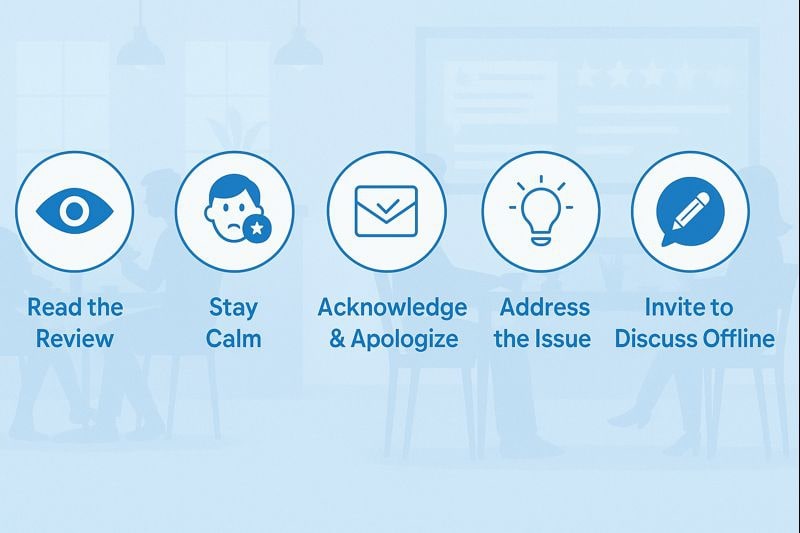
When a harsh review pops up, your first reaction might be emotional—especially if it feels unfair. But the first rule of how to handle negative reviews at your restaurant is to pause and evaluate. Never reply while angry. Take a moment to read the entire review slowly and, if possible, ask a neutral colleague to read it too.
Start by categorizing the review:
- Legitimate service or quality complaint – The guest had a real negative experience (slow service, undercooked food, a rude interaction).
- Misunderstanding or expectation gap – Perhaps they expected full table service at a counter-service concept or didn’t know about a special policy.
- Potentially fake or malicious – No record of their visit, odd details, or clear signs they may be a competitor or someone with a personal issue.
- Red flag issues – Allegations of foodborne illness, discrimination, harassment, or safety hazards. These trigger your highest level of response and documentation.
Compare the review with your records: POS logs, reservation systems, camera footage if appropriate and lawful, and staff accounts. This helps you determine whether the complaint reflects a one-off mistake or a pattern already seen in other negative reviews at your restaurant.
If it’s clearly fake or violates platform policies (hate speech, threats, off-topic remarks), you can flag or report it via Google, Yelp, or other platforms’ reporting tools while still considering a short, professional response for public readers.
For serious allegations, treat the review like a formal complaint: document your findings, consider contacting your insurer or legal advisor, and follow Delaware’s food safety and consumer complaint guidance where relevant.
This calm evaluation step gives you the information needed to decide how to handle negative reviews at your restaurant in a way that is fair to the guest, safe for your business, and credible to the public.
Crafting a professional public response on Google, Yelp, and TripAdvisor
Your public response is the part of how to handle negative reviews at your restaurant that most diners see. You are not just speaking to the reviewer; you’re speaking to every future guest considering a reservation.
Most review platforms and expert guides recommend a similar structure:
- Thank and acknowledge
- “Thank you for taking the time to share this feedback.”
- “Thank you for taking the time to share this feedback.”
- Apologize or empathize (even if you disagree on details)
- “We’re sorry that your experience didn’t match the standards we aim to deliver.”
- “We’re sorry that your experience didn’t match the standards we aim to deliver.”
- Address specifics without oversharing
- Mention the dish, service issue, or incident in general terms, and avoid arguing point-by-point.
- Mention the dish, service issue, or incident in general terms, and avoid arguing point-by-point.
- Explain corrective actions
- Briefly note steps you’re taking: retraining staff, checking recipes, reviewing wait times.
- Briefly note steps you’re taking: retraining staff, checking recipes, reviewing wait times.
- Invite offline contact
- Provide a manager email or phone number for further discussion or resolution.
Keep the tone calm, professional, and human. Avoid copy-pasting identical replies to every complaint; Google and Yelp users can spot generic responses, and platforms emphasize authenticity and personalization in their guidelines.
Personalized responses show that how you handle negative reviews at your restaurant is rooted in genuine care, not just reputation management.
Be careful not to share private details about the guest or argue publicly over who is “right.” Even if a review feels unfair, the goal is to look reasonable and solution-oriented to everyone reading. A well-crafted answer can make even a one-star review work in your favor by demonstrating responsible leadership and respect for diners.
When and how to take the conversation offline
A key part of how to handle negative reviews at your restaurant is knowing when to switch from public conversation to private discussion. Public replies show accountability, but complex situations are best resolved offline where both sides can speak freely.
If the complaint includes sensitive information—health concerns, staff behavior, or personal conflicts—acknowledge it briefly in your public response and then invite the guest to contact you directly. For example:
“We’re concerned to hear about what you described and would like to learn more. Please contact our general manager at [email/phone] so we can discuss this in detail and work toward a resolution.”
Once the guest reaches out, listen actively, ask clarifying questions, and avoid defensiveness. Offer a concrete resolution that matches the seriousness of the issue: refund, replacement meal, or a thoughtful invitation to return.
Document the conversation and any commitments made. This offline process is where some of the most powerful wins happen—guests who feel truly heard often update their reviews, turning one-star complaints into three- or four-star stories about how well you handled the issue.
However, you must balance openness with boundaries. If a guest becomes abusive, demands unreasonable compensation, or repeatedly threatens bad reviews, you can calmly end the discussion while still honoring your obligations.
Clearly documenting your efforts is part of how you responsibly handle negative reviews at your restaurant. In Delaware, that documentation might be important if the complaint escalates to consumer protection agencies or legal channels.
By moving complex cases offline while keeping your public response professional, you show future diners that you know how to handle negative reviews at your restaurant with maturity and integrity.
Handling Specific Types of Negative Reviews at Your Restaurant
Food quality and safety complaints
Food quality complaints are among the most common negative reviews at your restaurant and often the most emotionally charged. A guest who feels their meal was undercooked, bland, or inconsistent may question your entire kitchen.
When the complaint touches on food safety—undercooked meat, suspected food poisoning, or cross-contamination—the stakes are even higher.
Publicly, your response should be calm and caring. Thank the guest, validate their concern, and avoid dismissing their experience. You can say that food safety and quality are top priorities and that you take every report seriously.
Rather than arguing about whether it was truly food poisoning, invite them to contact you directly so you can gather details and investigate internally. This shows other readers that how you handle negative reviews at your restaurant puts guest safety first.
Privately, follow Delaware’s food safety guidance. If the complaint suggests a possible foodborne illness outbreak—multiple affected guests, similar symptoms—you may need to document the incident fully, review time and temperature logs, and, in serious cases, consult health authorities or your local health inspector.
Keeping detailed records of your investigation demonstrates that you treated the review as a serious food safety signal, not just reputational noise.
Use patterns in food-related negative reviews at your restaurant to identify deeper issues: inconsistent recipes across shifts, inadequate line checks, or vendors whose products vary too much.
When you address these root causes and then occasionally mention process improvements in future marketing (“new quality checks,” “updated recipes”), you turn a weak point into a promise of better standards. That’s a sophisticated way to show you know how to handle negative reviews at your restaurant in a safety-conscious, transparent way.
Service, staff behavior, and wait-time complaints
Complaints about rude servers, inattentive bartenders, or long waits are incredibly visible because they speak to your hospitality culture. These negative reviews at your restaurant often hurt more than food critiques because they imply disrespect.
Your public response should show empathy for how the guest felt, regardless of intent. Phrases like “We’re sorry that our service made you feel rushed/unwelcome” recognize their experience without immediately blaming staff.
Explain that this is not the standard you expect and that you’re addressing it with your team. This shows that how you handle negative reviews at your restaurant includes accountability at the leadership level.
Internally, use these reviews as coaching opportunities—not witch hunts. Sit down with the staff involved, share the review neutrally, and ask for their perspective. Cross-check with other feedback; if multiple negative reviews at your restaurant mention the same server or time slot, you may have an understaffing issue or training gap rather than a single “bad apple.”
Wait-time complaints can sometimes be mitigated by clearer communication. If your restaurant has peak hours with inevitable delays, train hosts and servers to set realistic expectations and provide updates.
Consider small gestures like offering water, bread, or a snack sampler during extended waits. When you respond to reviews, highlight any operational changes you’ve made, such as adjusted staffing or a waitlist app.
By making it clear—both online and in-house—that you take service complaints seriously, you demonstrate that you truly understand how to handle negative reviews at your restaurant in a way that protects morale, improves service, and reassures future guests that you’re listening.
Pricing, value, and “not worth it” comments
Price and value complaints are subtle but important negative reviews at your restaurant. Guests may say portions are too small, cocktails are overpriced, or the overall experience “wasn’t worth the money.” Even if your pricing is carefully calculated, perception is reality.
In your public responses, avoid sounding defensive about your prices. Instead, acknowledge that you’re sorry they left feeling the experience did not match their expectations.
Briefly highlight what goes into your pricing—fresh ingredients, local sourcing, staff wages, or scratch cooking—without lecturing. The goal of how you handle negative reviews at your restaurant here is to show that value is about more than just price, and that you care when guests don’t feel they received that value.
Behind the scenes, track how often “pricey,” “expensive,” or “overpriced” shows up in negative reviews at your restaurant. If these comments increase, compare your menu with similar concepts in your area.
You might discover that a few highly visible items (e.g., a signature steak or seafood dish) create sticker shock, even if the rest of the menu is reasonable. Adjusting those headliners or improving how they’re described can shift perceived value.
You can also enhance value perception through presentation and experience: better plating, stronger hospitality touches, or inclusive extras (like complimentary bread or a treat with the check).
When these efforts show up in later reviews, it proves that how you handle negative reviews at your restaurant includes listening to guests on value—not just taste. Over time, that reputation for fairness and transparency can help you maintain pricing power while keeping loyal guests happy.
Fake, malicious, or unreasonable reviews
Not all negative reviews at your restaurant are fair. Sometimes you’ll face posts from people who were never there, competitors pretending to be guests, or individuals making unreasonable or abusive claims. How you handle these can protect your reputation while staying within platform rules.
First, evaluate whether the review violates Google, Yelp, or TripAdvisor content policies—such as hate speech, threats, off-topic comments, or clear conflicts of interest. Most platforms allow you to flag or report such reviews for investigation.
When reporting, provide concise evidence (e.g., no record in your reservation or POS system) rather than long arguments.
Even when you flag a review, consider leaving a short public response. Something like, “We’re unable to find a record of your visit based on the details provided, but we take all feedback seriously.
Please contact us at [email] so we can look into this further,” signals to other diners that you have standards and a process for addressing complaints. This measured approach is central to how to handle negative reviews at your restaurant when they appear questionable.
Avoid engaging in public fights or accusing the reviewer of lying; that often looks worse than the original comment. Also avoid offering compensation to obviously fake reviewers—it can encourage copycats.
If you observe a coordinated attack (multiple similar negative reviews at your restaurant in a short time), document everything, contact the platform’s support channels, and consider seeking legal advice if defamation or extortion is involved.
By combining calm public replies with smart use of reporting tools and documentation, you show that how you handle negative reviews at your restaurant defends your team and brand without undermining trust in genuine feedback.
Turning Negative Reviews at Your Restaurant into Operational Improvements
Using reviews as a free audit of your restaurant
One of the most underrated aspects of how to handle negative reviews at your restaurant is treating them as a free, ongoing audit. Every complaint is a data point telling you where the guest experience is breaking down. Instead of only reacting emotionally, create a structured way to analyze review content.
Aggregate reviews from Google, Yelp, TripAdvisor, and delivery platforms and tag them by theme: food quality, temperature, wait time, staff friendliness, cleanliness, parking, noise level, and so on.
Over a few months, you’ll often see patterns. Maybe multiple negative reviews at your restaurant mention slow brunch service, inconsistent seasoning at dinner, or confusion about your reservation policy. Those patterns are clues for where to focus your energy.
Once you identify recurring issues, prioritize them based on impact. A minor complaint about décor is less urgent than consistent comments about undercooked chicken or long waits.
Use team meetings to share anonymized excerpts and ask staff for ideas. When staff help interpret negative reviews at your restaurant, they become partners in solutions rather than feeling attacked.
You can also track whether operational changes reduce complaints. For example, after adjusting kitchen staffing or re-training hosts, monitor the next few months of reviews to see if related negative reviews at your restaurant drop.
This feedback loop transforms criticism into continuous improvement and shows your team that guest voices truly shape how the restaurant evolves.
Closing the loop: training, SOP updates, and follow-up with guests
It’s not enough to say you’re “looking into it.” A sophisticated approach to how to handle negative reviews at your restaurant includes closing the loop—internally with your team and externally with guests where possible.
Internally, codify improvements into training and standard operating procedures (SOPs). If negative reviews at your restaurant frequently mention inconsistent greetings at the door, update your host script and train all hosts on a standard welcome.
If people complain about slow drink service, redesign your bar workflow or schedule an additional bartender for peak times. Document these changes so new hires automatically learn the improved process.
Externally, when a guest who left a negative review at your restaurant returns or contacts you again, reference the improvements you’ve made. For example: “Based on your feedback and others, we’ve updated our reservation system and added another server on weekends.
We’d love for you to see the difference.” If they do return and have a better experience, many guests will voluntarily update their review or share a new, positive one.
You can also share “we listened” moments in your marketing: social posts or email updates that mention you have added new training, updated menu items, or improved seating layout because of guest feedback.
This reinforces the idea that how you handle negative reviews at your restaurant is proactive, humble, and guest-centered. Over time, that reputation may reduce the emotional sting of an occasional bad review because both staff and regulars know that your restaurant listens and evolves.
Building a Review-Positive Reputation in Delaware
Encouraging happy guests to leave honest reviews
An essential part of how to handle negative reviews at your restaurant is balancing them with a steady flow of positive reviews. If you only get reviews when something goes wrong, your online reputation will always look worse than reality.
Make it easy and natural for satisfied guests to share their experiences. Train servers to recognize happy tables—guests who compliment the food, ask about your story, or appear particularly enthusiastic.
At the end of the meal, have staff say something like, “We’re so glad you enjoyed everything. If you have a moment to leave us a review on Google or Yelp, it really helps small local restaurants like ours.” This light, non-pushy task can significantly increase reviews.
You can also add QR codes on receipts or table tents that link directly to your Google Business Profile or preferred review platforms.
Just avoid offering incentives like discounts in exchange for reviews, as this can violate platform policies and newer Google review rules that emphasize authentic, unbiased feedback. Make it clear you welcome honest reviews, not just glowing ones.
When positive reviews come in, respond to them with the same energy you bring to negative reviews at your restaurant. Thank guests personally, mention specific details they praised, and invite them back.
Platforms and experts recommend replying to all reviews (not just the bad ones) to boost trust and local search performance. This holistic approach proves that how you handle negative reviews at your restaurant is part of a broader commitment to feedback—not just firefighting.
Local partnerships, community presence, and PR recovery
In a relatively close-knit community like many parts of Delaware, word of mouth and community presence are powerful tools for balancing negative reviews at your restaurant. Local guests often give more grace to restaurants they see contributing positively to the neighborhood.
Look for ways to show up beyond your dining room: sponsor youth sports teams, host charity nights, participate in local food festivals, or collaborate with nearby farms, breweries, or wineries.
These activities generate organic goodwill and often lead to social media posts and local news coverage that outrank or counterbalance occasional negative reviews at your restaurant.
If a particularly harsh or viral review hurts your reputation, consider a gentle PR recovery strategy. This might include a transparent social media post acknowledging the concern, outlining specific improvements, or even inviting guests to give you another chance during a limited-time “We Listened” event featuring updated dishes or service enhancements.
Approach this carefully and sincerely; the goal is not to argue with the reviewer but to show the wider community that how you handle negative reviews at your restaurant includes honest reflection and real change.
Engage with local influencers and food writers who genuinely like your restaurant. Don’t ask them to “fix” negative reviews, but do invite them to experience any improvements you’ve made. Their independent coverage can help tell a more balanced story.
Over time, a strong community reputation in Delaware can make single negative reviews at your restaurant seem like outliers rather than defining narratives.
Future Trends: The Next 3–5 Years of Managing Negative Reviews at Your Restaurant
AI review filters, fake review detection, and transparency
Looking ahead, how to handle negative reviews at your restaurant will evolve along with technology and policy changes. Platforms like Google and Yelp are already improving their systems to detect fake or incentivized reviews, and recent updates emphasize authentic, experience-based feedback over sheer volume of stars.
Artificial intelligence is being used by platforms to analyze language patterns, identify suspicious activity, and surface more credible reviews to users. That means strategies based on “gaming” reviews—like mass fake positives or coordinated attacks on competitors—are increasingly risky and less effective.
For Delaware restaurants, the safest long-term strategy is to commit to genuine guest experiences and transparent responses. This also strengthens your position when you flag obviously malicious reviews at your restaurant, as platforms are more likely to trust businesses with consistent, professional histories.
On your side, AI tools can help you summarize review trends, generate draft responses matching your tone, and monitor multiple platforms more efficiently. Just remember that regulators and platforms expect businesses to remain ultimately responsible; don’t blindly paste AI-generated responses without checking accuracy and sensitivity.
The human touch—especially in a hospitality context—is still crucial to how you handle negative reviews at your restaurant.
As transparency norms grow, diners will increasingly expect you to share how you use feedback. Restaurants that publicly showcase “before and after” improvements, menu revisions based on reviews, or upgraded training programs will likely stand out.
Over the next few years, this culture of openness will become a competitive advantage, particularly in local markets like Delaware where community trust is central.
Omnichannel feedback: social DMs, delivery apps, and messaging
In the next 3–5 years, negative reviews at your restaurant won’t just appear on Google and Yelp. Guests already leave feedback through Instagram DMs, Facebook comments, TikTok videos, email, and delivery apps like DoorDash or Uber Eats. Managing reputation will require an omnichannel approach.
To stay ahead, incorporate social and messaging feedback into your overall strategy for how to handle negative reviews at your restaurant. Assign someone on your team to regularly check direct messages and comments, and respond with the same professionalism you use on formal review sites.
A guest complaining in a story or reel can sometimes be turned into a loyal advocate if you respond quickly, apologize sincerely, and offer a solution.
Delivery platforms deserve special attention. Many diners now experience your restaurant for the first time through takeout or delivery.
Issues like missing items, cold food, or packaging problems can generate negative reviews at your restaurant that have nothing to do with in-house service. Track these separately and adjust your packaging, order checks, and driver hand-off processes.
In the future, we can expect more integration between these channels: centralized dashboards that show you all feedback in one place and tools to respond directly. Restaurants that invest early in systems and habits for monitoring multiple streams will be better prepared.
This omnichannel readiness will be a key part of how you handle negative reviews at your restaurant, ensuring no complaint falls through the cracks and every guest feels heard, no matter where they speak up.
FAQs
Q.1: How fast should I respond to negative reviews at my restaurant?
Timeliness is critical in how to handle negative reviews at your restaurant. Industry data suggests that many consumers expect a business to respond to online reviews within a few days, and delays can create the impression that you don’t care.
Aim to check major platforms—Google, Yelp, TripAdvisor, and key delivery apps—at least once per day. For especially serious allegations, such as food safety issues or discrimination claims, try to respond even faster.
A quick, respectful acknowledgement like “We’ve just seen your review and are looking into this immediately” shows urgency even if you need more time to investigate.
However, speed should never come at the cost of thoughtfulness. Part of how to handle negative reviews at your restaurant is taking a moment to review internal records, talk to staff, and understand what happened before replying.
If you’re too reactive, you may write something you regret or contradict later. Strive for a balance: fast acknowledgment, followed by a well-considered full response, often within 24–72 hours.
Over time, consistent timely replies signal to both guests and platforms that your restaurant is actively managed and responsive, which can help your local online visibility and reputation.
Q.2: Should I ever ignore or delete negative reviews at my restaurant?
Answer: Ignoring negative reviews at your restaurant is almost always a bad idea. Unanswered complaints look like abandoned messes that future guests notice. Even if you can’t fix every issue, a brief, empathetic response shows that you care.
Guides from review platforms and marketing experts stress the importance of replying to both positive and negative reviews to build credibility and trust.
You usually can’t delete reviews yourself, and you shouldn’t try to pressure guests into removal. Instead, understand how to handle negative reviews at your restaurant within each platform’s rules.
You can report reviews that violate content guidelines—such as those containing hate speech, threats, or obvious conflicts of interest—and request that the platform evaluate them.
If a review is harsh but honest, your best approach is to respond constructively, learn from it, and improve operations where appropriate. In some cases, when you handle things well, guests voluntarily update or soften their review later.
That visible transformation can be more powerful than a perfect rating, because it showcases your maturity and commitment to guests. This is why a thoughtful response strategy is at the heart of how to handle negative reviews at your restaurant.
Q.3: How much should I offer (refunds, gift cards, free meals) when handling negative reviews at my restaurant?
Answer: Compensation is a tool, not a default answer, in how to handle negative reviews at your restaurant. Offering something is often appropriate when the guest clearly didn’t receive what they paid for—like severely delayed food, a wrong order never corrected, or an obviously undercooked dish.
In those cases, a partial or full refund, replacement meal, or a sincere invitation to return with a complimentary item can rebuild trust.
However, avoid turning compensation into your only move. If guests learn from reviews that complaining guarantees freebies, you may unintentionally encourage more negative reviews at your restaurant, including insincere ones.
Instead, focus first on empathy, explanation, and operational fixes. Only then decide what gesture matches the situation.
Consider setting internal guidelines: minor inconveniences might merit a small discount or dessert; major failures may justify a full refund or comped future visit. Document these guidelines so staff are consistent and feel supported.
In Delaware, remember that compensation does not replace your obligation to properly investigate serious complaints, especially those related to safety or potential consumer protection issues.
The key is to make any offer feel like a genuine attempt to make things right, not a bribe to change reviews. When done thoughtfully, this approach strengthens how you handle negative reviews at your restaurant without undermining your brand.
Q.4: What if the guest is clearly wrong or exaggerating in their negative review?
Answer: It’s frustrating when negative reviews at your restaurant misrepresent what actually happened. However, how you handle negative reviews at your restaurant in these moments says a lot about your professionalism. Public arguments rarely end well. Instead, stay calm, correct gently if necessary, and focus on empathy.
For example, you might say, “We’re sorry that our policy came as a surprise and that it affected your experience. We try to communicate our reservation and seating guidelines clearly, and we appreciate your feedback as we work to improve that.”
If an important factual error must be corrected—for instance, a guest claiming you served a dish you don’t carry—do so in a neutral tone: “We don’t serve [item], but we’d be happy to talk more to understand what happened.”
Internally, review the incident to confirm your understanding and see if communication gaps contributed to the misunderstanding. Even if you believe the guest exaggerated, there may still be something to learn about clarity, signage, or staff scripting.
Ultimately, the audience for your response is not just the reviewer; it’s every future guest reading your page. When your replies to even unfair negative reviews at your restaurant stay composed, respectful, and solution-oriented, readers will often side with you—even if the star rating stays low. That’s a powerful outcome of mastering how to handle negative reviews at your restaurant.
Q.5: Do I need a special strategy for Delaware when handling negative reviews at my restaurant?
Answer: Yes, local context matters. While the core principles of how to handle negative reviews at your restaurant are universal, Delaware’s regulatory and community environment adds some specific considerations.
Delaware has clear mechanisms for consumer complaints and a dedicated Consumer Protection Unit that can mediate disputes between consumers and businesses.
Knowing this, it’s wise to create easy internal pathways for guests to escalate serious concerns to you before they consider involving state resources. Clear contact information, a published complaint process, and visible efforts to resolve issues show good faith.
Food safety oversight through the Office of Food Protection and related agencies means that complaints about illness or unsafe practices should trigger well-documented internal reviews and, when warranted, contact with relevant authorities.
This is an integral part of how to handle negative reviews at your restaurant when they involve potential health risks.
Finally, Delaware’s relatively tight-knit communities mean that reputation spreads quickly offline as well as online. Partnering with local organizations, maintaining a visible community presence, and communicating transparently about improvements based on feedback can all help mitigate the impact of negative reviews at your restaurant.
A strong local brand can make occasional bad reviews seem like isolated incidents rather than defining traits.
Conclusion
In today’s review-driven dining world, knowing how to handle negative reviews at your restaurant is as essential as your recipes and service standards. For restaurants in Delaware, where community ties and state regulations both matter, your approach must blend hospitality, legal awareness, and modern digital savvy.
The path is clear: prepare before reviews appear by building a feedback-friendly culture and a written response playbook. When negative reviews at your restaurant do arrive, evaluate them calmly, respond publicly with empathy and professionalism, and move complex cases offline for deeper resolution.
Distinguish between honest criticism and malicious or fake comments, using platform tools and careful documentation where necessary.
Most importantly, treat every review—especially the bad ones—as a chance to improve. Use them as data to refine your menu, training, and operations. Balance criticism by actively encouraging happy guests to share genuine reviews, and reinforce your reputation with visible community involvement around Delaware.
Stay aware of evolving platform policies and emerging tools, including AI-powered analytics, so that how you handle negative reviews at your restaurant stays aligned with future trends.
Handled well, negative reviews at your restaurant won’t just be fired to put out. They’ll become a built-in system for quality control, a public display of your professionalism, and a key driver of trust with guests who are deciding right now where to eat next.