How to Apply for a Delaware Resale Certificate (What Delaware Really Issues, and What to Do Instead)
If you’re searching for how to apply for a Delaware resale certificate, you’re not alone. Many business owners assume every state issues a resale certificate (sometimes called a reseller permit, sales tax ID, or sales tax exemption certificate). Delaware is different.
Delaware does not have state or local sales tax, and the Delaware Division of Revenue states that sales tax exemption certificates and reseller certificates are not applicable to Delaware.
It also notes that sales for resale are not exempt under Delaware’s system, because Delaware relies on license and gross receipts taxes rather than sales tax.
So, what does that mean in real life?
- You generally cannot “apply for a Delaware resale certificate” the way you would in many other states.
- Instead, you typically need a Delaware business license and you may use specific Delaware forms (like Form 373) in limited wholesale situations, plus the correct out-of-state resale documentation when buying or selling across state lines.
This guide explains the updated, practical path business owners use when they think they need a Delaware resale certificate—step by step, with compliance tips, edge cases, and what to expect in the future.
Understanding the “Delaware Resale Certificate” Confusion
The phrase Delaware resale certificate is common online, but it’s often based on how sales tax works elsewhere. In many states, a resale certificate lets you buy inventory without paying sales tax because you’ll collect sales tax when you resell it. Delaware’s tax structure doesn’t follow that model.
Delaware’s Division of Revenue explains that there are no state or local sales taxes, and therefore reseller certificates are not applicable. Delaware instead imposes license and gross receipts taxes on sellers and service providers, and it also states that sales for resale are not exempt.
That distinction matters because it changes what you “apply for.”
When people say they want a Delaware resale certificate, they usually mean one of these goals:
- They want to buy inventory tax-free from a vendor located in another state.
- They want proof they’re a legitimate reseller (wholesale pricing, distributor approval, B2B onboarding).
- They need a document to support an exemption in a special Delaware wholesale shipping/pickup scenario.
- They’re registering a Delaware business and assume “resale certificate” is part of the setup.
In Delaware, those goals are solved differently:
- Your key Delaware credential is often a Delaware business license (not a resale number).
- For some wholesale transactions, Delaware provides Form 373 Wholesale Exemption Certificate, which is tied to gross receipts tax handling—not sales tax.
- For purchases in other states, you generally use that other state’s resale certificate rules, not Delaware’s.
If you keep the keyword Delaware resale certificate in mind, the best “application” is really learning which document you actually need for your situation—and collecting it the right way so your vendors accept it and you stay compliant.
What Delaware Actually Requires: Business License + Gross Receipts Tax Basics
Because Delaware doesn’t use sales tax, the state’s business tax compliance revolves around two big concepts: business licensing and gross receipts tax.
Delaware gross receipts tax in plain English
Delaware imposes a gross receipts tax on the seller of goods or services in the state, not the consumer. The Division of Revenue explains gross receipts tax is based on total receipts from goods sold and services rendered in Delaware, and there are no deductions for costs like labor, materials, delivery, or other expenses.
It also states gross receipts tax rates range from 0.0945% to 1.9914% (with a variable petroleum products rate that can be higher), and filing frequency can be monthly or quarterly depending on the business. New businesses are generally set up as quarterly filers.
Why this matters for the Delaware resale certificate issue
In many sales-tax states, “resale” means “sales tax exemption at purchase.” In Delaware, there is no sales tax exemption framework for resale, and Delaware explicitly says sales for resale are not exempt.
So the “resale certificate” concept shifts into:
- proving you’re a business (via licensing), and/or
- documenting specific wholesale exemptions under gross receipts tax rules (Form 373), and/or
- using other states’ resale certificates when buying or selling outside Delaware.
If your goal is to operate as a reseller, wholesaler, ecommerce seller, retailer, or distributor, your best next move is typically to register properly and obtain your business license through Delaware’s official registration pathways.
Step-by-Step: The Closest Thing to “Applying” for a Delaware Resale Certificate (Registration & Licensing)
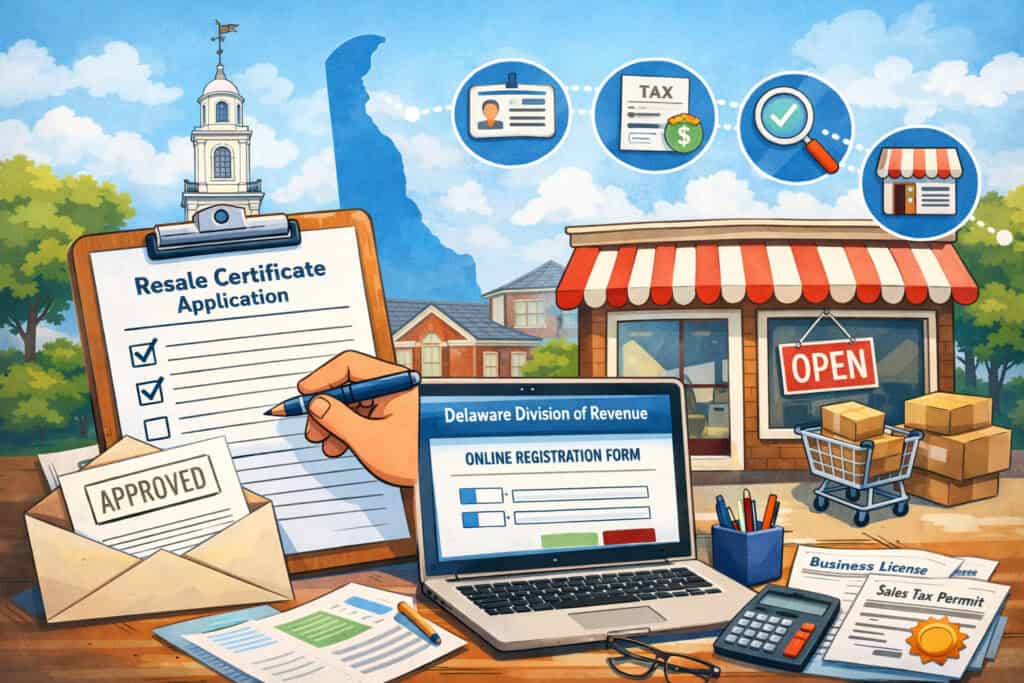
If you’re trying to “apply for a Delaware resale certificate,” the practical equivalent is: register your business and obtain the appropriate Delaware business license(s) so you have official proof of business status and can meet Delaware tax obligations.
Delaware’s Division of Revenue points new businesses to One Stop registration and licensing services.
Step 1: Decide what your business will do (retail, wholesale, services, etc.)
Before you register, be clear about your activities. Delaware tax handling differs depending on whether you’re:
- Retail (selling to end customers)
- Wholesale (selling to other businesses)
- Manufacturing/processing
- Services
- Mixed activities (common for ecommerce, subscription + product bundles, or repair + parts sales)
Why it matters: your activity impacts your licensing classification and how gross receipts tax applies. Delaware notes that if you derive income from more than one type of activity, separate gross receipts reporting may be required.
Step 2: Register using Delaware’s official business registration pathway
For new businesses, the Division of Revenue’s business tax forms page directs you to One Stop Business Registration, Licensing, and Withholding Services.
This process is often what vendors want to see when they ask for a “Delaware resale certificate.” Many wholesalers will accept a copy of your Delaware business license or registration evidence as proof you’re a legitimate business—especially when Delaware doesn’t issue a resale number.
Step 3: Obtain and maintain your Delaware business license
Once you have the appropriate licensing in place, keep digital copies ready:
- for supplier onboarding
- for wholesale account applications
- for marketplace verification
- for payment processor underwriting (common for ecommerce and higher-risk categories)
Even though it’s not called a Delaware resale certificate, this is the document most frequently used as the Delaware-side proof of business status.
Step 4: Set up your Delaware tax accounts and filing habits
Because Delaware uses gross receipts tax, treat compliance like an operational routine:
- track Delaware-sourced revenue accurately
- keep invoices, shipping documents, and exemption documentation organized
- confirm whether you’re a monthly or quarterly filer over time
This is where many businesses get tripped up: they focus on the “Delaware resale certificate” idea and miss the real requirement—ongoing gross receipts compliance.
When You DO Need a Delaware Exemption Document: Form 373 (Wholesale Exemption Certificate)
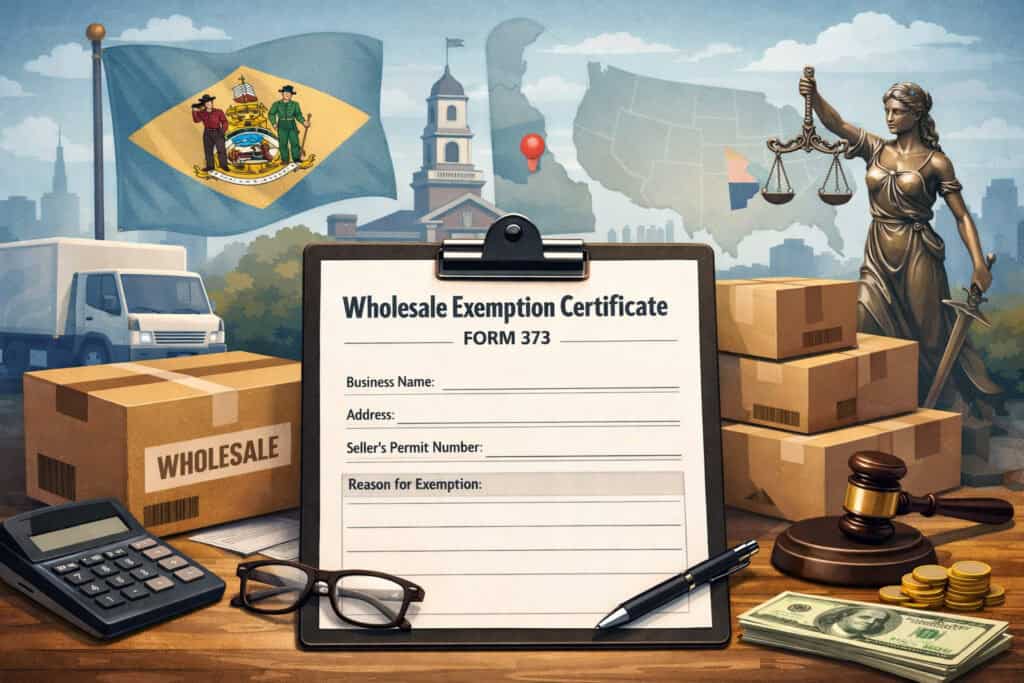
While Delaware does not issue resale certificates, Delaware does provide Form 373 Wholesale Exemption Certificate for a specific scenario that often gets mixed up with resale.
What Form 373 is for
Delaware’s gross receipts tax FAQ explains that a Delaware “Wholesale” business is not liable for gross receipts tax on certain sales when an out-of-state purchaser takes possession in Delaware only if Form 373 is completed prior to or concurrent with the sale.
Form 373 itself states it is used to substantiate exempt sales to out-of-state purchasers which are picked up in Delaware and then delivered/consumed outside Delaware. It includes conditions about the purchaser’s vehicles/employees, inventory warehousing, and whether goods come to rest in Delaware.
Single purchase vs blanket certificate
Form 373 allows:
- Single purchase certificate (tied to an invoice), or
- Blanket certificate for multiple sales to the same purchaser (with rules for keeping it current).
The instructions specify that a blanket certificate can substantiate multiple exempt sales if the seller maintains a duly executed certificate dated within one year prior to the sale, and each invoice should note that an exemption is being claimed.
What records to keep (this is what auditors care about)
Form 373 instructions are very clear about documentation:
- complete the form before or at the time of sale
- maintain lists of exemption certificates
- make sure invoices reference the exemption claim
- retain forms for three years from the end of the calendar year in which the sale occurs
If you’re a wholesaler and your customer pickup/shipping patterns fall into this scenario, Form 373 becomes the closest thing Delaware has to an “exemption certificate” related to resale activity.
Important: Form 373 is not a general Delaware resale certificate. It’s a targeted document for a narrow wholesale exemption situation tied to Delaware gross receipts tax rules.
Buying Inventory From Other States: How to Handle Resale Certificates Without a Delaware Resale Number
A huge share of “Delaware resale certificate” searches come from business owners trying to buy inventory from an out-of-state vendor without paying sales tax at checkout.
Here’s the key reality: when you buy from a vendor in another state, that state’s sales tax rules control the resale exemption. Because Delaware does not issue reseller certificates, some vendors can’t “validate” a Delaware resale number—because it doesn’t exist.
Practical options vendors commonly accept
Depending on the vendor and state involved, you may use:
- a resale certificate from a state where you are registered (if you have nexus/registration there)
- the vendor’s acceptable alternative documentation policy (often a business license + reseller affidavit)
- state-specific reciprocal rules (some states may accept alternate proofs)
Many compliance providers publish guidance on resale certificate verification across states, which highlights that verification and rules vary widely by state and document type.
Why vendors may still charge tax
Even if you are a reseller, a vendor may charge sales tax if:
- you cannot provide the correct resale documentation for that state
- the state doesn’t accept your form of proof
- the vendor’s system requires a specific format or state ID
If you regularly purchase inventory from one or two specific states, it can be worth formally registering in those states (when required) so you can issue that state’s resale certificate properly.
This is especially true for ecommerce businesses that also sell into many states and may trigger economic nexus thresholds over time.
How this ties back to the Delaware resale certificate keyword
In practice, the “Delaware resale certificate” problem is really a multistate documentation problem. Delaware gives you business licensing and specific gross receipts exemption tools, but sales tax resale exemptions are handled by the states that impose sales tax, not by Delaware.
Compliance Checklist: Using Delaware Documentation Correctly (and Avoiding Expensive Mistakes)
Whether you’re a retailer, wholesaler, or ecommerce seller, the fastest way to get into trouble isn’t “forgetting to apply for a Delaware resale certificate.” It’s misusing documents, failing to keep records, or misunderstanding which tax applies.
Here’s a practical compliance checklist aligned with Delaware’s official guidance:
1) Don’t claim a general Delaware resale exemption
Delaware explicitly states reseller certificates are not applicable and “sales for resale are not exempt.”
So avoid creating your own “Delaware resale certificate template” and presenting it as a state-issued exemption document. Vendors may accept internal forms for their own records, but it’s not a Delaware-issued resale certificate.
2) Treat gross receipts tax as an operational tax, not a one-time setup step
Delaware explains gross receipts tax is on total receipts and allows no deductions for cost of goods sold and similar expenses. That means your pricing, margins, and bookkeeping should account for it.
3) If you use Form 373, follow the timing and retention rules
Form 373 must be completed before or at the time of sale, and vendors must retain it (and supporting records) for the specified period. A common mistake is “backdating” documentation after the fact—this is exactly what auditors scrutinize.
4) Keep shipping and delivery proof for out-of-state shipment claims
Delaware’s gross receipts tax FAQ notes that retail/wholesale sellers may not owe gross receipts tax on goods shipped directly to customers outside Delaware, but must keep documentation of interstate shipment.
So keep:
- carrier labels
- bills of lading
- tracking confirmations
- customer invoices showing ship-to addresses
5) Match each transaction type to the correct document
- Wholesale pickup by out-of-state purchaser in Delaware (exempt scenario): Form 373
- Out-of-state buying for resale: that other state’s resale certificate rules
- Proof of Delaware business legitimacy: Delaware business license / registration
This “document matching” mindset is what keeps your Delaware resale certificate strategy accurate and audit-resistant.
Future Prediction: Where “Delaware Resale Certificate” Requirements Are Headed
Even though Delaware doesn’t issue resale certificates, the ecosystem around the keyword Delaware resale certificate is likely to evolve because commerce keeps getting more digital and cross-border.
Here are realistic trends to watch:
1) More digital-first compliance portals and electronic documentation
Delaware already mandates online filing in several areas and continues to expand online tax systems and portals for business interactions.
Over time, businesses should expect:
- more automated validations
- increased use of electronic records during audits
- tighter matching of invoices to exemption documentation (like Form 373)
2) Vendors will keep tightening onboarding rules
Wholesalers and distributors increasingly require structured documentation because they face audit risk in sales-tax states. Since Delaware doesn’t issue a resale number, vendors may:
- request a Delaware business license plus a signed reseller statement
- require you to register in the vendor’s state if you frequently purchase there
- deny resale exemptions without a state-issued resale ID (common in strict states)
3) Multistate nexus rules will matter more than Delaware’s internal rules for many ecommerce businesses
If you sell online, your compliance burden is often driven by where your customers are. That can lead to registrations in multiple states with sales tax, and those registrations come with resale certificate capabilities in those states.
So while Delaware itself may not create a “Delaware resale certificate,” the need for resale documentation will expand around Delaware businesses that operate nationally.
FAQs
Q.1: Is there an official Delaware resale certificate I can apply for?
Answer: Delaware’s Division of Revenue states that because Delaware has no state or local sales taxes, sales tax exemption certificates and reseller certificates are not applicable to Delaware. So there isn’t a standard Delaware-issued resale certificate in the way many other states provide one.
Q.2: Then why do people talk about a Delaware resale certificate?
Answer: Because “resale certificate” is the common term across many states. Business owners use Delaware resale certificates as shorthand for “the document I need to buy inventory for resale” or “proof I’m a reseller.” In Delaware, those needs are usually handled through business licensing and (in special cases) Form 373 for wholesale exemptions.
Q.3: What document should I give a wholesaler who asks for my Delaware resale certificate?
Answer: In many cases, you’ll provide:
- your Delaware business license / registration proof, and
- any vendor-required reseller statement or application.
If the wholesaler is in another state and is trying to remove sales tax on your purchase, you may need to comply with that state’s resale certificate rules, which may require you to be registered there.
Q.4: What is Delaware Form 373 and when do I use it?
Answer: Form 373 is the Wholesale Exemption Certificate used to substantiate certain exempt wholesale sales to out-of-state purchasers who pick up goods in Delaware for delivery/consumption outside Delaware. It must be completed prior to or concurrent with the sale and has detailed documentation rules.
Q.5: Do I owe Delaware gross receipts tax if I ship goods to customers outside Delaware?
Answer: Delaware’s gross receipts tax FAQ indicates you generally do not have to pay gross receipts tax on goods shipped by you directly to your customer outside Delaware, but you must keep documentation of interstate shipment. (Always match your fact pattern to current guidance and maintain strong records.)
Q.6: How do I register my business properly in Delaware if I’m starting from scratch?
Answer: Delaware’s Division of Revenue directs new businesses to register online via One Stop Business Registration, Licensing, and Withholding Services. That registration and licensing process is usually the correct starting point for anyone searching for “how to apply for a Delaware resale certificate.”
Conclusion
If you came here wanting to know how to apply for a Delaware resale certificate, the most important update is this:
Delaware does not issue a general resale certificate because Delaware does not impose a state or local sales tax. Delaware’s Division of Revenue states reseller certificates are not applicable and that sales for resale are not exempt under Delaware’s system.
What you should do instead depends on your goal:
- If you need proof you’re a reseller: obtain and maintain your Delaware business license and keep your registration records organized.
- If you’re handling a specific wholesale exemption scenario involving out-of-state purchasers picking up goods in Delaware: use Form 373 Wholesale Exemption Certificate correctly and keep records.
- If you’re buying inventory from a vendor located in a sales-tax state: follow that state’s resale certificate rules, which may require separate registration.
That’s the accurate, compliant, and vendor-friendly way to handle the Delaware resale certificate issue today—and it’s the approach most likely to protect your business as documentation and digital verification standards continue to tighten.