
Delaware Return Policy Rules: What Retailers Should Know
Returns are where customer trust, profitability, and compliance collide. In Delaware, retailers have flexibility to design return policies that fit their inventory, margins, and fraud risk—but that flexibility comes with responsibility.
If you advertise “easy returns” and then make the process confusing, or if you hide important limits (like restocking fees, short timelines, or “final sale” exclusions), you can create legal exposure and customer complaints fast.
A strong policy does more than reduce disputes. It helps staff make consistent decisions, protects your brand during peak seasons, and limits losses from return fraud. It also clarifies what happens when products are defective, misrepresented, delayed, or delivered damaged.
In other words: the best Delaware return policy rules aren’t just about “yes or no.” They’re about clear disclosures, consistent processes, and a documented path to resolution.
This guide focuses on Delaware return policy rules retailers should know—how state consumer protection standards intersect with warranties, receipts, online sales rules, shipping delays, and gift card requirements.
You’ll also see practical language options, operational tips, and forward-looking predictions so your policy can stay resilient as retail keeps changing.
Delaware’s legal framework for return policies

Delaware does not have a single “one-size-fits-all” statute that forces retailers to accept returns for buyer’s remorse. Instead, Delaware return policy rules are shaped by general consumer protection principles and contract/warranty rules—meaning what you promise, what you disclose, and whether the product is defective or misrepresented matter a lot.
A key foundation is the Delaware Consumer Fraud Act, which makes it unlawful to use deception, misrepresentation, unfair practices, or the omission of material facts in connection with selling or advertising merchandise. That broad standard is why retailers should treat return policy terms as “material facts” that must be accurate and not misleading.
Another foundational layer is Delaware’s adoption of the Uniform Commercial Code (UCC) for sales of goods, including the implied warranty of merchantability unless properly excluded or modified. If goods aren’t fit for ordinary use, “no returns” language may not protect you the way you think it does—especially if the issue is a true defect.
Why “disclosure” is the real compliance trigger
In practice, the biggest risk for retailers isn’t having a strict return policy—it’s having an unclear one. If a customer can reasonably claim they weren’t informed of key terms (like “store credit only,” “7 days only,” “final sale,” or “restocking fee applies”), your policy becomes harder to enforce consistently, and disputes escalate.
Under Delaware’s consumer fraud framework, a hidden or confusing policy can be argued as an “omission of material fact” or an unfair practice when the policy was relevant to the purchase decision.
That’s why the most defensible Delaware return policy rules look like this:
- posted where shoppers actually decide (product page, shelf tag, register area),
- repeated where shoppers commit (checkout screen, receipt, confirmation email),
- written in plain language,
- enforced consistently (with documented exceptions for defects).
When you treat disclosure as the compliance trigger, your policy becomes both customer-friendly and legally sturdier.
Returns you can deny vs. returns you should not deny
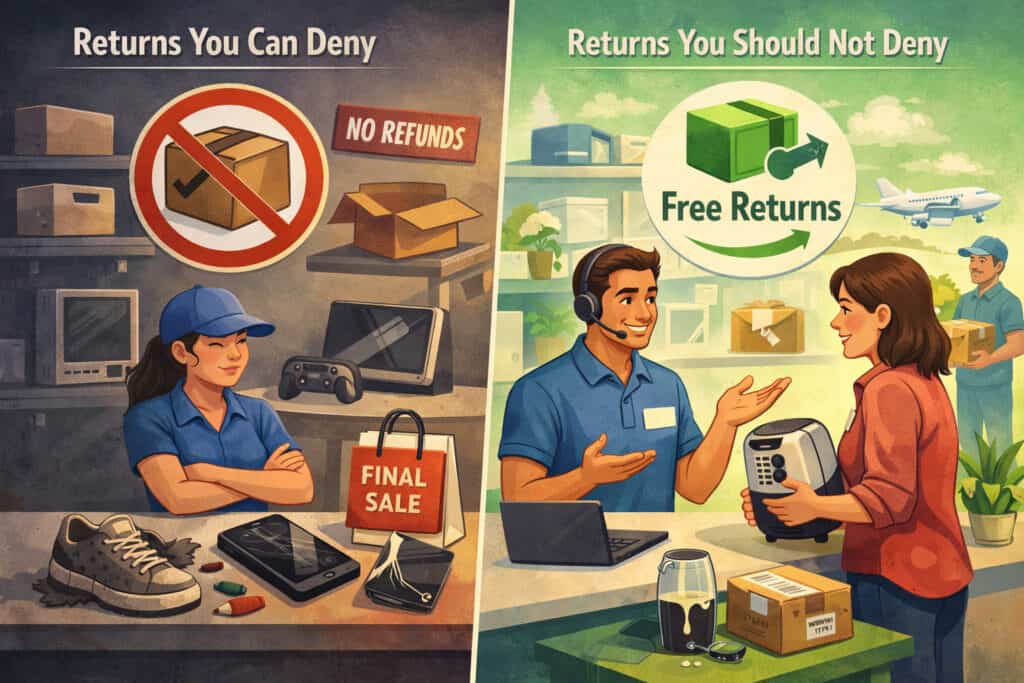
Retailers in Delaware generally can deny returns for buyer’s remorse if the policy is clear. But Delaware return policy rules become stricter when the issue is defect, damage, misrepresentation, or failure to deliver what was promised.
If a product is defective, a customer’s complaint often shifts from “return policy” into “warranty/contract performance.” Delaware’s UCC implied warranty of merchantability—unless properly disclaimed—supports the expectation that goods will work for ordinary purposes.
Separately, if an advertisement or salesperson statement created a false impression—“washable,” “genuine leather,” “works with X,” “includes subscription,” “new in box”—and that turns out untrue, Delaware’s consumer fraud standards can come into play.
So the smart approach is to categorize returns into two lanes:
- Lane A: Policy-based returns (buyer’s remorse): You control the timeline, condition requirements, restocking fees, exclusions, and refund method—so long as disclosed.
- Lane B: Problem-based returns (defect/misrepresentation/non-delivery): You should prioritize resolution: repair, replacement, refund, or other remedy consistent with warranties and what was promised.
Delaware return policy rules don’t require you to “take everything back,” but they do reward retailers who resolve genuine product problems quickly and transparently.
“Final sale” is not a magic shield
Many retailers use “final sale” to reduce return volume, especially for clearance, intimate apparel, special orders, or open-box items. “Final sale” can be valid—if it’s disclosed clearly before purchase and not contradicted by your marketing.
However, “final sale” is not a universal defense if the item is materially defective or materially not as described. If you sold something as functional and it’s not, the dispute may not be about returns—it may be about product performance and truth in selling under Delaware’s consumer protection standards and sales law concepts.
Best practice under Delaware return policy rules:
- Use “final sale” for change-of-mind returns.
- Build a separate “defective item resolution” path that still protects you (inspection, documented defect, exchange-first options).
- Train staff to avoid blanket statements like “we never refund anything,” which can inflame disputes when the real issue is a defect.
Drafting a compliant Delaware return policy that customers understand

A return policy is only as good as how customers interpret it at checkout. The best Delaware return policy rules are written so a customer can answer four questions instantly:
- How long do I have?
- What condition must it be in?
- What do I get back—refund, store credit, exchange?
- Are there fees or exclusions?
Because Delaware’s consumer fraud standard focuses on deceptive or unfair practices, clarity and consistency are your strongest defenses.
To keep it readable and search-friendly, write in short paragraphs, avoid legal jargon, and use scannable formatting:
- “Return Window: 30 days from purchase”
- “Proof of Purchase: receipt, email order confirmation, or account lookup”
- “Refund Method: original payment method where possible”
- “Exclusions: final sale items, gift cards, custom orders, perishables”
- “Condition: unused, with tags/packaging (when applicable)”
- “Fees: restocking fee applies only to opened electronics (if you choose this)”
The operational win is consistency. When your staff can apply Delaware return policy rules in a repeatable way, you reduce chargebacks, online disputes, and “manager exceptions” that train customers to argue.
Where and how to disclose your policy (store, receipt, and online)
If you want your Delaware return policy rules to hold up under real-world scrutiny, disclosure must match the shopping journey.
For in-store sales, post your key terms:
- at the register,
- near customer service,
- and on signage for categories with special rules (clearance, open-box, hygiene items).
For e-commerce, publish your policy in multiple layers:
- product page (especially for exclusions like final sale),
- cart/checkout link,
- order confirmation email,
- returns a portal.
And for delivery-based sales, align with federal shipping-delay rules: if you can’t ship when promised, you must handle delays and refunds properly under the Mail, Internet, or Telephone Order Merchandise Rule. That rule requires sellers who can’t ship on time to seek consent to delay or provide a refund for unshipped items.
Even if Delaware return policy rules are your focus, online retail compliance is often won or lost at checkout and post-purchase messaging.
Restocking fees, store credit, and “original payment method” refunds

Retailers ask the same question constantly: “Can we charge a restocking fee?” In Delaware, you can often set these terms for buyer’s remorse returns—if they’re disclosed clearly and applied consistently. The biggest compliance risk is a fee that feels “hidden,” surprising, or selectively applied.
Delaware return policy rules work best when your policy answers:
- When the fee applies (opened electronics, large appliances, special packaging),
- How much it is (flat fee or percentage),
- When it does not apply (defect, wrong item shipped, damage on arrival).
If a customer returns something because it’s defective or not as described, charging a restocking fee can backfire. That’s because the dispute can move into warranty/performance territory where fairness and truthful dealing become the spotlight.
Delaware’s consumer fraud standard and UCC concepts reinforce why defect-related returns should be treated differently than buyer’s remorse.
Store credit policies should also be plain:
- expiration (if any),
- how credit is issued (physical card, digital credit),
- whether credit can be combined with promotions,
- what happens if the customer loses it.
The more precise your Delaware return policy rules are, the fewer “policy interpretations” your front line has to improvise.
Exchanges: the most customer-friendly middle ground
Exchanges often reduce refund leakage while preserving goodwill. A well-designed exchange approach can be the “default resolution” for many returns:
- size/color swaps,
- replacement for damaged packaging,
- exchange for equal value within a set window.
If you prefer exchanges over refunds, say it clearly—and don’t market “hassle-free refunds” if you don’t deliver them. Under Delaware consumer fraud principles, marketing claims must match reality.
A smart model many Delaware retailers adopt:
- Defect/damage: replacement or refund (customer chooses after verification)
- Buyer’s remorse: exchange or store credit (refund only under certain conditions)
- Special categories: final sale with defect-resolution only
This structure makes Delaware return policy rules feel fair, predictable, and enforceable.
Online orders, shipping delays, and cancellation rights
E-commerce returns are where policy details matter most, because customers shop quickly and rely on what they read (or don’t read). Delaware return policy rules still apply, but you also need to follow federal standards for shipping promises, cancellation processes, and disclosures.
If you sell merchandise online or by phone and cannot ship within the promised time, the federal Mail, Internet, or Telephone Order Merchandise Rule requires you to obtain the buyer’s consent to a delay or refund payment for unshipped items.
This is one of the most important “returns-adjacent” rules for online sellers because failure here creates complaints, chargebacks, and regulatory risk.
Another major cancellation concept is the “Cooling-Off Rule” for certain door-to-door and off-premises sales, which gives a three-business-day right to cancel in covered situations. If your business does pop-up sales, events, or in-home demos, you should know when that rule applies.
Even if you focus on Delaware return policy rules, customers don’t separate “return,” “refund,” and “cancel” the way legal frameworks do. Your policy should explain:
- order cancellation window (before shipping),
- refusal of delivery process,
- who pays return shipping,
- how long refunds take after receipt/inspection,
- how you handle partial shipments.
This prevents confusion that can trigger disputes and negative reviews.
Returns portals and “friction” as a future risk
Retail is trending toward return portals that charge small fees for mail returns, offer incentives for store drop-off, or steer customers toward exchanges. That strategy can work, but it must be disclosed clearly and implemented fairly.
A forward-looking Delaware return policy rules prediction: expect stronger national expectations around transparent fees and checkout disclosures, especially as regulators focus more on hidden costs and confusing terms.
The broader push for price transparency at the federal level signals that “surprise fees” and buried terms (including return costs) may face greater scrutiny over time.
So if you add a “mail return fee” or “return shipping deduction,” disclose it prominently before purchase, not after.
Gift cards, store credit, and Delaware-specific requirements
Gift cards sit in a special category because they function like stored value and often become part of return workflows (“We’ll issue store credit on a gift card”). Delaware has addressed gift cards and gift certificates directly, including rules tied to expiration dates and fees in specific contexts.
From a returns perspective, this matters because a policy that automatically converts refunds into store credit via gift card must be careful about:
- whether the credit expires,
- whether inactivity fees are charged,
- whether the terms are communicated to the recipient or purchaser.
Your Delaware return policy rules should also specify:
- whether gift cards are refundable (many retailers state “gift cards are non-refundable”),
- how returns are handled when the original purchase was made with a gift card,
- whether promotional gift cards are treated differently than purchased gift cards.
Operationally, document your gift card issuance:
- link credits to the original receipt,
- record issuance date and amount,
- store card identifier for fraud prevention.
Gift-card-related disputes often overlap with fraud, so clarity protects both you and honest customers.
Store credit wording that reduces friction
If your preferred remedy is store credit for buyer’s remorse returns, don’t hide it in fine print. Use direct language customers understand:
- “Returns are eligible for store credit within 30 days with receipt.”
- “Refunds to the original payment method are available only for unused items returned within 7 days.”
Delaware return policy rules become easier to defend when your policy states the “what” and “why” without sounding punitive:
- “We price competitively year-round, so we offer store credit on most returns to keep costs low for customers.”
Clear, human language reduces escalations and helps your staff enforce the same standard every time.
Handling disputes, complaints, and small claims in Delaware
Even with strong Delaware return policy rules, disputes happen—especially with expensive items, electronics, furniture, and online shipping problems. Your goal is to resolve issues before they become chargebacks or formal complaints.
Delaware’s Attorney General Consumer Protection Unit is a common destination for consumer complaints, and retailers should treat any complaint notice as a signal to respond professionally with documentation: receipt, posted policy, communication history, and inspection results.
If a dispute escalates to court, Delaware’s Justice of the Peace Court provides a path for smaller civil claims, with a limit of $25,000 for awards, and it offers guidance on starting a civil action.
From a retailer operations standpoint, the best defense is a “return resolution file” that includes:
- policy version in effect on purchase date,
- proof the customer had access to it (receipt footer, checkout link),
- condition photos at return time,
- staff notes on what was offered (repair, exchange, refund),
- timeline of customer communications.
This turns emotional disputes into document-based outcomes.
Chargebacks: treat them as policy feedback
Chargebacks aren’t only payment problems—they’re often “policy comprehension failures.” If you see repeat disputes about:
- “I didn’t know it was final sale,”
- “They deducted shipping,”
- “They took a restocking fee,” then your Delaware return policy rules may need better disclosure.
Tighten:
- checkout disclosures,
- receipt language,
- confirmation email summary,
- return portal steps.
Retailers who treat chargeback patterns as UX signals usually reduce disputes without becoming more lenient.
Return fraud, abuse, and loss prevention without harming good customers
A modern return policy must balance customer experience with fraud controls. Return fraud can include:
- “wardrobing” (wear and return),
- receipt fraud,
- returning stolen merchandise,
- switching items (different SKU inside the box),
- repeated “item arrived damaged” claims.
Delaware return policy rules allow retailers to set reasonable conditions such as ID checks for no-receipt returns or limiting high-risk return methods—again, the key is disclosure and consistency.
Practical controls that preserve a customer-friendly feel:
- require proof of purchase for refunds to original payment method,
- allow no-receipt returns for store credit only (with ID, limited frequency),
- flag high-frequency returners for manager review,
- serialize high-value items and verify at return,
- photograph returns for high-risk categories.
When you deny a return for suspected fraud, document the reason neutrally:
- “Item serial number does not match receipt”
- “Return exceeds no-receipt limit”
- “Product condition inconsistent with return eligibility”
This keeps Delaware return policy rules enforceable while reducing discriminatory or inconsistent application.
Staff training: the hidden compliance tool
Policies fail at the counter, not on paper. Your staff should be trained on:
- the difference between buyer’s remorse vs defect returns,
- when to offer exchange-first,
- how to escalate exceptions,
- how to explain denials calmly.
Consistency is what makes Delaware return policy rules credible. If one cashier says “we never do refunds” and other refunds instantly, customers learn to argue—and complaints increase.
Future predictions: where return policies are heading in Delaware retail
Return policies are evolving fast due to e-commerce pressure, higher shipping costs, and regulation trends around transparency. While Delaware return policy rules are rooted in broad consumer protection standards, national shifts can influence expectations and enforcement priorities.
Here are realistic forward-looking developments:
- More emphasis on fee transparency: Regulators have been prioritizing clear disclosure of costs and terms in other contexts, suggesting return-related fees and deductions could face stronger expectations for prominence and clarity over time.
- More automated returns—more disclosure risk: AI-driven return portals and “instant credit” systems can reduce labor, but they can also create disputes if the portal’s wording is confusing.
- Higher scrutiny of “dark patterns:” If your checkout pushes customers away from reading return terms or makes the policy hard to find, that can look unfair.
- Greater consumer expectation of “defect fairness:” Even strict retailers often preserve goodwill by being generous on defects and mis-shipments, while being tighter on buyer’s remorse.
A smart future-proofing move: version-control your policy and keep an archive. If a dispute arises months later, you can show exactly what Delaware return policy rules applied at the time of purchase.
Building a policy that survives changes
The most resilient policy structure is modular:
- Core return window rules (buyer’s remorse)
- Defective/damaged/misrepresented product resolution
- Category exclusions (final sale, perishables, custom)
- Online shipping delays and cancellation
- Refund method rules and processing timelines
When laws, platforms, or consumer expectations shift, you update one module—not the entire policy.
FAQs
Q1) Do Delaware retailers have to accept returns for buyer’s remorse?
Answer: In most retail situations, Delaware retailers are not automatically required to accept returns just because a customer changed their mind. That’s why many Delaware return policy rules are set by the merchant, not mandated by a single state “return window” law.
The key is that whatever you choose—cash refunds, exchanges only, store credit only, or final sale—should be clearly disclosed and not misleading.
Where retailers get into trouble is when marketing or staff statements create an expectation that contradicts the written policy. If you advertise “free returns” but your policy quietly deducts shipping, charges a restocking fee, or limits returns to 7 days, customers may argue they were misled.
Delaware’s consumer fraud standards focus on deception, misrepresentation, and omission of material facts in connection with sales or advertising, which is why clear disclosure matters.
Best practice: treat the return policy as part of the sales promise. Put the key terms where customers actually see them before purchase, and train staff to describe the policy accurately.
Q2) If a product is defective, can a “no returns” policy still be enforced?
Answer: A “no returns” policy can reduce buyer’s remorse returns, but it may not fully protect you when the issue is a genuine defect. Delaware sales law includes implied warranty concepts (unless excluded or modified properly), including the implied warranty of merchantability, which supports the expectation that goods will function for ordinary purposes.
This is why many retailers separate Delaware return policy rules into two tracks: (1) discretionary returns for change-of-mind, and (2) defect-resolution processes that offer repair, replacement, or refund after verification.
If you refuse any remedy for a truly defective product, the conflict may shift from “policy” to “product performance” and “truth in selling,” especially if the item was marketed as functional.
A practical approach is to keep your buyer’s remorse policy strict but build a fair defect path:
- require the item and proof of purchase,
- inspect/confirm the defect,
- offer exchange or replacement first (if appropriate),
- refund if replacement isn’t possible.
This reduces abuse while aligning with how disputes are evaluated in real life.
Q3) Can we charge a restocking fee under Delaware return policy rules?
Answer: You can often charge a restocking fee for eligible buyers remorse returns if it is disclosed clearly, applied consistently, and stated upfront (including the amount or percentage and what triggers it).
Restocking fees become risky when they feel like a surprise or when they are applied to returns caused by the retailer (wrong item shipped, defect, shipping damage).
Delaware return policy rules are shaped heavily by consumer protection principles against deceptive or unfair practices. If a fee is buried or not communicated before purchase, it can be framed as an unfair surprise term.
To reduce disputes:
- state the fee near checkout and on the receipt,
- list exact categories it applies to (opened electronics, large items, special packaging),
- clearly state exceptions (defects, damage on arrival, incorrect shipment),
- document why the fee was applied.
Done right, restocking fees can protect margin without triggering complaint volume.
Q4) What rules apply to online orders that ship late?
Answer: If you sell online (or by phone/mail) and cannot ship within the promised time, federal rules apply regardless of your store’s internal policy. The Mail, Internet, or Telephone Order Merchandise Rule requires sellers who can’t ship on time to obtain the buyer’s consent to a delay or provide a refund for unshipped merchandise.
This matters because customers often request cancellations or refunds due to delays—and if the business handles it poorly, it becomes a compliance issue plus a customer experience issue. Delaware return policy rules should be written to coordinate with this reality:
- define when an order can be canceled before shipment,
- explain how delays are communicated,
- explain how refunds are processed for unshipped items,
- give realistic timelines for refund completion.
A common best practice is to automate delay notifications and make “refund for unshipped items” easy, because it reduces chargebacks and escalations.
Q5) Do gift cards have special rules in Delaware?
Answer: Yes—gift cards and gift certificates are treated differently than ordinary merchandise because they represent stored value. Delaware has addressed gift card definitions and related requirements in its code, including concepts tied to expiration and fee treatment in specific contexts.
From a returns perspective, gift cards matter because many retailers issue store credit for returns. Your policy should explain:
- whether purchased gift cards are refundable (many retailers say no),
- how returns are handled when the original purchase used a gift card,
- whether promotional gift cards are treated differently,
- what happens to unused balances.
To avoid disputes, always communicate gift-card-related terms at the point of issuance (receipt line, email, or printed terms). If store credit is issued via gift card, make sure the customer understands whether it expires and whether any fees could apply.
Q6) Where do customers complain if they think a retailer’s return policy is unfair?
Answer: Customers often complain to the Delaware Department of Justice Consumer Protection Unit, especially if they believe a policy was misleading or not disclosed. Retailers should treat complaints seriously and respond with documentation: the policy language, proof it was posted/available, the receipt, and the steps taken to resolve the issue.
If a dispute escalates to court, Delaware’s Justice of the Peace Court provides a route for smaller civil disputes, and the court notes it may not award amounts exceeding $25,000.
In practice, most disputes resolve before court when retailers:
- respond quickly,
- show the policy clearly,
- offer a reasonable defect-resolution path,
- and document everything.
Your Delaware return policy rules should include an escalation contact (store manager or customer service email) so customers have a “next step” besides public complaints.
Q7) What’s the best “minimum viable” return policy for a small Delaware retailer?
Answer: A “minimum viable” policy is short, clear, and defensible. Delaware return policy rules for a small retailer should cover:
- return window (example: 14–30 days),
- proof of purchase requirements,
- condition requirements (unused/with tags if applicable),
- refund method (original payment vs store credit),
- exclusions (final sale, gift cards, custom orders, perishables),
- defect/damage resolution (repair/replace/refund after verification),
- online shipping/delay handling (if you sell online),
- processing timelines (example: refunds within 5–10 business days after inspection).
Then, make it visible:
- a register sign,
- a receipt footer,
- a webpage link (if online),
- and staff training.
This structure is strong because it aligns with the real compliance driver in Delaware: don’t mislead customers, and handle defects fairly under sales and consumer protection principles.
Conclusion
Delaware return policy rules give retailers meaningful flexibility—but that flexibility works only when your policy is transparent, consistent, and honest. You generally can define your own buyer’s remorse rules, including timelines, condition requirements, store credit, exchanges, and even restocking fees.
The moment the issue becomes defect, misrepresentation, or failure to deliver what was promised, the conversation shifts toward warranties, performance expectations, and consumer protection standards—where “fine print” strategies tend to fail.
A high-performing return policy in Delaware is built on disclosure: show customers the terms before purchase, repeat them at checkout, and enforce them consistently.
For online sales, coordinate your policy with federal shipping-delay requirements so late shipments don’t become refund disasters. For gift cards and store credit, be precise about terms and communication.
Finally, design your Delaware return policy rules for the future: more automated returns, more fee scrutiny, and higher consumer expectations of fairness. When your policy is clear, your staff is trained, and your exceptions are documented, returns become a controlled operational process—not a daily argument at the counter.