
Delaware Restaurant License Requirements: Step-by-Step Guide (2026)
Opening a restaurant is exciting, but the paperwork can feel like a second full-time job. This step-by-step guide breaks down Delaware restaurant license requirements in plain language, so you can move from idea to opening day without missing a must-have permit.
The key thing to know is that Delaware restaurant license requirements are not a single “restaurant license.” Instead, you’ll stack several approvals: a state business license, a food establishment permit from public health, and (if applicable) alcohol licensing, plus zoning, building, and fire sign-offs.
Delaware also encourages early outreach—especially to the Office of Food Protection—before you sign a lease or start construction, because layout, equipment, and menu choices can change what you’re required to submit.
This guide focuses on what most operators need: dine-in restaurants, cafes, fast casual, bakeries, and food trucks. You’ll also see common “surprise” items inside Delaware restaurant license requirements, like hood suppression documentation and plan review coordination. The goal is to help you build a clean timeline, avoid rework, and pass inspections faster.
You’ll see the keyword Delaware restaurant license requirements throughout because it’s the core topic, but the real value is the detail: what to apply for, why it matters, and how to keep everything compliant after you open.
Understand the “License Stack” in Delaware
When people search Delaware restaurant license requirements, they often expect one application that covers everything. In practice, restaurant compliance in Delaware works like a stack:
- Register and license the business through the state system (Delaware One Stop) so you can legally operate and handle tax and employer setup. Delaware’s One Stop is specifically designed to guide businesses through registration and licensing online.
- Obtain a Delaware business license (commonly called the general business license) through the Division of Revenue. Delaware One Stop is the common path to get it.
- Secure a food establishment permit through the Division of Public Health / Office of Food Protection. Delaware strongly encourages you to contact the Office of Food Protection early to understand the licensing procedure.
- Meet facility safety and construction approvals (zoning, building permits, fire plan review, hood suppression documentation). The State Fire Marshal provides plan review and inspection categories relevant to opening restaurants, including kitchen hood and suppression plans.
- Optional but common add-ons under Delaware restaurant license requirements: alcohol licensing through the Office of Alcoholic Beverage Control Commissioner (OABCC), signage permits, outdoor seating permissions, and entertainment approvals depending on local rules.
OABCC is the state office that handles liquor license applications, modifications, inspections, and renewals.
Think of the stack as: Business legality + Food safety + Building/fire safety + Optional alcohol. You can often work on parts in parallel, but the order matters: plan review and construction decisions can slow down permitting if handled late.
That’s why the best strategy is to map Delaware restaurant license requirements into a timeline before spending heavily on build-out.
Step 1: Choose Your Restaurant Concept and Confirm the Location is Eligible

A restaurant concept is not only a menu idea—it affects the approvals inside Delaware restaurant license requirements.
For example, a simple coffee-and-pastry shop may have fewer equipment and process requirements than a full-service kitchen with raw proteins, cooling logs, complex prep, and multiple food holding steps.
Public health review focuses on whether your facility, layout, and procedures support safe food handling under the State Food Code framework.
The location is just as important as the concept. Before signing a lease, confirm:
- The property’s zoning allows restaurant use (or the specific use type such as “restaurant,” “fast food,” “tavern,” “catering,” “food truck commissary,” etc.). Counties and cities have zoning offices and certification processes; for example, New Castle County provides zoning information and certification guidance.
- The space can support required systems: grease management, ventilation, restroom capacity, fire protection, and accessibility.
- If you’re taking over an existing restaurant, ask whether the prior operator had a permit and whether you’re changing operations (menu/process changes can trigger additional review under many food safety frameworks).
This step is often where delays begin. Many compliance surprises happen when a concept is chosen first and the site is chosen second. Under Delaware restaurant license requirements, the best path is the opposite: choose a concept, shortlist sites, then confirm zoning/building feasibility before committing.
Step 2: Register Your Business and Set Up Delaware One Stop
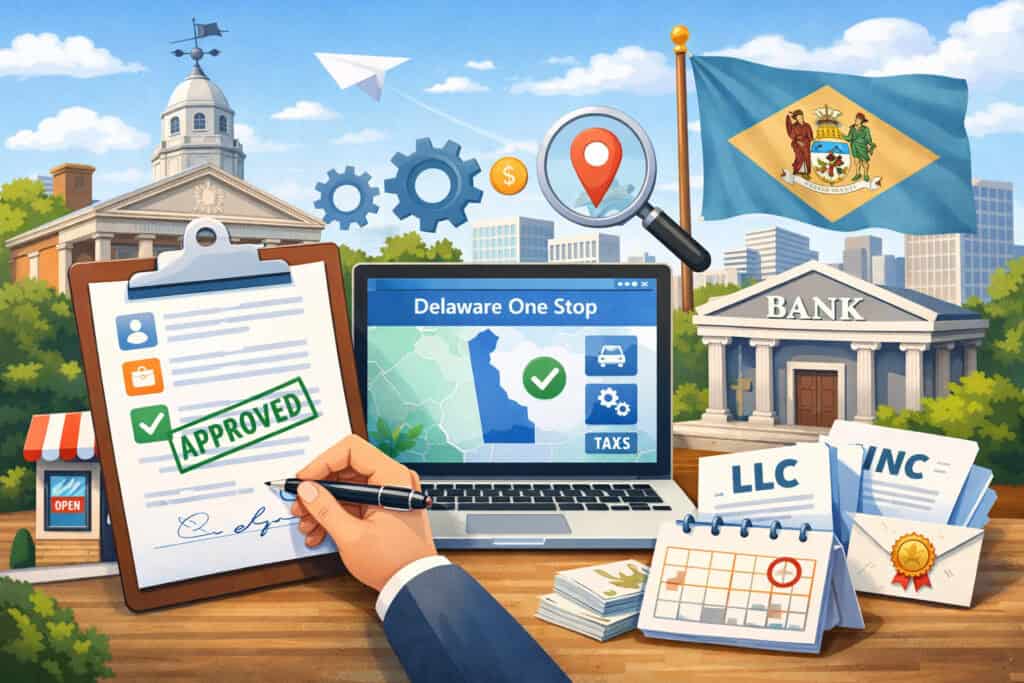
A restaurant can’t legally operate until your business is properly registered and licensed. Delaware’s One Stop system is the central online portal that guides business owners through registration and licensing steps. It also supports actions like adding, renewing, changing, or closing licenses for Delaware registered businesses.
In real-world terms, this step is where you align your restaurant’s “paper identity” with the state:
- Your legal entity type (LLC, corporation, partnership, sole proprietor)
- Your business name and any trade name usage
- Your physical location and mailing address
- Your operational profile (restaurant/food service activities)
Delaware One Stop also flags employer-related registrations when you have employees. For example, it notes that if you have employees working in Delaware, you may need Workers’ Compensation and Unemployment Insurance forms, and withholding registration.
From the perspective of Delaware restaurant license requirements, this is the foundation. Without business registration and the ability to obtain the Delaware business license, other steps become harder.
Vendors, landlords, and insurers also commonly request proof that your business is properly registered before they finalize agreements.
Step 3: Get the Delaware Business License Through the Division of Revenue
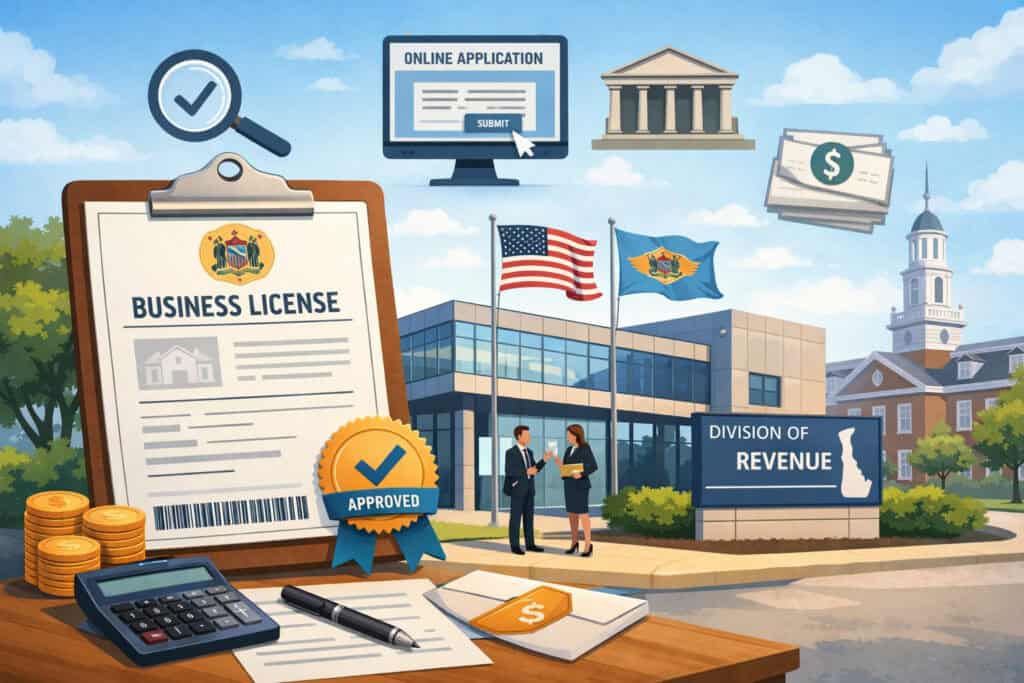
A central part of Delaware restaurant license requirements is obtaining the Delaware business license through the Division of Revenue. Delaware’s Division of Revenue explains that One Stop allows businesses to obtain a Delaware business license and register online.
For restaurant owners, treat the Delaware business license as your “permission to do business” at the state level. It connects your restaurant to tax accounts and compliance obligations. While your operations may feel “local,” the business license is a statewide item—meaning you should plan for renewal, updates if you change locations, and correct classification of your activities.
Practical tips that reduce headaches:
- Apply early, because other stakeholders (banking relationships, merchant services, distributor agreements, and sometimes landlord build-out approvals) may request proof of licensing.
- Keep your business information consistent across applications (entity name, trade name, address, owner details).
- Build a compliance folder (digital + printed) where you store confirmations and account identifiers.
If you ever feel unsure whether your restaurant activity triggers licensing or specific state registrations, Delaware One Stop guidance explicitly encourages contacting the Division of Revenue for clarification.
This step is non-negotiable in Delaware restaurant license requirements. It’s also a step you can often complete while your kitchen plan review is being prepared, which helps keep your timeline moving.
Step 4: Apply for a Food Establishment Permit (Office of Food Protection)
If your business license is the “permission to operate,” your food establishment permit is the “permission to serve food safely.” Delaware’s Division of Public Health issues permits to thousands of food establishments and strongly encourages new operators to contact the Office of Food Protection early to understand the licensing procedure.
This is the heart of Delaware restaurant license requirements for most restaurants. The public health process typically includes:
- Determining whether your operation qualifies as a food establishment and which category you fall into (fixed, mobile, temporary, etc.)
- Submitting required paperwork and planning documents
- Aligning your facility with the State Food Code approach to safety, sanitation, and honest presentation of food
- Completing inspections and receiving the final permit to operate
One important detail: Delaware’s regulatory materials emphasize that a permit remains valid for a defined period (commonly one year) and can be impacted by ownership or management changes.
That means buying an existing restaurant does not automatically mean you “inherit” the same permit status—ownership or management changes can trigger requirements.
Because the food establishment permit is so central, operators should treat it like a project: assign a folder, track submissions, keep copies of menus and equipment specs, and document changes.
Within Delaware restaurant license requirements, this is usually the step that interacts most directly with your day-to-day kitchen operations.
Step 5: Complete Plan Review the Right Way (Menu, Layout, Equipment, Workflow)
Many delays in Delaware restaurant license requirements happen at plan review. Delaware’s public health plan review materials explain that properly prepared plans and specifications must be submitted for review and approval (with fees, where applicable) before construction, conversion, remodeling, or certain operational changes.
Plan review is not just “send a drawing.” It’s a package that connects:
- Your menu (what you plan to serve)
- Your processes (prep, cooking, cooling, reheating, holding)
- Your equipment (make/model, capacities)
- Your facility design (hand sinks, dishwashing, storage, flow, separation)
Delaware’s plan review packet lists typical items such as the food establishment permit application forms, the proposed or actual menu, and an equipment schedule with manufacturer and model numbers, among other supporting documents.
That’s a major reason you should avoid “finalizing” equipment purchases before your review is aligned—changing equipment later can create rework.
A practical way to pass plan review faster:
- Write your menu with enough detail to show risk level (raw/undercooked items, sushi/seafood handling, cooling needs).
- Build a workflow narrative: receiving → storage → prep → cook → serve → clean.
- Make sure the plan shows handwashing access, dishwashing method, and separation between clean and dirty zones.
If you treat plan review as part of Delaware restaurant license requirements (not a side task), you’ll avoid last-minute changes that cost time and money.
Step 6: Fire Safety, Hood Suppression, and Plan Review with the State Fire Marshal
Restaurants are high-risk occupancy types because of cooking equipment, grease vapor, open flame, and customer traffic. That’s why fire approvals are a major part of Delaware restaurant license requirements—especially if you install or modify ventilation, hoods, suppression, alarms, or seating layouts.
Delaware’s State Fire Marshal provides guidance on plan review and inspections and includes restaurant-relevant categories such as kitchen hood duct mechanical plan submittals and kitchen hood fire suppression system plan submittals.
For operators, that means you should assume fire-related documentation will be reviewed when you build or remodel a kitchen.
A common restaurant-specific requirement area is commercial cooking hood suppression systems. The State Fire Marshal site includes information and forms related to commercial cooking hood suppression (pre-engineered systems).
In practice, you’ll need licensed professionals and inspection documentation, and you’ll want everything ready before your final inspections.
How to avoid fire-plan delays:
- Coordinate your architect/GC and hood vendor early.
- Keep copies of system specs, shop drawings, and inspection certificates.
- Confirm occupant load and seating changes, because layout decisions can change fire requirements.
In the real world, your restaurant isn’t “open” until fire clearance aligns with health approvals. Under Delaware restaurant license requirements, treat fire plan review as a core step, not an afterthought.
Step 7: Zoning, Building Permits, and Local Inspections (County/City)
Even if you satisfy state-level Delaware restaurant license requirements, your restaurant still has to be legal at the local level. Zoning and building approvals are location-based and can vary depending on whether you’re in a county jurisdiction or within a municipality.
For example, New Castle County provides zoning standards and describes a process for zoning-related confirmations and certifications, including verifying whether an intended use is permitted in a zoning district.
New Castle County also provides resources on permits and inspections, including access to permit-related information and services.
This matters because “restaurant use” can be permitted by right in one zone and require special approvals in another. It also affects:
- Parking requirements
- Outdoor seating / patio use
- Signage rules
- Hours of operation, noise considerations, and sometimes waste handling
If you’re converting a space (say, retail to restaurant), building officials may require additional work: ventilation, plumbing, grease interceptor updates, restroom upgrades, and accessibility changes. You should also expect local inspections at multiple stages during build-out.
Within Delaware restaurant license requirements, local rules are where owners can get blindsided. The best strategy is to make local compliance part of your earliest site review—before lease signature or construction drawings are finalized.
Step 8: Alcohol Licensing (If You’ll Serve Beer, Wine, or Spirits)
If your restaurant will serve alcohol, alcohol licensing becomes one of the most time-sensitive parts of Delaware restaurant license requirements. Delaware’s Office of the Alcoholic Beverage Control Commissioner (OABCC) handles liquor license applications, modifications, inspections, and renewals.
OABCC also provides forms and application materials, including information about on-premises licenses used by establishments such as restaurants, hotels, and clubs.
Alcohol licensing can add complexity because it often involves:
- License type selection (on-premises vs other categories)
- Premises diagrams and operational details
- Inspections and compliance commitments
- Renewals and ongoing adherence to serving rules
A practical approach:
- Decide early whether you need alcohol to meet your business model.
- Discuss alcohol licensing timeline with your lease negotiations (some owners negotiate contingencies if approval is uncertain).
- Build policies and training around age verification and responsible service.
Even if alcohol is not your main revenue driver, the compliance burden is real. Under Delaware restaurant license requirements, alcohol licensing is not a “later” task—start it early if you plan to serve.
Step 9: Employer Setup, Insurance, and Workforce Compliance
Most restaurants hire staff quickly, which means employment compliance becomes part of Delaware restaurant license requirements in a practical sense—because you can’t operate smoothly without proper payroll setup and legally required protections.
Delaware One Stop notes that if you have employees working in Delaware, you may need workers’ compensation and unemployment insurance forms and to register for a withholding account.
Delaware’s worker’s comp resources are maintained through state agencies, and the state provides employer-facing information via the Office of Workers’ Compensation.
Key steps most restaurants should plan for:
- Employer registrations (withholding and unemployment where applicable)
- Workers’ compensation coverage (commonly required when you have employees)
- Clear onboarding documents and scheduling policies
- Food safety role assignments (who is responsible for logs, receiving, training)
Even though staffing is not the “headline” when people search Delaware restaurant license requirements, the reality is that inspector interactions, incident response, and daily compliance depend heavily on training and accountability. A well-trained team is your best defense against violations and customer complaints.
Step 10: Taxes and Ongoing Reporting You Should Plan For
Delaware’s tax landscape is part of Delaware restaurant license requirements because tax accounts and filing schedules are tied to licensing and operating legally. One important concept for Delaware operators is gross receipts tax.
Delaware’s Division of Revenue explains that gross receipts tax returns and payments are due either monthly or quarterly, depending on a business’s total gross receipts, and that the state uses a look-back period to determine filing frequency. Delaware also maintains a gross receipts tax portal and related resources.
What restaurant owners should do with this information:
- Build tax compliance into your accounting from day one (don’t wait until you’re “busy”).
- Track revenue streams consistently (dine-in, takeout, delivery, catering, merch).
- Keep monthly close processes so filings don’t become a crisis.
A smart compliance habit is to set recurring reminders for renewals and filings. Many restaurant failures are not because the food isn’t good—but because compliance tasks pile up and become expensive.
Within Delaware restaurant license requirements, taxes are an “always-on” obligation. Treat them like rent: predictable, scheduled, and non-optional.
Step 11: A Step-by-Step Timeline Checklist You Can Actually Follow
Here’s a realistic sequence that aligns with Delaware restaurant license requirements while minimizing rework. This is written in operator language, not bureaucratic language, so you can use it as a build-out roadmap.
Phase A: Before you sign a lease (2–6 weeks)
- Choose concept and draft a real menu (not a placeholder)
- Confirm zoning/use eligibility for the location
- Talk to the Office of Food Protection early, especially for new builds or major remodels
Phase B: Paper foundation (1–3 weeks, can overlap)
- Register and license through Delaware One Stop
- Apply for the Delaware business license via One Stop / Division of Revenue pathway
Phase C: Plans and safety approvals (4–12+ weeks depending on build)
- Prepare plan review package (menu, equipment schedule with model numbers, layouts)
- Coordinate fire plan review topics including kitchen hood and suppression plan submissions
- Obtain building permits and pass local inspections
Phase D: Final approvals (1–3 weeks)
- Schedule health inspection(s) and receive the food establishment permit
- If serving alcohol, complete OABCC steps and inspections
- Set up compliance binder (licenses, permits, inspection reports, training logs)
This checklist keeps Delaware restaurant license requirements in the correct order. You can still overlap tasks, but you’ll avoid the classic mistake: building first and asking for approval later.
Common Mistakes That Delay Delaware Restaurant License Requirements
Even experienced operators get tripped up by the same issues. These mistakes don’t usually come from laziness—they come from underestimating how interconnected Delaware restaurant license requirements are across agencies.
Mistake 1: Waiting to call the Office of Food Protection until construction is underway
Delaware encourages early contact so you understand the process before purchasing or constructing. If your sink placement, prep flow, or storage setup is wrong, changes late in the game are expensive.
Mistake 2: Submitting “concept drawings” instead of a real plan review package
Delaware plan review materials point to properly prepared plans/specs and supporting documents like menus and equipment schedules with model numbers. If your plan doesn’t match your real equipment and menu, you’ll likely get revisions.
Mistake 3: Treating fire approvals as separate from restaurant licensing
The State Fire Marshal includes restaurant-related plan review categories such as kitchen hood duct mechanical and suppression plan submittals. Fire delays can block your opening even if health is ready.
Mistake 4: Ignoring zoning until the end
Zoning and permitted use verification can decide whether your restaurant is allowed at that site. If your use isn’t permitted, you may face delays or need variance/special approvals.
Avoiding these issues helps you satisfy Delaware restaurant license requirements faster and with less stress.
Future Outlook: How Delaware Restaurant License Requirements May Evolve
No one can predict the future perfectly, but you can plan intelligently. Based on how state agencies emphasize early coordination, inspections, and science-based food safety requirements, the direction of Delaware restaurant license requirements is likely to continue toward:
- More digital-first workflows for registration and licensing, expanding on the state’s One Stop approach for business licensing and maintenance.
- Increased documentation expectations around plan review: equipment specs, menu risk categories, and written procedures are already central to approvals.
- Stronger integration of fire safety documentation in restaurant build-outs, especially around hood suppression systems and plan review categories that the State Fire Marshal already publishes.
- Greater emphasis on ongoing compliance, not just “getting open.” Public health frameworks focus on preventing foodborne illness and regulating how food is handled, prepared, and served.
What this means for operators: build a compliance system early. If you treat Delaware restaurant license requirements as a one-time hurdle, you’ll struggle later. If you treat it as an operating standard, your restaurant becomes easier to manage, easier to scale, and more resilient.
FAQs
Q.1: Do I need a separate “restaurant license,” or is it multiple permits?
Answer: In most cases, Delaware restaurant license requirements are satisfied through multiple permits and approvals, not a single “restaurant license.” You typically need a Delaware business license (state-level permission to do business) obtained through the Division of Revenue and supported by Delaware One Stop workflows.
Then you’ll need a food establishment permit through the Division of Public Health’s Office of Food Protection, which regulates food safety, inspections, and permitting. Delaware explicitly notes that it issues permits to thousands of food establishments and encourages early contact for the licensing procedure.
Beyond that, your specific site and concept may require zoning confirmation, building permits, and fire plan review—especially if you’re installing cooking equipment that triggers hood or suppression requirements.
The State Fire Marshal’s plan review topics include restaurant-relevant submissions like kitchen hood duct mechanical and suppression. If you serve alcohol, licensing through OABCC becomes another major component.
So the best mindset is: Delaware restaurant license requirements = business legality + food permit + facility safety + optional alcohol.
Q.2: How early should I start the food establishment permit process?
Answer: You should start early—ideally as soon as you have a target location and a clear concept/menu. Delaware’s guidance strongly encourages prospective operators to call the Office of Food Protection “as early as possible” to learn the licensing procedure and understand the full process prior to purchasing, constructing, or amending the premises.
This is practical advice, not just bureaucracy. Food safety approvals often depend on your physical layout: hand sinks, warewashing, refrigeration capacity, storage, prep flow, and whether your processes require specialized controls.
Plan review materials also describe submitting properly prepared plans and specs for review and approval before construction, conversion, remodeling, or operational changes. If you start late, you risk redesign costs and schedule delays.
For Delaware restaurant license requirements, “early” usually means before you finalize construction drawings and definitely before you order major equipment. A short early call can prevent weeks of rework later.
Q.3: If I buy an existing restaurant, do I still need new permits?
Answer: Buying an existing restaurant can speed up your opening timeline, but it doesn’t eliminate Delaware restaurant license requirements.
Delaware’s regulatory materials emphasize that permits are valid for a set period and can be affected by changes such as a new owner, management firm, or lessee taking possession, among other conditions. That’s why you should never assume the prior operator’s status transfers cleanly to you.
In addition, changes in your menu, equipment, or operational model may trigger new plan review or approval needs. Plan review guidance highlights review requirements before certain types of remodeling or operational changes.
If you’re adding fryers, expanding cooking capacity, changing ventilation, or remodeling, you may also need fire plan review items (kitchen hood duct, suppression submissions) and local building permits.
For the smoothest transition, treat the acquisition like a new opening: confirm what permits exist, what must be updated, and what agencies need to inspect before you operate.
Q.4: What’s the deal with fire suppression and hood requirements for restaurants?
Answer: Fire safety is a major operational risk area, so it’s a major part of Delaware restaurant license requirements whenever you install or modify commercial cooking systems.
Delaware’s State Fire Marshal provides plan review and inspection categories relevant to restaurants, including kitchen hood duct mechanical plan submittals and kitchen hood fire suppression system plan submittals.
This signals that hood and suppression considerations are not “optional”—they’re often core to approval.
Commercial cooking hood suppression systems also have licensing and documentation components, and Delaware provides a dedicated page for commercial cooking hood suppression (pre-engineered) related applications and forms.
In practical terms, plan for:
- Professional design and installation
- Clear documentation and inspection certificates
- Coordination with building inspections and final approvals
If you handle this early, it usually becomes a controlled task. If you handle it late, it’s often the reason a restaurant “can’t open yet” even after everything else seems finished.
Q.5: How do I keep compliant after I open?
Answer: Passing inspections is only the beginning. The most sustainable way to manage Delaware restaurant license requirements is to build an “always-ready” system:
- Keep your business license and permit documents organized and accessible
- Maintain food safety routines aligned with the State Food Code goals of preventing foodborne illness and ensuring safe, honestly presented food
- Track required renewals and agency communications
- Maintain tax compliance habits, including tracking gross receipts tax filing frequency (monthly or quarterly depends on receipts and the state’s look-back approach)
- Keep fire system inspection documentation and vendor service records in a dedicated binder (digital + printed)
A simple rule: if an inspector asks for it, you should be able to pull it in under two minutes. Restaurants that systemize compliance spend less time in panic mode, train staff faster, and handle growth (second location, catering expansion, alcohol program) with fewer surprises.
Conclusion
Delaware restaurant license requirements are manageable when you treat them as a planned sequence instead of a last-minute scramble.
The core path is consistent: use Delaware One Stop to register and license your business, obtain the Delaware business license through the Division of Revenue, and secure the food establishment permit through the Office of Food Protection.
From there, align local zoning, building permits, and fire plan review—especially for hood and suppression systems—so inspections don’t derail your opening. If you plan to serve alcohol, start the OABCC process early because it adds its own timeline and compliance track.
The best “pro move” is to front-load decisions that drive approvals: menu, workflow, equipment, and site eligibility. Then run your opening like a project with a checklist, a compliance binder, and clear ownership of tasks.