Cottage Food Laws in Delaware: What You Can Sell from Home (2026 Guide)
If you’re dreaming about turning your cookies, granola, jams, or candies into real income, Delaware does have a pathway for selling homemade food in Delaware legally—but it’s more structured than many people expect.
Delaware runs its home-based food program through the Cottage Food Establishment (CFE) rules, administered by the Delaware Department of Health and Social Services (DHSS), Division of Public Health (DPH).
The big idea is simple: you can sell certain low-risk foods made in your primary residence—as long as you register, meet training and labeling rules, and only sell through approved direct-to-consumer channels.
This guide walks you through Delaware cottage food regulations as they stand for 2026—what’s allowed, what’s not, where you can sell, and the Delaware cottage food permit requirements (Delaware uses “registration,” but most people still call it a permit).
It’s practical, compliance-focused, and written like a small-business advisor—not a legal textbook.
What “cottage food” means in Delaware
In Delaware, “cottage food” is handled under the Cottage Food Establishment (CFE) program. A CFE is a place where specific foods are made in a home-style kitchen located in the producer’s permanent, primary residence, for sale directly to consumers.
A key phrase you’ll see is that cottage foods must be non-TCS (non–time/temperature control for safety) foods. That’s a food-safety way of saying: these products don’t need refrigeration to stay safe, and they’re generally less likely to support dangerous bacterial growth. Delaware’s rules specifically limit CFE production to non-TCS foods.
This program is designed for:
- Home bakers selling shelf-stable baked goods (no cream fillings, no meat, no custards that require refrigeration)
- Hobby cooks making qualifying fruit preserves or candies
- Farmers market vendors who want to sell their own compliant, packaged foods
- Micro-entrepreneurs testing a product idea before committing to a commercial kitchen
And just as important: the CFE rules are not meant for:
- Full meal prep, hot foods, or catering
- Refrigerated/frozen ready-to-eat foods
- Wholesale (selling to stores, coffee shops, restaurants)
- Online checkout and shipping (Delaware prohibits online sales under the CFE rules—even if marketing is allowed)
Delaware cottage food regulations in 2026: the rules that matter most (quick snapshot)
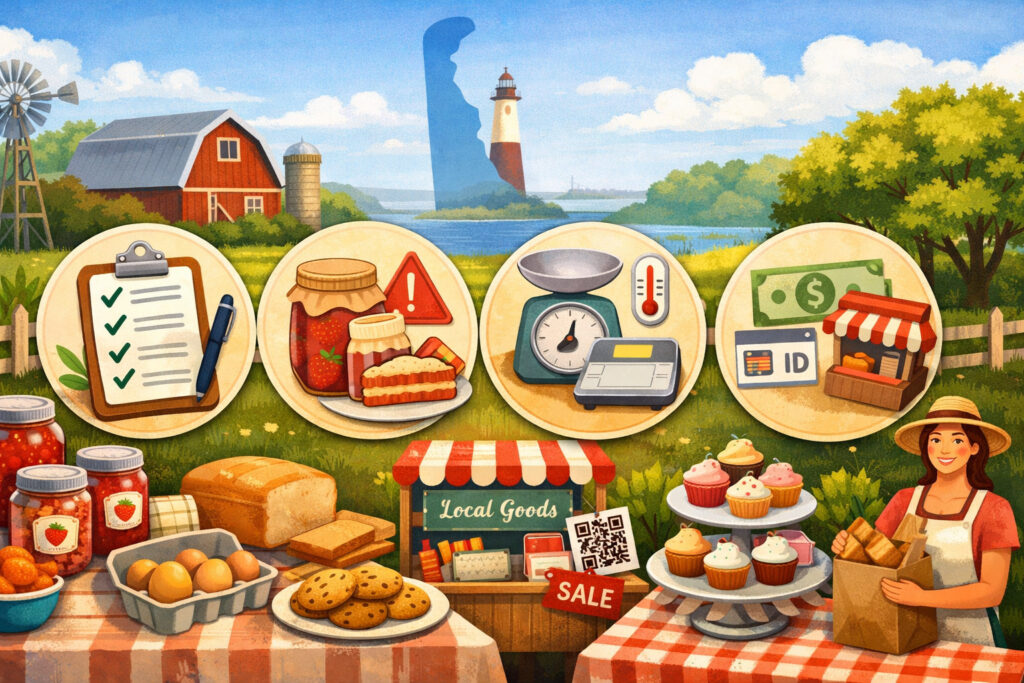
When people get tripped up by cottage food laws in Delaware, it’s usually because they focus on the recipe and forget the sales channel, registration, and label rules. Here are the rules you should have in your head from day one:
- Direct sales only (Delaware-only movement of product): Delaware defines direct sales as sales that move products only within the State of Delaware, directly to the consumer, without a retailer or intermediary. CFEs are only permitted to engage in direct sales with consumers in Delaware.
- Online sales are not permitted (marketing is okay): Delaware explicitly states: online sales are not permitted, but online advertising and marketing are permitted. That means you can post on Instagram, but you can’t take online payment as the sale transaction under the CFE rule.
- No wholesale: CFEs cannot sell wholesale or to resellers/food establishments. If a café wants to carry your muffins, you’ll need a different compliant setup (often a permitted commercial kitchen).
- Registration + fee + registration year: The regulations set an annual registration fee of $30 per CFE, and registration runs during a year beginning April 1 and ending March 31 (or the remaining portion after issuance).
- Training is required: At least one employee during hours of operation must have food safety proficiency by passing a test that is part of a program approved by the Office of Food Protection.
- Inspections can be part of approval: Delaware allows for preoperational inspections, and the rules describe being added to the registry after requirements are met “up to and including the on-site inspection.”
- Sales cap: Delaware’s cottage food regulations list limits—but do not set a dollar cap: The “limitations” section addresses direct sales, online sales prohibition, and wholesale prohibition, but it does not specify an annual revenue cap. (If you hear a cap number, verify it against the current regulation and DPH guidance.)
What you CAN sell from home in Delaware (clear categories + examples)

Delaware’s rules say cottage food production is limited to non-TCS foods and to products on the approved list maintained by the Division. The regulations explicitly call out categories that are allowed, including baked goods, jams/jellies/fruit preserves, and candies (as long as the final product is non-TCS).
Because Delaware ties approval to an official list and your registration, the safest way to think about “what you can sell” is:
- Start with categories Delaware explicitly allows in the regulation, and
- Confirm your specific item is on the Division’s approved list and is listed on your registration.
Below are practical categories and examples that align with the regulation’s language and the non-TCS principle.
Shelf-stable baked goods (the Delaware home bakery sweet spot)
Delaware allows the manufacturing of baked goods in a CFE and lists examples of “traditional bakery items” such as cakes, breads, cookies, rolls, muffins, brownies, fruit pies, and pastries.
The catch is in the next sentence: bakery items that contain components that meet the definition of TCS—like cream filling or meat—are not allowed.
What this means in real life:
- Usually fits well: sandwich cookies (no cream cheese), biscotti, scones, tea cakes, banana bread, unfrosted cupcakes, fruit pies with shelf-stable filling
- Often triggers questions: buttercream frosting (usually okay if shelf-stable, but recipe matters), pumpkin pie (commonly requires refrigeration), cheesecake (refrigerated), custard-filled pastries (TCS)
Even if something is “baked,” it can still be TCS based on moisture and pH (think custards, cream fillings, and many dairy-forward desserts). If you’re aiming for a “home bakery license Delaware” approach, treat your first product line like a compliance-friendly menu: dry, shelf-stable, clearly labelable, and easy to keep consistent.
Jams, jellies, and fruit preserves (with process discipline)
Delaware allows the manufacturing of jams, jellies, and other fruit preserves in a CFE, as long as each product is produced in compliance with the requirements.
In practice, fruit preserves are where people accidentally drift into higher-risk territory:
- High-acid fruit jams/jellies are typically the safer lane.
- Low-acid canned goods (like many vegetables, beans, salsa, soups) are commonly not cottage foods because they can support botulism if processed incorrectly.
- “Refrigerator jam” recipes may be delicious, but if the product requires refrigeration for safety, it’s not a cottage food item under Delaware’s non-TCS rule.
If you plan to sell preserves, focus on:
- consistent, tested recipes
- clear batch coding (Delaware requires lot/date identifiers on labels or as a lot number/date of production)
- recordkeeping for traceability (Delaware requires batch records and sales records kept for 3 years)
Candies and confections (non-TCS only)
Delaware allows candy products such as fudge, lollipops, chocolates, tortes, hard candy, and rock candy, as long as the final products are non-TCS.
This category is great for cottage businesses because:
- many candies are naturally shelf-stable (low water activity)
- packaging is straightforward
- labeling is predictable
But keep your eye on ingredients and fillings:
- Shelf-stable: brittle, caramel candies (shelf-stable recipe), hard candy, marshmallows
- Riskier: truffles with dairy-rich ganache that needs refrigeration, chocolates with fresh cream fillings, anything “keep refrigerated”
What you CANNOT sell (examples + safety reasoning)
“Prohibited” in cottage food world usually means one of three things:
- The product is TCS (needs time/temperature control for safety)
- The product is outside the scope of the cottage rules (like meals, catering, wholesale)
- The product isn’t on Delaware’s approved list or isn’t listed on your registration
Delaware doesn’t give a single “giant prohibited foods” list inside the core regulation PDF. Instead, it anchors what’s allowed to non-TCS foods and to the approved list maintained by the Division, and it restricts sales methods.
Here are the most common “not allowed” categories—plus why they’re risky.
Foods that require refrigeration (TCS foods)
Delaware defines TCS foods as those needing time/temperature control to limit pathogen growth or toxin formation. If your product must be held cold to stay safe, it’s typically outside cottage food.
Examples that often fall into this bucket:
- cheesecake, cream pies, custard pies
- tiramisu, mousse, pudding cups
- dairy-based dips and spreads
- fresh salsas that require refrigeration
Even “I keep it cold in a cooler” doesn’t fix the compliance issue—cottage foods must be non-TCS by nature.
Meat, seafood, and cooked meals (hot foods, meal prep, catering)
Cottage rules are designed around packaged, shelf-stable, low-risk foods—not hot meals or items where temperature control is the safety backbone.
Examples:
- soups, stews, cooked rice dishes
- BBQ, tacos, meal trays
- cooked meat fillings, meat pies, jerky (often regulated separately)
If your dream business is selling meals, your next step is usually a permitted commercial kitchen or a properly permitted mobile/temporary food setup.
Low-acid canned goods and “danger zone” preserved foods
Home canning can be safe when done correctly, but low-acid items are where botulism risk becomes serious. That’s why many states keep them out of cottage programs unless you’re in a specifically approved category (and Delaware ties approval to its official list).
Examples that are commonly not cottage foods:
- canned vegetables, beans, soups
- many salsas, sauces, garlic-in-oil style products
- pickled items that aren’t in an approved/validated category
Cannabis-containing products are explicitly prohibited
Delaware’s cottage food regulation is clear that products may not contain cannabis.
Where you can sell in Delaware (farmers markets, direct-to-consumer, online, shipping—what’s allowed in 2026)
Sales rules are where Delaware is strict—and very specific.
Delaware CFEs may only engage in direct sales with consumers in the State of Delaware. Delaware defines “direct sales” as moving products only within Delaware directly to the consumer, with no retailer or intermediary.
In-person venues: farmers markets and other approved events
The regulation describes cottage food products being sold directly to consumers at a farmer’s market or other approved venue, and it also says your registration must be displayed at farmers markets, craft fairs, charitable organizations, or other approved venues/functions where cottage foods are sold.
In practical terms, “approved venues” commonly include:
- farmers markets
- craft fairs
- community events and festivals
- charitable organization events (when approved)
Many individual markets will also have their own vendor requirements. For example, county-run markets may ask for proof of business license and food safety training as part of vendor onboarding.
Direct-to-consumer means no wholesale and no resellers
Delaware prohibits wholesale or other sales to resellers or food establishments. So:
- Not allowed: selling your cookies to a coffee shop to resell
- Not allowed: selling to a grocery store, even if it’s “local”
- Allowed (direct): selling a packaged product straight to the person eating it
Online sales and shipping: Delaware says “no”
This is one of the most important 2026 clarifications for new cottage producers:
- Online sales are not permitted.
- Online advertising and marketing are permitted.
So what can you do online?
- post your menu and prices
- promote where you’ll be selling
- collect inquiries (DMs, email requests)
What you should avoid (under the CFE rule)?
- taking payment through an online checkout
- listing items for purchase on a website/cart
- shipping orders (because your product movement and sale method won’t fit Delaware’s direct-sales-only structure)
Delaware cottage food permit requirements (registration): agency, steps, fees, timelines, inspections
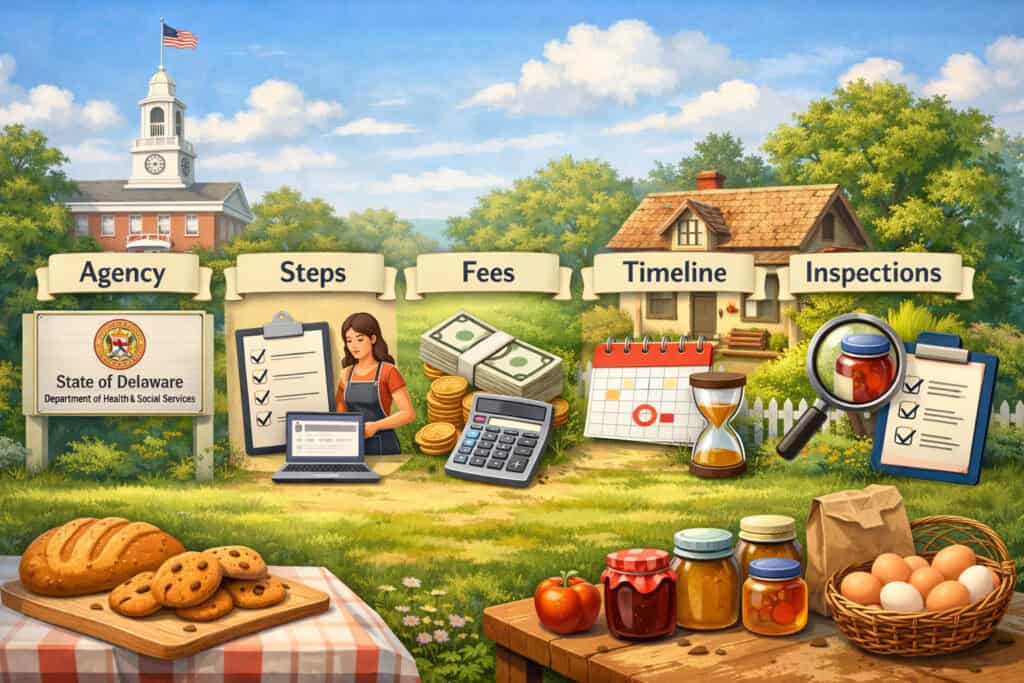
If your goal is selling homemade food in Delaware legally, your compliance foundation is the CFE registration process.
Which agency administers Delaware cottage food registration?
Delaware’s cottage food rules are adopted under DHSS authority and define “Division” as the Delaware Division of Public Health. The training rule references programs approved by the Office of Food Protection.
In everyday terms: Delaware cottage food is run through DHSS / DPH (Office of Food Protection).
Delaware cottage food permit requirements: the step-by-step pathway
Here’s the practical workflow implied by the regulation:
- Confirm your product is non-TCS and on the approved list: Delaware limits products to those on an approved list maintained by the Division and to non-TCS foods.
- Complete required food safety training: At least one employee during hours of operation must show proficiency via a test in a program approved by the Office of Food Protection.
- Prepare your application materials: Delaware’s application must demonstrate you meet requirements. The regulation lists items such as contact info, business structure, product/process info (including example labels), a floor plan of the processing area, proof of training, and the types of venues where you’ll sell.
- Submit application to DPH and be ready for inspection: Delaware allows preoperational inspections and describes being added to the state registry after requirements are met “up to and including the on-site inspection.”
- Pay the annual registration fee and renew on the Delaware cycle: The annual registration fee is $30 per CFE, with the registration year beginning April 1 and ending March 31.
- Sell only what you registered and follow labeling + recordkeeping rules: You may only produce the products listed on your registration; your registration must be displayed at approved venues; and labeling/records rules apply.
Fees and timelines (realistic ranges, not promises)
Delaware’s fee is set by regulation: $30 annually.
Timelines aren’t guaranteed in the regulation, so plan for a range:
- Best case: a few weeks if your paperwork is complete and inspection scheduling is smooth
- Common reality: longer during peak season (spring/summer market season)
When are home kitchen inspections required?
Delaware’s rules allow the Division to conduct one or more preoperational inspections to verify the establishment is constructed/equipped as described and in substantial compliance. Additional inspections may occur for complaints or other situations.
Food safety best practices for home producers (sanitation, storage, cross-contact, packaging)
Even though cottage foods are “low risk,” Delaware still expects you to operate like a responsible food business. The regulation includes requirements that touch on safe facilities, equipment, temperature measuring devices, and more—plus it requires a recall plan and three years of records.
Here are best practices that match the intent of Delaware’s program and help you avoid the most common problems.
Build a simple “home bakery” sanitation routine you can repeat
A compliance-friendly kitchen is consistent, not perfect. Your goal is to reduce contamination risks and prove you can operate in a controlled way.
- Clean and sanitize food-contact surfaces before and after production
- Keep pets out of the processing area during production
- Store ingredients off the floor and away from chemicals
- Use dedicated, food-grade containers for dry storage
- Calibrate and use thermometers when relevant (even if finished goods are non-TCS, ingredients and cooling steps still matter)
Delaware also requires food-grade packaging contact surfaces and ties packaging safety to state code requirements.
Manage allergens like a pro (even in a tiny kitchen)
Delaware labeling requires major allergen food sources to be declared unless the source is already in the ingredient name.
In a home kitchen, allergen management is mostly about:
- making one allergen-heavy product at a time (e.g., peanut brittle day)
- cleaning thoroughly between batches
- storing allergen ingredients in clearly marked containers
- using separate utensils when reasonable (or washing/sanitizing carefully)
For your customers, the “big eight” allergens you mentioned—milk, eggs, wheat, peanuts, tree nuts, soy (and also fish/shellfish in federal lists)—are the ones people most commonly look for. Your labels should make this easy to see.
Packaging and storage that protect the product (and your reputation)
Cottage foods live or die by shelf stability and presentation. Practical habits:
- Cool baked goods fully before sealing (prevents condensation and mold)
- Use packaging that matches the product (barrier bags for granola, sturdy clamshells for cookies)
- Add lot/date identifiers so you can trace batches
- Keep finished products in a clean, dry area away from household chemicals
Delaware also requires you to maintain distribution/sales records and batch records for 3 years, which is much easier if your labeling and lot coding are consistent.
Delaware food labeling requirements (what must be on the package + exact disclaimer wording)
Labeling is non-negotiable in Delaware’s cottage food program. The regulation lays out the required label elements and even specifies minimum type size and the required disclaimer statement.
What Delaware requires on cottage food labels
Delaware requires products to be properly labeled with:
- Name of CFE
- Name of product
- Town/City, Delaware
- Phone number or email of the CFE
- Net weight or unit count
- Date of production or lot number
You must also include:
- Ingredients in decreasing order by weight (or have the list available upon request if the label is too small)
- Major allergen food sources (unless already part of the ingredient name)
And Delaware requires this exact disclaimer statement:
“This food is made in a Cottage Food Establishment and is NOT subject to routine Government Food Safety Inspections”.
Formatting rules:
- Labels must be printed in at least 10-point type in a color that clearly contrasts with the label background.
A practical sample label (copy format, customize content)
Delaware Cottage Bakery
Chocolate Chip Cookies
Wilmington, Delaware
Email: [email protected] | (302) 555-1234
Net Wt. 8 oz (227 g)
Produced: 02/16/2026 | Lot: CC021626A
Ingredients: Wheat flour, sugar, butter (milk), chocolate chips (sugar, chocolate liquor, cocoa butter, soy lecithin, vanilla), eggs, baking soda, salt, vanilla extract.
Contains: Wheat, Milk, Eggs, Soy
This food is made in a Cottage Food Establishment and is NOT subject to routine Government Food Safety Inspections.
Business setup basics (DBA/LLC, Delaware business license, insurance, pricing)
Cottage food compliance is only one side of the coin. The other side is being “real” as a business: licensing, naming, taxes, and risk management.
Delaware business license: what most sellers need to check
Delaware offers One Stop registration to obtain a Delaware business license and register online through the Division of Revenue and other agencies.
Even if you’re tiny, venues may ask for proof of:
- business license
- product registration/approval (your CFE registration)
- food safety training documentation
Start your research with Delaware One Stop and the Division of Revenue business licensing guidance.
DBA vs LLC (high-level, not legal advice)
- DBA (trade name): lets you operate under a business name that isn’t your legal name. Delaware One Stop notes trade names/DBAs are handled through the Division of Revenue effective February 2, 2026.
- LLC: separates business liability from personal assets in many situations (but not a magic shield). It can also make banking and wholesale transition easier later.
A simple approach many cottage producers use:
- Start with a compliant product line + registration
- Validate demand at markets
- Consider LLC + brand expansion once you have consistent sales
Insurance: the “sleep better” line item
Even careful makers have accidents—label mix-ups, customer allergy claims, damaged goods at events. Consider:
- general liability
- product liability (often bundled)
Ask your agent about coverage tailored to home-based food businesses and farmer’s market selling.
Pricing tips that keep you profitable (without guesswork)
A basic pricing structure:
- Ingredient cost per unit
- Packaging cost per unit
- Your time (hourly target)
- Market fees + permits amortized across projected units
- A cushion for waste/unsold items
Then test pricing in the real world. If customers love your product but balk at the price, consider:
- smaller pack sizes
- “premium” versions (gift boxes, sampler packs)
- products with better shelf life to reduce waste
“Can I sell this?” Delaware decision guide (with printable checklists)
Before you print labels or buy a tent, run every product idea through a repeatable filter that matches Delaware’s structure: non-TCS + approved list + direct sales + correct label.
The 5-question decision filter (fast, practical, Delaware-aligned)
- Is it a non-TCS food (no refrigeration needed for safety)?
- Is it on Delaware’s approved list maintained by DPH—and will it be listed on my registration?
- Am I selling directly to the end consumer, only within Delaware?
- Am I avoiding online sales/checkout and avoiding wholesale/resellers?
- Can I label it with Delaware’s required info + disclaimer + allergens?
If any answer is “no” or “not sure,” pause and confirm with DPH before selling.
Pro Tip: A “maybe” product is the #1 way new cottage businesses waste money. Build your first menu from easy “yes” products.
Printable checklist: product compliance (copy/paste and print)
- Product is non-TCS (does not require refrigeration for safety)
- Product is on the approved list maintained by the Division
- Product is listed on my CFE registration (I will only produce registered products)
- I will sell direct to consumers in Delaware only
- I will not sell online (marketing only)
- I will not sell wholesale or to resellers/food establishments
- Label includes: CFE name, product name, town/city “Delaware,” phone/email, net weight or unit count, production date or lot number
- Ingredients listed in decreasing order by weight (or available upon request if label too small)
- Major allergens declared (milk, eggs, wheat, peanuts, tree nuts, soy, etc.)
- Disclaimer included exactly as required + 10-point type
Printable checklist: market-day compliance
- Bring a copy of your CFE registration and display it where required at the venue
- Bring backup labels and a marker for emergency lot coding
- Keep products protected (covered, off the ground, away from sun)
- Have a clean “cash/phone” hand separate from “food” hand
- Keep an order log: product, lot/date, location of sale (Delaware requires records)
Allowed vs not allowed: a real-world product list (30+ items)
This list is designed to be practical—but remember Delaware ties approval to non-TCS foods and an approved list maintained by DPH, and you may only produce what’s on your registration. Use this as a starting point, then confirm your exact items.
Typically “Yes” (fits Delaware’s non-TCS + examples in the regulation)
- Chocolate chip cookies
- Sugar cookies
- Brownies
- Blondies
- Muffins (no perishable fillings)
- Banana bread
- Zucchini bread
- Scones
- Biscotti
- Rolls (shelf-stable finished product)
- Fruit pies (not custard-based)
- Pastries without cream/custard fillings
- Hard candy
- Rock candy
- Lollipops
- Fudge (shelf-stable recipe; confirm)
- Chocolate bark (no perishable fillings)
- Fruit jam
- Fruit jelly
- Fruit preserves
Typically “No” (TCS, refrigerated, meal-type, or sales-method conflicts)
- Cheesecake (refrigerated)
- Cream pies / custard pies (refrigerated)
- Tiramisu / mousse cups (refrigerated)
- Meat pies / empanadas with meat
- Hot meals (plates, bowls, catering)
- Sushi or seafood products
- Garlic-in-oil style products (often higher risk; confirm)
- Low-acid canned vegetables/soups
- Dairy-based dips/spreads (refrigerated)
- Any product sold online as a checkout sale
- Any product sold wholesale to a café/store
- Any product containing cannabis
“Check with DPH / approved list” (common cottage items, but Delaware ties approval to the Division list)
- Granola
- Trail mix
- Popcorn seasoning blends
- Dry spice blends
- Dry baking mixes (cookie mix in a jar)
- Roasted nuts (watch allergens + cross-contact)
- Dried herbs
- Shelf-stable caramel sauce (recipe-dependent)
Mini case studies (how Delaware sellers launch without headaches)
These are realistic examples based on Delaware’s compliance structure. Use them as patterns you can copy.
Case study 1: Home baker starts with 6 “easy yes” items and scales at markets
Goal: Sell weekend baked goods at farmers markets and craft fairs.
Smart Delaware-first strategy
The baker chooses products clearly aligned with Delaware’s baked-goods examples: cookies, brownies, muffins, banana bread, and non-custard fruit pies. They avoid cream cheese frostings and custard fillings to stay firmly in non-TCS territory.
Compliance steps they follow:
- completes an Office-of-Food-Protection-approved food safety test/training (meets Delaware training requirement)
- submits application materials including example labels and a kitchen floor plan
- schedules preoperational inspection and waits for registry approval before selling
- uses consistent labels with lot codes and the exact Delaware disclaimer statement
Result
They sell out often—because the products travel well, don’t require coolers, and customers trust the professional labeling.
Case study 2: Jam maker keeps it simple with fruit preserves + batch records
Goal: Sell jam at community events and farmers markets.
Smart Delaware-first strategy
They focus on classic fruit jams/jellies (strawberry, blueberry, peach) and avoid low-acid canned items. Delaware allows jams/jellies/fruit preserves in a CFE when produced in compliance with requirements.
What makes them “inspection-ready”:
- keeps a batch log: product type, date, lot number
- keeps a sales log: date + venue of sales
Delaware requires batch and sales records be kept for 3 years.
Labeling done right:
- net weight/unit count
- production date or lot number
- ingredient list in descending order by weight
- allergens when applicable
- Delaware disclaimer statement
Result:
They’re able to respond confidently to customer questions (“Is this inspected?” “What’s in it?”) because the label and logs do the talking.
Case study 3: Candy seller builds a giftable brand without crossing into TCS
Goal: Sell candies seasonally (holidays, Valentine’s Day, weddings).
Smart Delaware-first strategy
They focus on hard candy, lollipops, chocolate bark, and shelf-stable confections—products Delaware explicitly recognizes as allowable candy items (non-TCS final products).
They avoid common pitfalls:
- no fresh-cream truffles that require refrigeration
- no online checkout (they promote online, but take orders as “inquiry” and finalize sales in person to stay within Delaware’s no-online-sales rule)
Result:
A clean, compliant product line with great margins and low spoilage.
Case study 4: Granola brand plans a compliant Phase 1 and a commercial Phase 2
Goal: Build a long-term brand that eventually sells online and wholesale.
Smart Delaware-first strategy
They launch Phase 1 through approved direct sales venues only, using compliant labeling and keeping strong records. They verify whether granola is on the current approved list and list it on their registration.
Phase 2 plan (after proof of demand):
- transition to a permitted commercial kitchen
- unlock online checkout + shipping
- pursue wholesale accounts
Result:
They avoid building an e-commerce engine that Delaware cottage rules don’t allow, and they time their “upgrade” when demand is real.
Common mistakes that trigger enforcement (and how to avoid them)
Delaware’s rules include clear compliance expectations, and the enforcement section notes consequences for operating without registration (including immediate closure) and other administrative actions.
Here are the most common mistakes that cause problems—especially for new vendors.
Mistake 1: Selling online because “it’s still direct to consumer”
Delaware is explicit: online sales are not permitted (marketing is allowed). Even if you only ship within Delaware or only sell to Delaware customers, an online checkout sale is still an online sale.
Fix: Use online channels for marketing and inquiries, then complete compliant sales in approved ways.
Mistake 2: “Wholesale-light” to a café or boutique
Delaware prohibits sales to resellers or food establishments. A “small wholesale test” is still wholesale.
Fix: If you want retail placement, plan your transition to a permitted commercial model.
Mistake 3: Labeling gaps (missing lot/date, missing disclaimer, unclear allergens)
Delaware’s label requirements are detailed, including the exact disclaimer statement and specific required information. Missing any of these can put you out of compliance.
Fix: Standardize labels early and keep a master label template for each product.
Mistake 4: Selling products not listed on your registration
Delaware requires you to produce only the specific products listed on your registration, and allowable products are limited to the Division’s approved list.
Fix: Update your registration when you add new products (and don’t sell the new SKU until it’s properly included).
Mistake 5: Weak recordkeeping
Delaware requires batch and sales records and a recall plan structure. If there’s a complaint, records can protect you and your customers.
Fix: Keep simple logs—paper notebook or spreadsheet—and store them for the required retention period.
Step-by-step “Launch Checklist” (from idea to first sale)
Use this as your practical roadmap. It’s designed to align with the regulation’s requirements while keeping your workload realistic.
Step 1: Choose a compliance-friendly product concept
- Product is non-TCS (no refrigeration needed for safety)
- Product fits Delaware’s allowed categories (baked goods, fruit preserves, candies)
- Product is on the approved list maintained by the Division (confirm)
Step 2: Build your label early (before you bake for sale)
- Add all required Delaware fields
- Ingredients in descending order by weight
- Allergen sources declared
- Exact Delaware disclaimer statement + 10-point type
Step 3: Complete training and document it
- Pass a test in a program approved by the Office of Food Protection
- Store your certificate digitally and printed
Step 4: Prepare your registration packet
- Product/process description + ingredients + example labels
- Kitchen/processing area floor plan
- Venues where you plan to sell
Step 5: Inspection readiness and approval
- Schedule preoperational inspection (if required/triggered)
- Pay annual registration fee ($30) and track renewal cycle (Apr 1–Mar 31)
Step 6: Set up your business basics
- Apply for Delaware business license via One Stop (as applicable)
- Register trade name/DBA if using a brand name (check current One Stop guidance)
- Consider insurance quotes (general/product liability)
Step 7: First sale—done the Delaware way
- Sell only direct-to-consumer, Delaware-only
- No online checkout sales
- Display your registration at approved venues
- Log the sale (date, venue, product/lot)
30/60/90-day action plan to start legally and scale safely
This plan assumes you’re starting from scratch and want to be compliant without burning out.
Days 1–30: Foundation + “proof you can comply”
Focus: product selection, labels, training, and paperwork.
- Pick 3–6 “easy yes” products (simple baked goods/candies/preserves)
- Draft labels for each SKU using Delaware’s required fields and disclaimer
- Complete required training (approved program test)
- Build your application materials: product/process descriptions, example labels, floor plan, venue list
- Start a batch log template and sales log template (records kept 3 years)
Days 31–60: Registration + inspection readiness + vendor outreach
Focus: get approved and get market opportunities lined up.
- Submit CFE registration application to DPH
- Prepare for preoperational inspection (clean, organized, documented)
- Apply for Delaware business license (as applicable) via One Stop
- Contact 3–5 markets/events and ask for their vendor requirements (some counties publish vendor resources)
- Finalize packaging suppliers and label printing workflow
Days 61–90: First sales + feedback loop + “scale safely” decisions
Focus: consistent production, compliance habits, and product-market fit.
- Launch at 1–2 venues with your tight SKU list
- Track lot numbers and sales locations consistently
- Collect customer feedback and improve packaging/label clarity
- Evaluate whether your growth goals require a post-cottage path (commercial kitchen for online/wholesale)
FAQs
Q.1: Do I need a permit to sell baked goods from home in Delaware?
Answer: Delaware requires registration as a Cottage Food Establishment (CFE) to operate legally under the cottage food rules, and operating without valid registration is a violation.
Q.2: What homemade foods are allowed under Delaware cottage food laws?
Answer: Delaware allows non-TCS foods on the Division’s approved list, and the regulation specifically allows baked goods, jams/jellies/fruit preserves, and certain candies (non-TCS final products).
Q.3: Can I sell at farmers markets in Delaware without a commercial kitchen?
Answer: Potentially yes—if you are properly registered as a CFE and your products and labels comply. Delaware also requires your registration be displayed at farmers markets and other approved venues.
Q.4: Can I sell online or ship cottage foods from Delaware?
Answer: Under Delaware’s CFE rules, online sales are not permitted (online marketing is allowed), and direct sales must occur within Delaware directly to consumers. Shipping and online checkout don’t fit that structure.
Q.5: Are there annual sales limits for Delaware cottage food businesses?
Answer: The regulation lists limitations (direct sales only, no online sales, no wholesale), but it does not state a dollar sales cap in the limitations section. Always confirm current guidance with DPH.
Q.6: Do I need to label allergens on homemade foods?
Answer: Yes. Delaware requires labels to include the food source for each major food allergen contained in the food unless it’s already part of the ingredient name.
Q.7: Can I sell foods that require refrigeration?
Answer: Generally no for cottage foods. Delaware limits CFE production to non-TCS foods, and TCS foods require time/temperature control for safety.
Q.8: Do I need an inspection of my home kitchen?
Answer: Delaware may conduct preoperational inspections and describes approval “up to and including the on-site inspection.” Additional inspections can occur for complaints or other situations.
Q.9: What if I want to sell hot foods or meals?
Answer: Hot foods, meals, catering, and similar operations usually fall outside cottage food. You’ll likely need a permitted commercial kitchen or a different permit pathway.
Q.10: Can I sell to restaurants, coffee shops, or retail stores?
Answer: Not under Delaware CFE rules. Wholesale or other sales to resellers or food establishments are not permitted for CFEs.
Q.11: What exactly must be on a Delaware cottage food label?
Answer: Delaware requires CFE name, product name, town/city “Delaware,” phone/email, net weight or unit count, production date or lot number; ingredients by weight; allergens; and the exact disclaimer statement in at least 10-point type.
Q.12: What is the required Delaware disclaimer statement?
Answer: “This food is made in a Cottage Food Establishment and is NOT subject to routine Government Food Safety Inspections”.
Q.13: How much does Delaware cottage food registration cost?
Answer: The regulation sets an annual registration fee of $30 per CFE.
Q.14: When do I renew my Delaware cottage food registration?
Answer: Registrations remain effective during a year beginning April 1 and ending March 31 (or the remaining portion after issuance).
Q.15: Do I need a Delaware business license too?
Answer: Many vendors do, and events may ask for it. Delaware provides One Stop registration to obtain a Delaware business license and register online. Confirm your specific obligations through the Division of Revenue/One Stop.
Q.16: How do I move from cottage food to a commercial kitchen?
Answer: The usual path is: validate demand under cottage rules → secure a permitted kitchen (commissary/shared kitchen) → apply for the appropriate food establishment permit and expand into online/wholesale where allowed.
Conclusion
Delaware’s cottage food path is doable—especially when you treat it like a real business from day one.
Here’s the simplest next step sequence:
- Pick a non-TCS product in Delaware’s clearly allowed lanes (baked goods, fruit preserves, candies).
- Draft compliant labels with Delaware’s required fields + the exact disclaimer statement.
- Complete required food safety training (approved program test).
- Apply for CFE registration and be inspection-ready before selling.
- Sell only direct-to-consumer in Delaware, with no online checkout and no wholesale.
- Handle business basics (Delaware business license/trade name as applicable) through Delaware One Stop and the Division of Revenue.