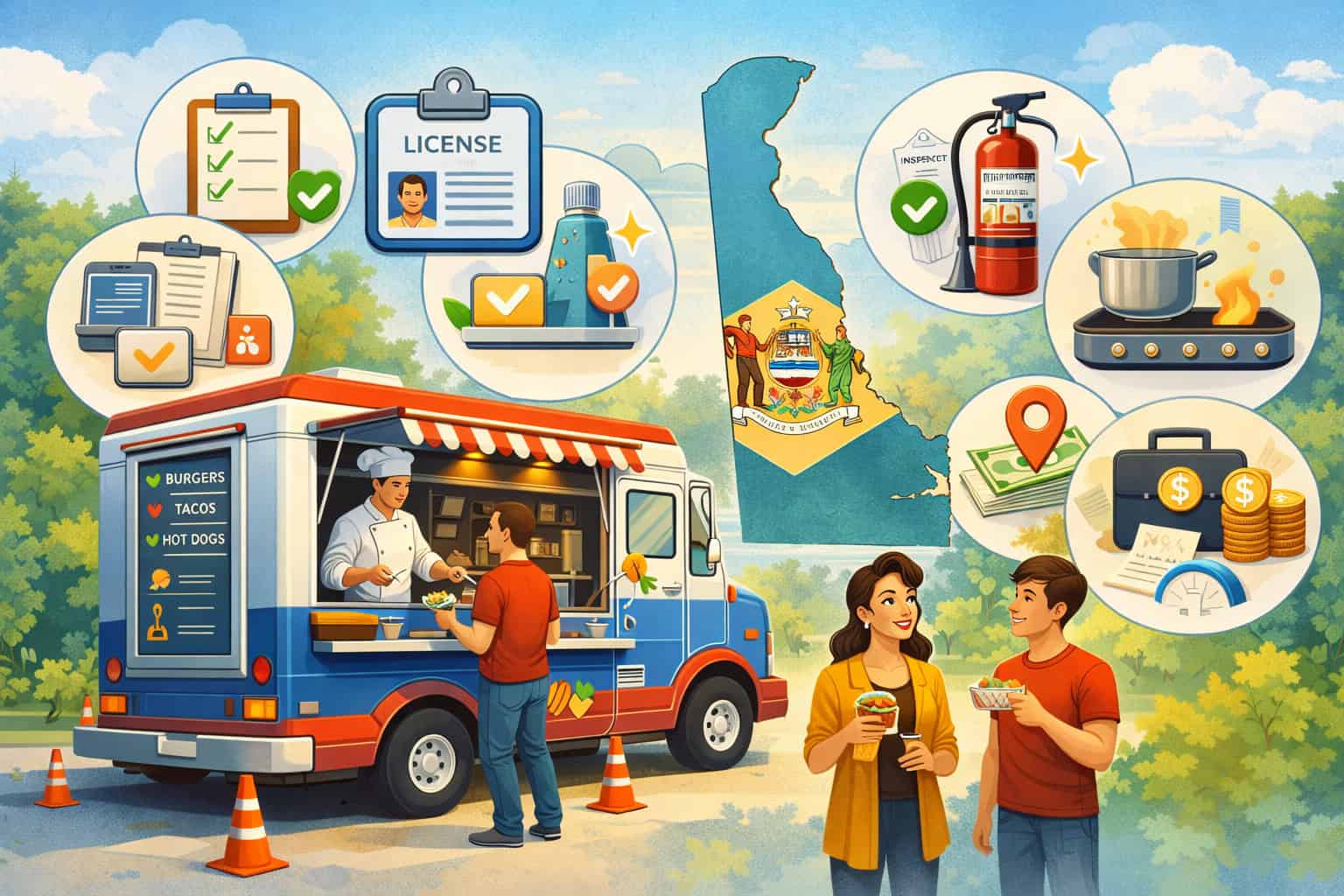
Food Truck Permit Requirements in Delaware (Latest 2026 Guide)
Starting a mobile kitchen is exciting, but the legal setup can feel like a maze. This guide breaks down food truck permit requirements in Delaware into clear, practical steps so you can launch faster, avoid inspection delays, and stay compliant as you grow.
Delaware’s rules come from a mix of state public health permitting, state business licensing/tax registration, and city/county requirements that change depending on where you park and sell.
The most important thing to understand is this: you don’t “just” permit a truck—you permit a food establishment operation that happens to be mobile, and you have to prove that your setup can safely handle food, water, waste, and temperature control in a compact space.
Delaware’s Office of Food Protection and field inspection staff enforce the State of Delaware Food Code, and inspections are ongoing, not one-and-done.
If you take nothing else from this article, remember this rule of thumb: the fastest path through food truck permit requirements in Delaware is to design your truck around inspection standards first, then match your menu and service style to what your equipment can safely support.
Understanding how food truck permit requirements in Delaware actually work
Many first-time operators assume the “permit” is a single document. In reality, food truck permit requirements in Delaware usually involve three layers:
- Public Health (Food Establishment Permit / licensing & inspection): If you prepare, handle, or serve food to the public, Delaware treats you as a food establishment, including operations conducted in a mobile unit.
This is regulated under the State’s food safety framework and enforced through inspections for compliance with the Delaware Food Code. - State Business License + tax registration: Delaware requires a business license for anyone conducting business in the state, and the Division of Revenue also explains that licensing is not your only obligation—depending on your setup you may need other registrations too.
A key Delaware-specific point: Delaware does not impose a state sales tax, but it does impose gross receipts tax on most businesses—something food truck owners must plan for from day one. - Local requirements (city, town, parking, zoning, fire): Even with state compliance, a city can still restrict where and when you can operate, require a local business license, or require fire inspections—especially if you use propane, generators, or commercial cooking equipment.
So when people ask about food truck permit requirements in Delaware, the best answer is: you’re building a compliant operation across health, revenue, and location rules. That’s also why the “right” order matters. If you do local approvals first but your truck fails health inspection later, you lose time and money.
The fastest step-by-step roadmap to meet food truck permit requirements in Delaware
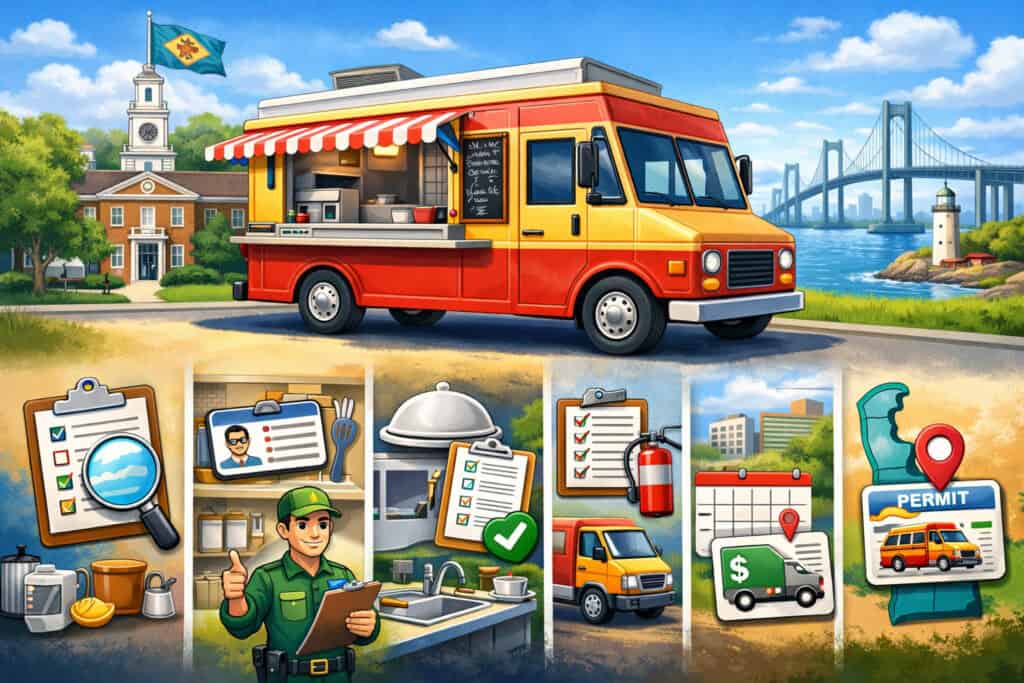
A smooth launch usually follows this sequence:
Step 1: Choose your business structure and name
Before you touch permitting, decide whether you’ll operate as a sole proprietor, LLC, or corporation, and lock down your business identity. That decision affects registration steps, insurance, and sometimes local licensing paperwork. It also reduces “rework” when you fill out applications.
Step 2: Build your menu around your truck’s capabilities
Menu drives equipment. Equipment drives inspection results. A complex menu (raw proteins, cooling/reheating, multi-step prep) triggers stricter requirements than a simple hot-hold and assemble model. If you want to pass food truck permit requirements in Delaware faster, design your concept so your truck can safely execute it every day, even during rush periods.
Step 3: Start the public health permitting process early
Delaware’s business guidance explicitly recommends contacting the state Food Protection office early—before construction or modifications—to avoid delays and extra costs. This is critical if you’re converting a trailer or customizing a truck.
Step 4: Register for a Delaware business license and plan your taxes
The Division of Revenue explains that any person or entity conducting business in Delaware must obtain a Delaware business license, and that you can use the One Stop system to register and even print a temporary license.
This is a core part of food truck permit requirements in Delaware because it’s how you operate legally and set up your tax accounts.
Step 5: Confirm local operating rules where you plan to sell
Some towns have dedicated food truck programs, reserved vending spaces, time windows, and separate local licensing steps. Wilmington is a well-known example, with defined locations and a city program structure.
Step 6: Schedule inspections and keep compliance documentation organized
Inspections are smoother when your paperwork matches your truck and your workflow is consistent with your written plan. Your goal is not to “pass once,” but to run in a way that passes repeatedly.
Following this order reduces backtracking and is the most reliable way to satisfy food truck permit requirements in Delaware.
Delaware public health licensing: the core of food truck permit requirements in Delaware
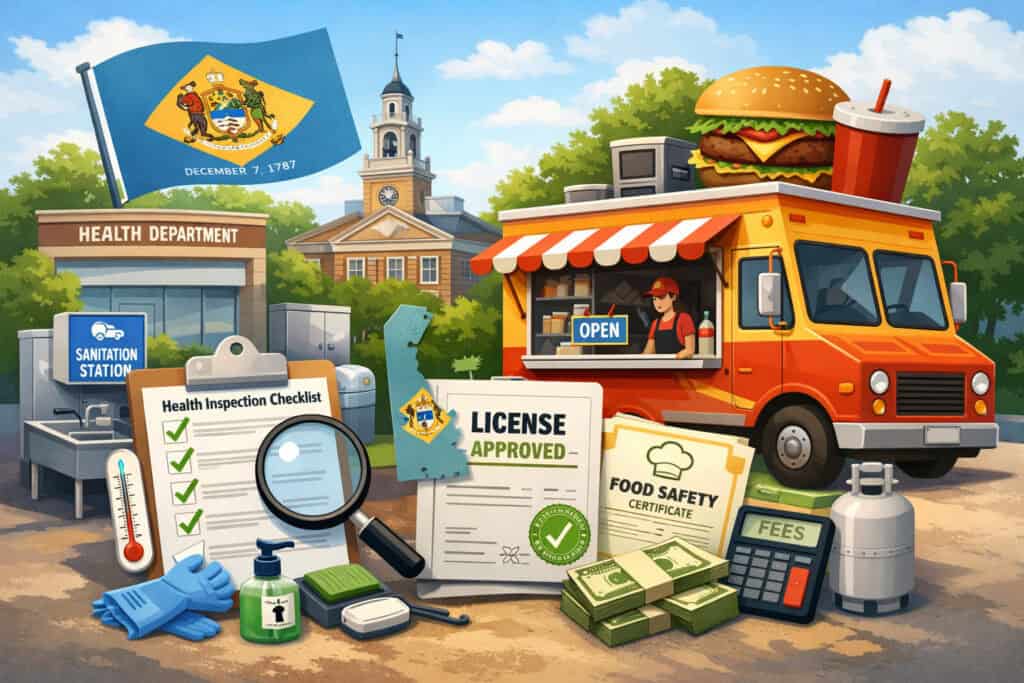
At the heart of food truck permit requirements in Delaware is Delaware’s public health oversight of food establishments. The state defines a “food establishment” broadly, including mobile operations, and explains that these operations are inspected regularly for compliance with the State of Delaware Food Code.
What the state looks for during mobile inspections
Even if your concept is simple, inspectors focus on the same safety pillars:
- Time/temperature control: keeping cold food cold and hot food hot, using reliable equipment and procedures.
- Handwashing: proper hand sink access, soap/paper towels, and a workflow that doesn’t block the sink.
- Cross-contamination prevention: raw vs ready-to-eat separation, sanitizer use, storage layout, and utensil management.
- Approved water and waste systems: potable water supply and wastewater capture/disposal that prevents contamination.
- Cleanable surfaces and maintenance: smooth, durable, non-absorbent surfaces and good repair.
If you plan to start quickly, build the truck as if you’ll be inspected on your busiest Saturday. That’s how you avoid “it worked in testing but failed in real operations.”
Ongoing inspections are part of the deal
Delaware makes inspection information publicly accessible and notes that permitted establishments are inspected on an ongoing basis and data is updated regularly. The practical message: compliance isn’t just a launch milestone—your daily habits become your long-term risk control.
This is why the smartest operators treat food truck permit requirements in Delaware as an operating system, not a checklist.
Plan review and build-out approval for mobile units in Delaware

A major reason food trucks get delayed is that owners buy or build a unit first, then discover it doesn’t meet plan review expectations or is hard to inspect. Delaware’s permitting guidance emphasizes contacting Food Protection early, even before construction or adjustments, to avoid unnecessary costs and delays.
Why plan review matters
Plan review is where you align your menu, layout, and equipment list with safe operations. A strong plan review package typically includes:
- Your proposed menu and how each item is prepared
- A clear explanation of where prep happens (on-truck vs commissary)
- Your equipment list (hot holding, cold holding, cooking, sinks, ventilation)
- Water and wastewater tank capacities and how you refill/dispose
- Cleaning and sanitizing approach
- Storage layout and food protection methods during service
Even if you aren’t required to submit every detail for every scenario, being thorough makes your inspection smoother. When your documentation matches your physical build, inspectors can verify compliance quickly. When it doesn’t, you risk re-inspections.
Build-out choices that help you pass faster
If you want to meet food truck permit requirements in Delaware without multiple corrections, prioritize:
- A handwashing sink that’s always accessible during service
- Cold storage capacity that fits your peak inventory needs
- A realistic workflow that prevents raw/ready-to-eat crossover
- Ventilation aligned to cooking methods
- A cleaning/sanitizing setup that doesn’t rely on “we’ll do it later”
Think like an inspector: “Can this unit safely operate for 4–6 hours in high volume without shortcuts?” If the answer is yes, you’re on the right track.
Delaware business license and tax setup for food trucks
A Delaware food truck needs more than health approval. The Division of Revenue states that any person or entity conducting a trade or business in Delaware is required to obtain a Delaware business license, and that you generally obtain it when business commences.
It also clarifies that a business license is not your only requirement—depending on where you operate you may need additional local registrations.
How to get the Delaware business license
Delaware’s Division of Revenue explains you can register online using the One Stop Business Licensing and Registration Service, and you may be able to print a temporary license at the end of the process.
This matters for food truck permit requirements in Delaware because many local programs and vendors (events, breweries, office parks) will ask for proof that you’re properly licensed as a business.
Tax reality: no state sales tax, but gross receipts tax exists
One of the most misunderstood parts of operating in Delaware is taxation. The Division of Revenue states Delaware does not impose a state sales tax; however, Delaware imposes a gross receipts tax on most businesses.
For food trucks, this impacts pricing and forecasting. Even if you’re used to collecting sales tax in other states, your Delaware structure is different—your tax planning should focus on gross receipts reporting and staying organized.
Business license renewals and timing
Delaware notes most business licenses are generally good for one year and often expire on December 31, with renewal processes available online and temporary printing options.
That means food truck permit requirements in Delaware include a yearly rhythm—set reminders and treat renewals like inventory ordering: routine and non-negotiable.
City and county rules: the “where you park” side of food truck permit requirements in Delaware
Even if you meet Delaware health requirements and have your state business license, local governments can still regulate food truck operations. Delaware’s business license FAQ explicitly notes that depending on where you are located, your city and/or county may require a local business license in addition to a state business license.
What local rules typically cover
Local requirements can include:
- Allowed vending zones and prohibited areas
- Time-of-day restrictions
- Parking rules and distance requirements (for storefront protection or traffic flow)
- Special rules for parks, beaches, downtown corridors, and historic areas
- Event-based permits or vendor approvals
- Noise/generator limits, trash management, and queue management
This is a huge part of food truck permit requirements in Delaware because it determines whether you can actually sell where your customers are.
Wilmington’s Mobile Food Truck Program (example of local structure)
Wilmington has a defined Mobile Food Truck Program with established locations and a sign-up/reservation model.
The city notes that before reserving a spot, a truck must receive a Mobile Food Service Establishment License from the city department, and the application references typical requirements like business licenses, health inspections, and fire marshal inspection documentation.
Wilmington also describes specific downtown locations and reservation time windows (for example, daytime reservation hours).
The key lesson: food truck permit requirements in Delaware are partly geographic. The same truck can be “legal” statewide but still restricted locally. So always confirm rules for your target vending zones early—before you design your weekly route.
Fire safety and equipment compliance for Delaware food trucks
Fire compliance isn’t just about avoiding accidents—it’s often required for local approvals and can be reviewed by fire marshals, especially for trucks using propane, fryers, grills, or generators.
Local programs may expect proof of a fire inspection as part of participating requirements, and Wilmington’s program materials explicitly reference fire marshal inspection among common documentation.
What fire reviewers typically focus on
While the exact checklist can vary by municipality, most fire safety reviews revolve around:
- Proper installation and storage of propane cylinders
- Safe generator placement and fuel handling
- Electrical safety (wiring, breakers, load management)
- Fire extinguishers (correct type, mounting, inspection tags)
- Hood/ventilation and suppression systems if you have grease-producing cooking
- Clearance around cooking equipment and heat sources
- Staff knowledge: shutoffs, emergency response steps, and safe daily checks
Because food truck permit requirements in Delaware can involve local fire review, build your safety systems into the truck design rather than trying to “add them later.” Retrofits are expensive and often create cramped layouts that are harder to clean and inspect.
Practical habits that reduce risk and keep you inspection-ready
- Do a quick “open” checklist daily: leaks, connections, extinguisher present, exits clear
- Keep spare sanitizer and gloves out of mechanical compartments
- Store combustibles away from heat-producing appliances
- Train your team on emergency shutoffs and what to do if a small flare-up occurs
Strong fire practices also protect your brand. Nothing kills momentum like a shutdown during peak season.
Food safety operations: how to stay compliant after you pass
Passing the first inspection is only the beginning. Delaware explains that food establishments are inspected regularly for compliance with the State of Delaware Food Code, and inspection reporting is maintained publicly. That makes consistent operations a core part of food truck permit requirements in Delaware.
The “daily controls” inspectors care about most
1) Temperature logs and active monitoring: You don’t need paperwork for paperwork’s sake, but you do need a reliable habit of checking hot/cold holding and refrigeration performance—especially during outdoor service and heat waves.
2) Handwashing behavior (not just the sink): A hand sink can exist and still fail you if it’s blocked by bins, used for storage, or missing soap/paper towels. Your workflow must make handwashing the easiest option, not an “extra step.”
3) Sanitizer setup and utensil discipline: Food trucks often operate at high speed. That increases risk of cross-contamination unless your utensil system is simple: clean tools staged, dirty tools contained, sanitizer available, and an easy reset method.
4) Allergen awareness and customer communication: Food trucks thrive on customization, but customization increases allergen exposure risk. Build a method: designated tools, wipe-down routine, and staff language that avoids guessing.
Why this matters for growth
If you plan to expand into catering, festivals, or multiple trucks, your operating consistency becomes your scaling advantage. Many event organizers will ask for proof of compliance and inspection history. When your systems are clean and repeatable, you can add staff and still maintain control.
That’s the long game of food truck permit requirements in Delaware: build a system that works even when you’re slammed.
Commissary kitchens, prep locations, water, and wastewater rules
Mobile units are small, and most successful operators rely on a support system: a commissary, approved prep space, and a documented method for handling water and waste. This is where many people accidentally violate food truck permit requirements in Delaware—not because the truck is dirty, but because the “off-truck” steps aren’t clearly controlled.
Commissary and prep strategy
A commissary can solve multiple compliance challenges at once:
- Larger refrigeration/freezer capacity
- Dry storage and protected ingredient staging
- Dishwashing support if your truck setup is limited
- Safe water fill and wastewater disposal points
- A consistent cleaning and maintenance routine
Even if your concept is “everything on the truck,” a commissary relationship can still be useful for long-term resilience and easier compliance documentation.
Water and waste: where trucks commonly slip
The most common operational problems include:
- Underestimating water needed for a full service day
- Letting wastewater systems become a last-minute scramble
- Treating “gray water” casually (inspectors do not)
- Inconsistent refill/disposal locations that aren’t reliably available
If you want to stay aligned with food truck permit requirements in Delaware, treat water and waste as core production inputs—like food inventory. Track them, plan them, and never assume you’ll “figure it out later.”
Cleaning frequency matters more in small spaces
Food trucks accumulate grease and residue quickly due to tight surfaces and airflow. A nightly cleaning routine isn’t optional if you want to pass re-inspections. Your goal is to make “clean” the default state, so you aren’t doing panic cleaning right before an event.
Special permissions: alcohol, festivals, and temporary/event vending
Some food truck operators add alcohol service, sell at big festivals, or partner with venues. Each of these can add requirements beyond baseline food truck permit requirements in Delaware.
Alcohol service (if applicable)
If your business model includes alcohol, you’ll need to comply with the relevant alcohol licensing and service rules for your setup and location. In many cases, venues handle alcohol under their own license, and the food truck simply provides food.
But if the truck itself is the alcohol vendor, licensing becomes a separate track with its own compliance expectations. Always confirm with the appropriate regulators and the venue.
Festivals and large events
Event organizers commonly require:
- Proof of health permitting/inspection
- Proof of business licensing
- Insurance certificates listing the event as additional insured
- Fire safety documentation if propane or cooking is involved
- Vendor agreements that specify trash, hours, and power access
Even when the event is “one weekend,” you can’t treat it as casual. Your truck is still a permitted food operation. Many operators treat major events as a stress test of their compliance system—if you can operate safely at a packed festival, your daily service becomes easier.
Private property vending
Breweries, office parks, and apartment communities may require:
- Written permission from the property owner
- Proof of business and health compliance
- Local approvals depending on the jurisdiction and zoning rules
This is why food truck permit requirements in Delaware are as much about relationships and documentation as they are about the truck itself.
Cost, timing, and planning: what to expect when meeting food truck permit requirements in Delaware
Costs and timelines vary based on your concept, truck condition, and location plan. But a realistic planning approach prevents cash-flow crunches.
Timing factors that commonly extend the process
- Truck build-out changes after you’ve already submitted details
- Equipment backorders delaying installation
- Re-inspection needs due to small but fixable issues
- Local approvals tied to committee meetings or seasonal rules
- Menu complexity requiring additional controls and workflow changes
Delaware’s business guidance recommends contacting Food Protection early to avoid delays and extra costs before construction or adjustments. That advice alone can save you weeks.
Budget categories most operators forget
- Fire safety and suppression upgrades
- Commissary fees and deposits
- Insurance that matches venue requirements
- Generator maintenance and replacement cycle
- Repairs caused by constant vibration and travel
- Ongoing licensing renewals and compliance checks
Treat the first year as a “systems year.” Strong systems reduce downtime, improve customer trust, and keep you aligned with food truck permit requirements in Delaware without constant stress.
Common mistakes that delay approval in Delaware (and how to avoid them)
Most delays are predictable—and avoidable—if you know where to look.
Mistake 1: Building the truck first, then asking what’s required
This is the biggest trap. If your layout makes handwashing inconvenient or creates cross-contamination risk, you may have to rework expensive parts of the build. Start with the compliance design first, not aesthetics.
Mistake 2: A menu that’s too complex for the space
A menu that requires cooling, reheating, raw handling, and multi-stage prep may be totally achievable—but only if you have the equipment and workflow to match. If you don’t, inspectors can require changes that force you to simplify.
Mistake 3: Not accounting for local rules
Operators sometimes assume “state approval = I can sell anywhere.” But Delaware’s revenue guidance explicitly notes you may need city/county licensing depending on where you operate.
And programs like Wilmington’s add structured participation steps and location rules.
Mistake 4: Weak documentation and inconsistent routines
If your plan says you sanitize every 4 hours but staff doesn’t know the sanitizer setup, that mismatch creates risk. Train your crew like your business depends on it—because it does.
Avoiding these mistakes makes food truck permit requirements in Delaware much easier to manage, and it turns compliance into a competitive advantage.
Future outlook: how food truck permitting in Delaware may evolve
Predicting regulation changes requires caution, but there are clear trends across food safety and municipal vending:
1) More transparency and digital inspection visibility
Delaware already publishes inspection information and updates listings regularly.
Expect this public visibility to keep shaping how customers and event organizers judge vendors. Food trucks with strong compliance reputations will win better spots.
2) Cities formalizing food truck programs
Wilmington’s model—designated spots, program rules, and structured participation—reflects a broader municipal trend: cities want order, safety, and predictable street use.
More Delaware towns may adopt similar frameworks, especially in busy downtown areas.
3) Stronger expectations around allergen communication and staff training
As consumer awareness grows, many regulators and venues emphasize allergen controls and staff knowledge. Even without dramatic rule changes, enforcement focus often shifts toward higher-risk behaviors.
4) Sustainability pressure (waste, grease, and power)
Expect more attention to trash plans, grease management, and generator noise/emissions in denser areas. Operators who proactively improve waste practices and power setups will face fewer local conflicts.
The best strategy is to treat food truck permit requirements in Delaware as a living system: stay connected to official updates, maintain clean documentation, and adapt quickly when local rules shift.
FAQs
Q1) Do I need a Delaware business license to run a food truck?
Answer: Yes. Delaware’s Division of Revenue states that any person or entity conducting a trade or business in Delaware must obtain a Delaware business license, generally at the time business commences.
This is separate from health permitting and is a core part of food truck permit requirements in Delaware.
Q2) Does Delaware require a food establishment permit for food trucks?
If you are preparing, handling, or serving food, Delaware treats you as a food establishment—including mobile operations—and regulates these operations under food safety rules and inspections.
Q3) Is a state license enough to sell anywhere in Delaware?
Answer: Not always. Delaware explicitly notes that depending on where you are located, your city and/or county may require additional local licensing. Local parking, zoning, and vending rules can also limit where you can operate.
Q4) How does Wilmington handle food trucks?
Answer: Wilmington has a Mobile Food Truck Program with defined locations and a process that includes receiving a city Mobile Food Service Establishment License before reserving spots, and the city notes typical documentation like business licenses, health inspections, and fire inspection.
Q5) Does Delaware charge sales tax on food truck sales?
Answer: Delaware’s Division of Revenue states Delaware does not impose a state sales tax; however, it does impose a gross receipts tax on most businesses. Plan your accounting accordingly.
Q6) What’s the most common reason a food truck fails inspection?
Answer: Operational gaps: blocked hand sinks, weak temperature control, cross-contamination risks, and inconsistent cleaning/sanitizing routines. Most of these come from workflow design, not just “cleanliness.”
Q7) What should I do before I buy or build a truck?
Answer: Contact the appropriate health authority early and align your menu, equipment, and layout to inspection expectations. Delaware business guidance emphasizes contacting Food Protection early—before construction or adjustments—to avoid delays and extra costs.
Conclusion
Meeting food truck permit requirements in Delaware is absolutely doable—if you treat compliance like part of your business model, not an afterthought.
Delaware’s system centers on food safety regulation through permitted food establishment operations and inspections under the State’s food code framework, paired with mandatory state business licensing and the reality that local rules can shape where you’re allowed to sell.
The winning approach is simple:
- Build your concept around safe, repeatable operations
- Start public health conversations early, before construction changes
- Lock in your Delaware business license and plan for gross receipts tax
- Confirm local requirements for each city or vending zone
- Train your staff and run your truck like an inspection could happen any day
If you do that, food truck permit requirements in Delaware stop being a barrier—and become the foundation for a trustworthy, scalable food business that can land better locations, bigger events, and repeat customers.