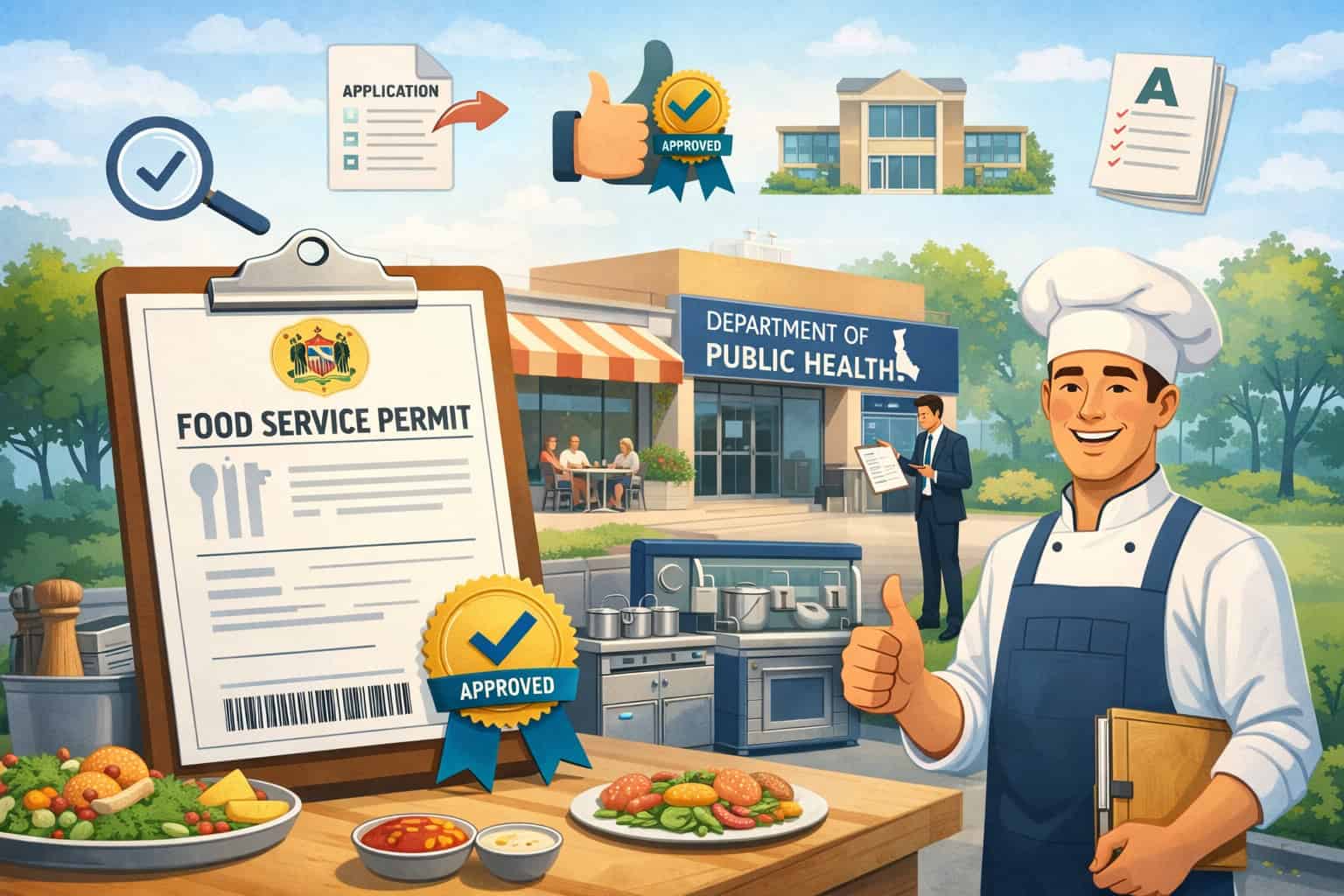
How to Get a Food Service Permit in Delaware (2026 Updated Guide)
Opening a restaurant, café, catering company, bakery, food truck, or pop-up starts with one core requirement: the food service permit in Delaware issued through the Division of Public Health’s Office of Food Protection (OFP).
Delaware’s permitting process is designed to reduce foodborne illness risk and make sure your facility, equipment, and daily practices meet the State of Delaware Food Code, which is based on a national model endorsed by the Food and Drug Administration.
This guide walks you through the food service permit in Delaware process step by step, using plain language and practical checklists. You’ll learn what to prepare before you apply, how plan review works, what inspectors look for, and how renewals and changes (like taking over an existing restaurant) really work.
We’ll also cover special cases—temporary events, cottage food, commissaries, and mobile units—so you don’t apply for the wrong permit and lose time.
If your goal is to open smoothly, avoid rework, and pass inspection confidently, treat the food service permit in Delaware like a project with milestones.
The sooner you align your concept, menu, and facility with OFP expectations, the faster you’ll reach approval. Delaware even urges new operators to contact OFP early—before purchasing or building—to avoid costly delays.
What Counts as a “Food Establishment” (And When You Don’t Need a Permit)

Before you chase a food service permit in Delaware, confirm whether your operation legally qualifies as a “food establishment.” Delaware defines a food establishment broadly: a business that stores, prepares, packages, serves, vends, or otherwise provides food for human consumption.
That includes restaurants, catering operations serving consumers, markets with food service components, delivery-linked operations, mobile units, and more.
This matters because entrepreneurs sometimes over-apply—especially if they’re only selling shelf-stable, prepackaged items.
Delaware lists examples of operations that may not require a food establishment permit, such as: offering only certain pre-packaged foods that are not time/temperature control for safety; produce stands selling only whole, uncut fruits and vegetables; and specific home-based scenarios (like limited bake-sale style setups with clear consumer notice).
But here’s the common trap: even if you don’t need the health permit, you may still need a Delaware general business license to operate. Delaware’s Business First Steps page flags this clearly—your business may be exempt from the permit list and still need state licensing through the Division of Revenue.
So, the smartest approach is to classify your model first:
- Retail food service (restaurant, coffee shop, deli, bakery with TCS foods) → you likely need a food service permit in Delaware.
- Mobile food (food truck, trailer, pushcart) → you likely need a food service permit in Delaware plus a compliant commissary plan.
- Temporary event booth (festivals, fairs) → you may need a temporary food establishment permit and must follow minimum requirements.
- Home-based cottage food (limited non-TCS foods) → you may fit a separate cottage food program rather than a standard food service permit in Delaware.
Correct classification is the foundation of everything that follows.
Agencies You’ll Deal With for a Food Service Permit in Delaware
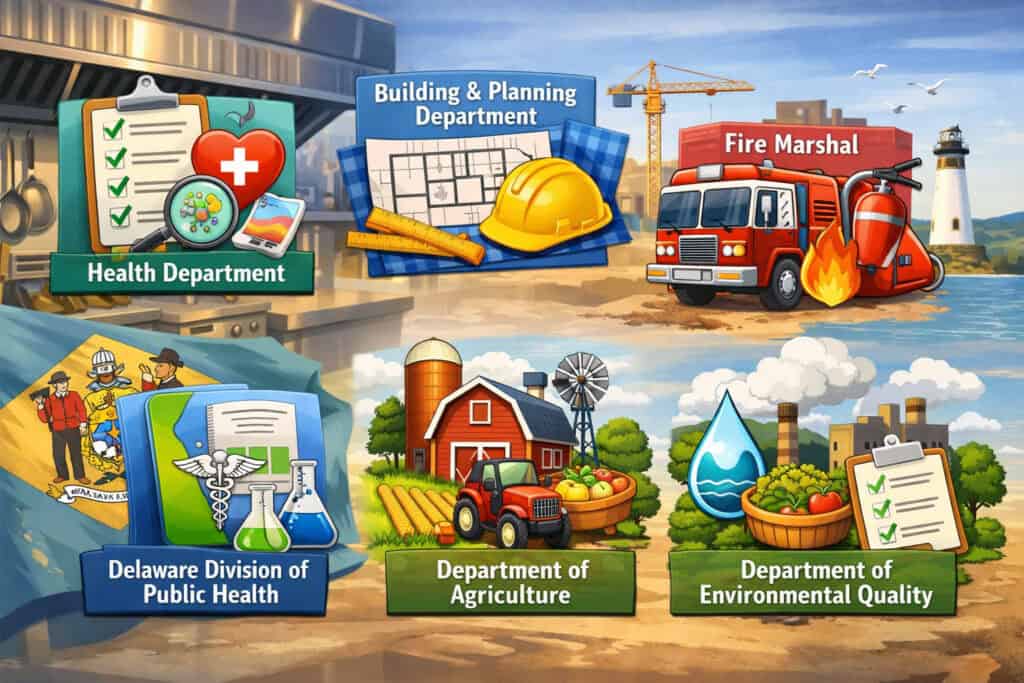
Getting a food service permit in Delaware isn’t just “submit a form.” It’s a coordinated compliance path involving multiple agencies and approvals that must align.
Delaware’s public guidance highlights the central role of the Division of Public Health (DPH) and its Office of Food Protection, which permits and oversees thousands of food establishments statewide.
Delaware Division of Public Health: Office of Food Protection (OFP)
OFP is your primary permitting authority for the food service permit in Delaware. OFP is responsible for licensing, inspections, enforcement, and helping operators understand how to meet the Delaware Food Code.
Delaware also strongly encourages new operators to contact OFP early in the process—before construction or major changes—to prevent avoidable costs and delays.
Delaware Division of Revenue: State Business License
In addition to the health permit, Delaware generally requires anyone conducting business in the state to obtain a State of Delaware Business License through the Division of Revenue.
Delaware notes the annual rate is generally $75 for a first location, with separate licenses for separate business activities. You typically handle this online through One Stop.
One Stop (Business Registration + Licensing Portal)
Delaware’s One Stop system is the hub for registering and licensing your business with participating agencies. It’s commonly used to obtain your Delaware business license and can link you to other registrations depending on whether you have employees.
Local City/County Requirements (Zoning, Building, Fire)
Delaware’s Division of Revenue notes additional licensing may exist depending on counties and towns, and advises checking local requirements and zoning.
In practical terms, many projects also involve building permits, fire/life safety review, and sometimes plumbing/grease management requirements based on location and build-out scope.
A successful food service permit in Delaware application aligns all of these so you don’t pass one review and fail another.
Step 1: Choose Your Concept and Menu (Because Permits Follow Risk)

Your menu drives your entire food service permit in Delaware pathway because food safety risk determines facility needs, equipment requirements, and inspection intensity. Two businesses can be “small,” but one may need far more infrastructure than the other.
A coffee kiosk serving only packaged pastries and bottled drinks is typically simpler than a café cooking eggs, steaming milk, washing dishes, and cooling leftovers.
The second model introduces time/temperature control for safety (TCS) foods and processes like cooking, cooling, reheating, and hot holding—each of which must be managed under the Delaware Food Code framework.
To set yourself up for approval, write a “permit-ready” menu draft with:
- All hot foods, cold foods, and any animal products
- Steps you perform (cook, cool, reheat, thaw, hot-hold, cold-hold)
- Whether food is prepared from raw ingredients vs. reheated/assembled
- Any special processes (vacuum packaging, reduced oxygen packaging, sous vide, curing, acidification)
This helps you avoid a classic delay: designing a kitchen for a limited menu, then expanding the menu later and discovering your sinks, refrigeration, ventilation, storage, or warewashing capacity is no longer adequate.
If you anticipate growth, design for the future at the start—because retrofitting after you’ve applied for the food service permit in Delaware can mean new plan review and added costs.
A strong menu plan also supports staff training and SOPs, which inspectors like to see translated into daily practice.
Step 2: Form the Business and Get the Delaware Business License
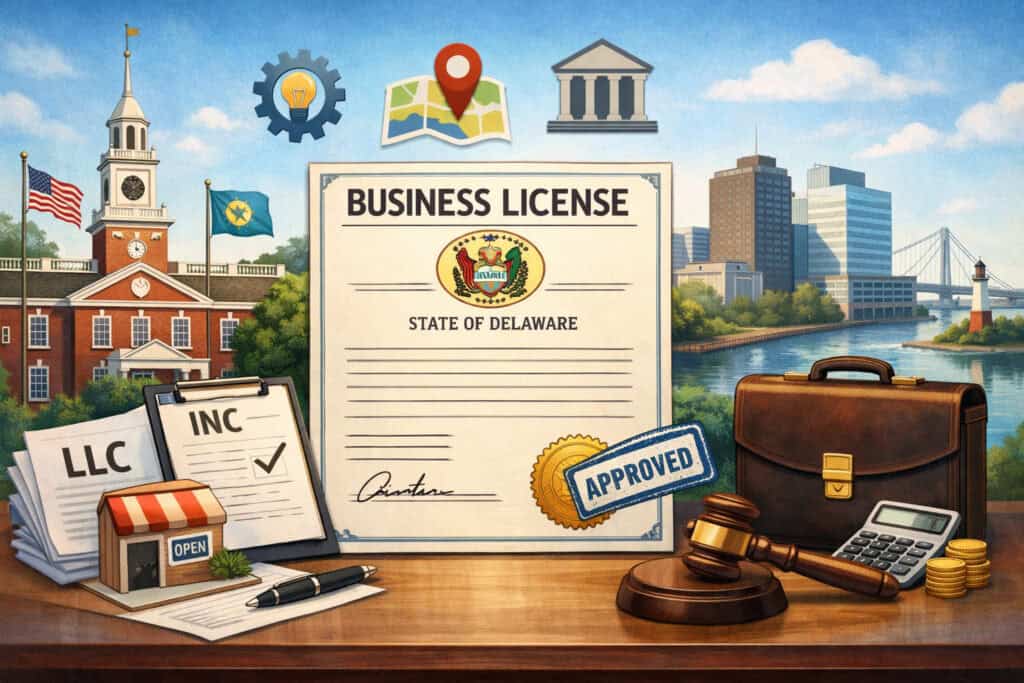
Many new operators focus only on the food service permit in Delaware and forget the business licensing layer. Delaware’s Division of Revenue states that any person or entity conducting a trade or business in Delaware must obtain a State of Delaware Business License.
Practically, you’ll usually do this early because:
- Landlords often request proof of business setup
- Vendors and processors may require business documentation
- Banking, merchant services, and insurance applications are smoother with formal registration
- Some local approvals assume your legal entity and business activity are established
Key items commonly handled at this stage:
- Decide on legal structure (sole proprietor, LLC, corporation)
- Obtain a federal EIN if needed (especially if you’ll have employees)
- Use Delaware’s One Stop system to register and obtain the business license
- Confirm if you need other registrations based on employees and business model
Delaware also notes business licensing fees are generally around $75 annually for a first location, with separate licenses required per business activity.
Even if you’re still months away from opening, locking down the business basics helps you move faster once you’re ready to submit your food service permit in Delaware paperwork.
Step 3: Contact OFP Early (This One Step Prevents the Most Delays)
Delaware’s official guidance is unusually direct: if you plan to open a food establishment, call the Office of Food Protection as soon as possible to learn the licensing procedure, and contact them before any construction or adjustments to avoid unnecessary delays and costs.
This is not a “nice to have.” It’s a strategic move that can save you thousands of dollars and weeks of setbacks.
Here’s why early OFP contact matters for your food service permit in Delaware:
- You may need plan review before you build or remodel
- Equipment choices (like sinks, dish machines, refrigeration) must match your menu
- Mobile units must show how they’ll handle water, waste, and commissary support
- Facility finishes (floors/walls/ceilings) must be cleanable and durable
- Handwashing sink placement is frequently flagged in reviews
- Improper layouts lead to workflow issues (cross-contamination risk) and rework
When you contact OFP, be prepared to describe:
- Concept and proposed menu
- Whether you are building new, remodeling, or taking over an existing space
- Facility type (fixed, mobile, temporary, home-based cottage food)
- Expected opening timeframe
- Address (if known) and county/city jurisdiction
If you treat OFP as a partner early on, your food service permit in Delaware process becomes more predictable—and far less stressful at the end.
Step 4: Plan Review and Facility Approval (Designing for the Delaware Food Code)
For many operations, the heart of the food service permit in Delaware process is plan review—a structured review of your proposed layout, equipment, and food safety controls before you open.
Delaware’s Business First Steps page explicitly warns operators to contact OFP before construction or changes, and it links to plan review resources as part of the application pathway.
What plan review is checking
Plan review aims to confirm your facility can safely:
- Protect food from contamination
- Maintain required temperatures (hot and cold)
- Support proper handwashing and warewashing
- Store chemicals separately and safely
- Provide adequate prep space and storage
- Manage wastewater and refuse
- Maintain cleanable surfaces and pest control barriers
The layout decisions that often trigger revisions
If your plan review doesn’t match your menu risk, you may be asked to revise:
- Number and placement of hand sinks (especially near prep and service)
- Dishwashing method (3-compartment sink vs. commercial dish machine)
- Mop/utility sink requirements and janitorial storage
- Food prep sink vs. hand sink separation
- Refrigeration capacity for safe cooling and storage
- Dry storage square footage and shelving design
- Ventilation/hood requirements for cooking equipment
- Restroom access and staff flow to reduce contamination risk
Plan review is where you “win” your food service permit in Delaware timeline. A thoughtful submission reduces back-and-forth and prevents late-stage surprises during the opening inspection.
If you’re inheriting an existing space, don’t assume you can just “use what’s there.” If your concept changes the risk level or equipment profile, you may still need review and upgrades to support your food service permit in Delaware approval.
Step 5: Equipment, Plumbing, and Utilities That Inspectors Care About Most
A common misconception is that the food service permit in Delaware depends mainly on cleanliness. Cleanliness is important, but inspectors also evaluate whether your setup can stay safe on your busiest day—not just on inspection morning.
Here are the practical infrastructure elements that most directly affect pass/fail outcomes.
Handwashing capacity (non-negotiable)
Handwashing is one of the most emphasized controls in retail food safety systems. Your facility should support frequent handwashing with properly located sinks, soap, and single-use towels. When sinks are missing, blocked, or inconveniently located, staff naturally wash less—raising risk.
Warewashing setup sized for your operation
Your dishwashing method must match your volume:
- Low-volume setups may use a properly sized 3-compartment sink plus air-drying space.
- High-volume restaurants often need a commercial dish machine and appropriate pre-rinse and drainage.
Cold holding and safe cooling capacity
If your menu includes cooked foods cooled for later service, you need enough refrigeration and food-safe containers so cooling happens quickly and safely. Many new kitchens underestimate cooling space, then struggle to meet standards.
Water, wastewater, and grease management
Your plumbing must support your sinks, dish equipment, mop sink, and any needed floor drains. In many jurisdictions, grease management is also reviewed. While local enforcement specifics vary, planning early helps prevent last-minute plumbing revisions that can delay the food service permit in Delaware.
Finishes and cleanability
Inspectors care whether floors, walls, and ceilings are smooth, durable, and cleanable—especially in prep, dish, and storage areas. This is why plan review and build-out choices affect your food service permit in Delaware outcome long before your first inspection.
Bottom line: the best way to pass is to build a system that makes safe behavior the easiest behavior.
Step 6: Submit the Application for the Food Service Permit in Delaware
Once your concept and facility plan align, you move into the formal application stage for the food service permit in Delaware. Delaware’s Business First Steps page describes the permit as annual and points applicants to OFP and related inspection resources.
While the exact submission package can vary based on your operation type (fixed, mobile, temporary, catering, etc.), a strong application typically includes:
- Business identity details (entity name, owner/operator info)
- Facility address or mobile unit details
- Menu and process description (especially if higher-risk)
- Layout and equipment list (if plan review applies)
- Water/waste plans for mobile operations
- Commissary agreement (if required for mobile)
- Proof that construction/remodeling approvals are in place where required
Delaware also emphasizes that operations are inspected regularly to monitor compliance with the State of Delaware Food Code. So your application should reflect not only how you will open, but how you will operate safely week after week.
One pro tip: create a “permit binder” (digital or physical) that includes your menu, supplier lists, cleaning schedules, allergen plan, thermometer calibration method, and staff training records.
Even when not strictly required for submission, having these ready supports a smoother path to the food service permit in Delaware because you’re prepared for inspection questions.
Step 7: Pass the Pre-Opening Inspection (What to Expect and How to Prepare)
For many businesses, the final gate for the food service permit in Delaware is the pre-opening inspection. Think of this as a live demonstration that your systems work: safe temps, safe storage, safe hygiene, and a facility that supports compliance.
What inspectors typically verify
While specifics depend on your model, most pre-opening inspections check:
- Hand sinks: accessible, stocked, hot water functioning
- Warewashing: proper setup, sanitizer available, test strips if applicable
- Thermometers: in cold units, probe thermometers for food
- Refrigeration: holding temps stable and monitored
- Hot holding: if applicable, capable of maintaining safe temps
- Food storage: off the floor, protected, properly labeled
- Chemicals: stored away from food and single-service items
- Employee practices: basic knowledge of hygiene and cross-contamination prevention
- Facility condition: cleanable surfaces, no pest entry points, proper waste handling
How to “stage” your opening for success
To improve your chances of first-pass approval:
- Turn on all refrigeration early so temps stabilize.
- Stock soap, towels, sanitizer, and test strips before inspection.
- Label shelves and storage zones (raw below ready-to-eat, allergens separated where possible).
- Create simple logs (cooler temp log, sanitizer log, cleaning checklist).
- Train staff on handwashing and glove use before the inspector arrives.
A strong inspection isn’t about perfection—it’s about control. When your systems reduce risk reliably, your food service permit in Delaware becomes the natural next step.
Special Path: Food Trucks and Mobile Units (Food Service Permit in Delaware for Mobile Operations)
Mobile operations can absolutely earn a food service permit in Delaware, but they usually face more scrutiny because water, wastewater, storage, and prep occur in compact spaces.
A mobile plan typically needs to answer:
- Where fresh water is filled and how it’s stored
- How wastewater is captured and legally disposed
- How foods stay cold/hot during service
- Where prep occurs (onboard vs. commissary)
- Where utensils are washed (onboard sinks vs. commissary warewashing)
- How the unit is cleaned and serviced between events
Many mobile operators rely on a commissary (a permitted base kitchen) for storage, prep, ice, warewashing, and waste disposal. If that’s your model, secure a commissary relationship early because it becomes a core part of your food service permit in Delaware documentation and inspection readiness.
Mobile success comes from proving repeatability: not just “we can do it once,” but “we can do it safely every service day.”
Special Path: Temporary Events and Pop-Ups (Temporary Food Establishment Requirements)
If you’re operating at fairs, festivals, and short-term events, you may not need a full annual permit—but you still must meet Delaware’s temporary food establishment minimum requirements.
Delaware’s temporary food establishment requirements warn that failure to comply can result in suspension of the operating permit and immediate cessation of food operations until corrected.
Temporary operators often struggle with:
- Handwashing stations (proper setup and replenishment)
- Safe cold holding (coolers that don’t maintain temperature under repeated opening)
- Safe hot holding (adequate equipment and power)
- Cross-contamination controls in tight booths
- Sanitizer availability and correct concentration
- Over-prepping food without safe cooling capacity
If your “temporary” operation becomes frequent, you may eventually find it more efficient to pursue a standard food service permit in Delaware. That path can open doors to broader service models and simplify repeat participation in events.
The key: match the permit type to the reality of how often—and how extensively—you will operate.
Special Path: Cottage Food vs. Commercial Permit (Don’t Apply for the Wrong Thing)
Delaware supports home-based food entrepreneurs through its Cottage Food Establishment (CFE) Program, which exists to regulate certain lower-risk foods made in residential kitchens.
This is not the same as a standard food service permit in Delaware for restaurants and commercial kitchens. Cottage food is typically limited to specific product types and sales models, while commercial food service permits cover broader operations with full inspection and facility requirements.
If you choose the cottage food route, confirm:
- Your products qualify (usually non-TCS foods)
- You meet program requirements for labeling and food safety controls
- Your sales channels comply with program rules
If you plan to sell TCS foods (like cooked meats, dairy-based sauces requiring refrigeration, cooked rice for later service, etc.), or you plan to operate a public-facing food service business, you likely need a standard food service permit in Delaware rather than cottage food registration.
Choosing correctly protects you from a painful scenario: building a brand under cottage rules, then discovering your best-selling items require a commercial permit and facility upgrade.
Renewals, Changes of Ownership, and Expansions (Keeping Your Permit in Good Standing)
A food service permit in Delaware is not a one-and-done task. Delaware’s Business First Steps page lists the permit term as annual and notes that renewal forms are sent to facilities prior to expiration, with OFP available for questions.
Renewals
Renewal success depends on maintaining inspection-ready operations year-round:
- Keep temperature logs and corrective actions
- Maintain staff training routines (especially for turnover)
- Update cleaning schedules and chemical labeling
- Repair issues quickly (leaks, damaged surfaces, broken thermometers)
Ownership changes and taking over an existing restaurant
This is one of the most misunderstood areas. Delaware’s OFP restaurant FAQ document states that permits are not transferable, and taking over a restaurant still triggers required steps (including plan review in that FAQ context). That means you can’t assume the previous owner’s permit “covers you.” Plan for permitting tasks as part of your acquisition timeline.
Remodels, menu expansions, and concept pivots
If you remodel, add new cooking equipment, change workflow, or introduce higher-risk processes, you may need additional review. Delaware’s plan review guidance emphasizes submitting plans for review and approval before certain changes.
A good rule: if the change affects food safety risk, facility layout, plumbing, ventilation, or equipment capacity, treat it as a potential update to your food service permit in Delaware pathway.
Common Reasons Applications Get Delayed (And How to Avoid Them)
Most delays in the food service permit in Delaware process are preventable. Delaware’s official guidance repeatedly emphasizes early contact and aligning construction with the licensing procedure.
Here are the most common delay drivers:
- Starting construction before OFP contact (leading to rework)
- Menu not matching facility (insufficient sinks, refrigeration, ventilation)
- Missing documentation (commissary letters, equipment specs, layout details)
- Unstable refrigeration temps at inspection due to late startup
- No sanitizer/test method ready for warewashing setup
- Poor storage plan (food stored on floor, chemicals near food areas)
- Underestimating staffing/training needs, especially for busy openings
- Local approvals not aligned (zoning/building/fire requirements still pending)
Avoid delays with a simple project approach:
- Treat plan review as “design approval,” not paperwork
- Build a checklist and complete it before scheduling inspection
- Do a mock inspection day with your team
When you operate like compliance is part of your brand, your food service permit in Delaware becomes a launch milestone—not a roadblock.
Future Outlook: How Food Permitting in Delaware May Evolve (2026–2028)
No agency can predict the future perfectly, but there are clear directional trends in retail food regulation and enforcement that can shape how the food service permit in Delaware experience feels over the next few years.
1) More digital self-service and online payments
Delaware’s OFP already supports online permit payment access points, and Delaware’s broader licensing ecosystem is strongly oriented around online systems like One Stop. Expect continued improvements in digital workflows, renewals, and communication channels.
2) Stronger emphasis on active managerial control
Across modern food codes, inspectors increasingly look for evidence that management systems prevent risk: logs, training, SOPs, and corrective actions. Businesses that build simple, consistent systems will find the food service permit in Delaware lifecycle easier over time.
3) Growth in mobile and nontraditional models
Food halls, ghost kitchens, shared commercial kitchens, and mobile vending continue to expand. As these models grow, expect clearer templates for commissary agreements, shared space responsibilities, and inspection scheduling—especially as Delaware continues permitting thousands of establishments statewide.
4) Allergen awareness and consumer transparency pressure
Even when not framed as “new rules,” enforcement focus often shifts toward allergen cross-contact prevention and truthful menu presentation. Businesses that invest early in allergen SOPs and labeling discipline reduce operational risk and customer complaints.
The best “future-proofing” move: design your operation so safe processes are easy to follow—even when you’re busy.
FAQs
Q1) Do I need a food service permit in Delaware if I only sell packaged snacks and bottled drinks?
Answer: Possibly not—Delaware notes some operations that only offer certain pre-packaged foods that are not time/temperature control for safety may not require a food establishment permit. However, you may still need a Delaware business license to operate.
Q2) How early should I contact the Office of Food Protection?
Answer: As early as possible. Delaware explicitly encourages prospective operators to call OFP early and to contact them before construction or adjustments to avoid delays and costs.
Q3) Is a Delaware food service permit annual?
Answer: Yes. Delaware’s Business First Steps page lists the permit term as annual and indicates renewal forms are sent prior to expiration.
Q4) Can I take over a restaurant using the previous owner’s permit?
Answer: No. Delaware’s OFP restaurant FAQ states permits are not transferable. Plan for your own approval steps when buying or taking over an existing location.
Q5) I’m doing festivals—do I need a full food service permit in Delaware?
Answer: Not always. Temporary event operations may need a temporary permit and must meet minimum requirements, and Delaware notes noncompliance can lead to suspension and immediate shutdown until corrected. If you operate frequently or expand complexity, a standard food service permit may make more sense.
Q6) Do I also need a business license?
Answer: In most cases, yes. Delaware’s Division of Revenue states anyone conducting a trade or business in Delaware must obtain a State of Delaware Business License.
Q7) Where do I start if I’m unsure which permit applies?
Answer: Start with Delaware’s Business First Steps guidance for food establishments and contact the Office of Food Protection. Delaware specifically recommends calling OFP to learn the licensing procedure for your exact model.
Conclusion
Getting a food service permit in Delaware is easiest when you treat it as a build-and-verify process, not a last-minute form. Start by confirming your business model fits Delaware’s definition of a food establishment and whether any exemptions apply.
Then handle your Delaware business license through the Division of Revenue and One Stop so your business identity and activity are properly established.
Next, do the step Delaware emphasizes most: contact the Office of Food Protection early—before construction or changes—so your plan review (if needed) matches your menu, workflow, and risk level. Build your facility and procedures around safe handwashing, temperature control, warewashing, and cleanable design.
Finally, prepare for the pre-opening inspection like you’re rehearsing a busy service day: stable refrigeration temperatures, stocked sinks, sanitizer controls, organized storage, and staff who understand basic food safety routines.
If you follow that sequence, the food service permit in Delaware becomes predictable—and your opening becomes a confident launch instead of a compliance scramble.